Gene editing techniques compared
Published
Five methods, three decades, one goal. Each finds a chosen stretch of DNA and changes it, but they get there in different ways.
What are the main gene-editing techniques?
The five best-known methods are zinc finger nucleases (1996), TALENs (2010), CRISPR/Cas9 (2012), base editing (2016) and prime editing (2019). The first three cut both DNA strands; the last two change the sequence without doing so.
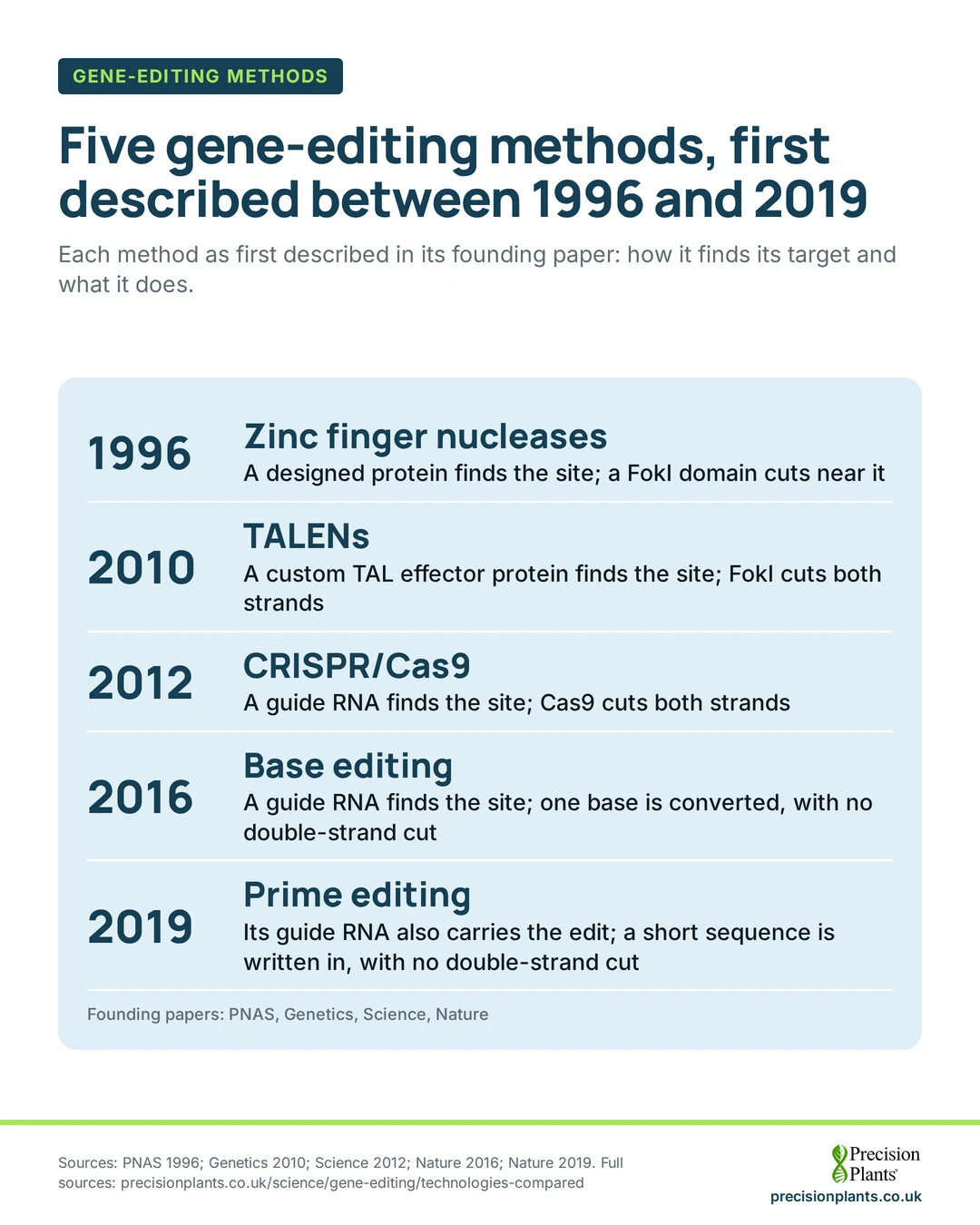
Animation: Precision Plants. Sources: Science (2012); Genetics, via PubMed (2010); Proceedings of the National Academy of Sciences (1996); Nature (2016); Nature (2019)
At a glance
The table sets the five side by side, each as first described in its founding paper.
| Method | How it finds its target | What it does to the DNA | First described |
|---|---|---|---|
| CRISPR/Cas9 | A guide RNA pairs with the target sequence [1] | Cuts both DNA strands at the chosen site [1] | 2012 [1] |
| TALENs | A custom TAL effector protein that binds the target sequence [2] | A FokI cutting domain breaks both strands at the site [2] | 2010 [2] |
| Zinc finger nucleases | Zinc finger proteins built to match the target [3] | A FokI cutting domain cuts near the site [3] | 1996 [3] |
| Base editing | A guide RNA, as with CRISPR [4] | Converts one DNA base into another without cutting both strands [4] | 2016 [4] |
| Prime editing | A prime editing guide RNA that also carries the edit [5] | Writes a short new sequence into the site without cutting both strands [5] | 2019 [5] |
The cutters
Zinc finger nucleases, TALENs and CRISPR/Cas9 are site-directed nucleases: they break both DNA strands at a chosen place and leave the cell to repair it [1][2][3]. Guidance in England describes three kinds of result. In SDN1, the cell simply rejoins the break. SDN2 uses a template for a small change, and SDN3 inserts a longer stretch of DNA [6].
The letter-changers
Base editing converts one DNA base into another without cutting both strands or needing a donor template [4]. Prime editing writes a short new sequence into the site, again without a double-strand break or donor DNA [5]. Guidance in England notes that both make the same type of genetic change that occurs naturally [6].
Guides in this section
- CRISPR/Cas9: A guide RNA steers the Cas9 enzyme to cut both strands.
- TALENs: A custom TAL effector protein finds the site; FokI cuts it.
- Zinc finger nucleases: Designed zinc finger proteins find the site; FokI cuts it.
- Base editing: Converts one DNA letter into another without a double-strand break.
- Prime editing: Writes a short new sequence in from a template on its guide RNA.
Frequently asked questions
Which gene-editing method is the oldest?
Zinc finger nucleases, first reported in 1996, followed by TALENs in 2010 and CRISPR/Cas9 in 2012.
Which methods do not cut both DNA strands?
Base editing and prime editing. Both nick a single strand and change the sequence directly.
Are all five used in plants?
Yes. Each has been used in crops, including rice, wheat, maize, cotton and tomato.
References
- Science (2012). A programmable dual-RNA-guided DNA endonuclease in adaptive bacterial immunity (Jinek and others)
- Genetics, via PubMed (2010). Targeting DNA double-strand breaks with TAL effector nucleases (Christian and others)
- Proceedings of the National Academy of Sciences (1996). Hybrid restriction enzymes: zinc finger fusions to Fok I cleavage domain (Kim, Cha and Chandrasegaran)
- Nature (2016). Programmable editing of a target base in genomic DNA without double-stranded DNA cleavage (Komor and others)
- Nature (2019). Search-and-replace genome editing without double-strand breaks or donor DNA (Anzalone and others)
- Advisory Committee on Releases to the Environment, GOV.UK (2025). ACRE guidance on producing precision bred plants
- EFSA Panel on Genetically Modified Organisms, EFSA Journal (2012). Scientific opinion addressing the safety assessment of plants developed using Zinc Finger Nuclease 3 and other Site-Directed Nucleases with similar function
- Plant Cell Reports (2019). CRISPR/Cas precision and off-targeting in plants (Hahn and Nekrasov, title shortened)
Last reviewed 2026-09-26. Edited by Mark Turner.