TALENs
Published · Updated
The idea came from a plant disease. Bacteria that infect crops carry proteins that read DNA one letter at a time, and researchers turned them into editing tools.
What are TALENs?
TALENs, or TAL effector nucleases, are gene-editing tools made by joining a custom TAL effector protein, which binds a chosen DNA sequence, to the cutting domain of the FokI enzyme. They break both DNA strands at the target site.
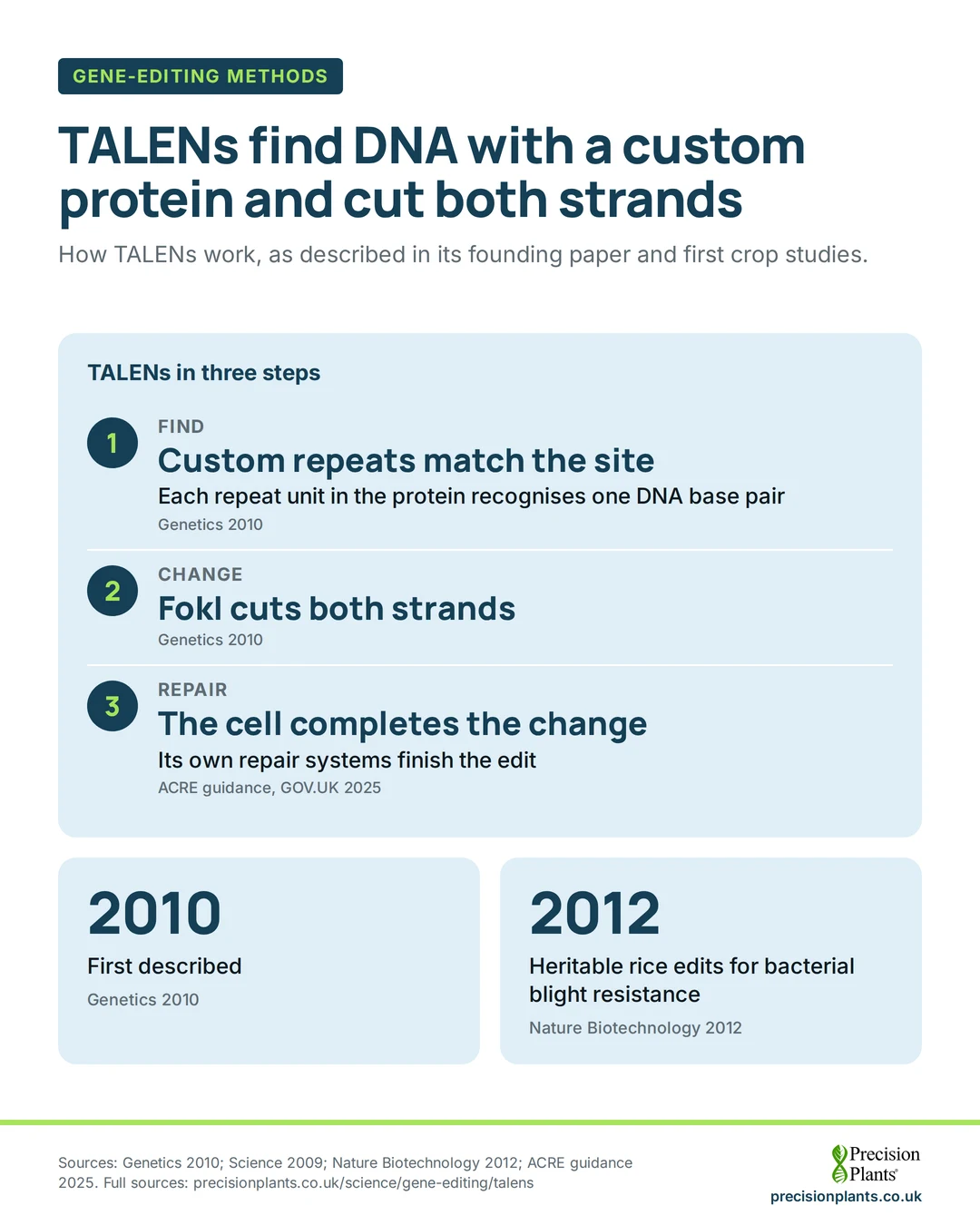
Infographic: Precision Plants. Sources: Genetics, via PubMed (2010); Science (2009); Nature Biotechnology (2012); Advisory Committee on Releases to the Environment, GOV.UK (2025)
What it is
TAL effectors come from Xanthomonas bacteria, which infect plants. Inside the plant cell they bind DNA through a central chain of repeated protein units [6]. In 2010 researchers fused TAL effectors to the cutting domain of the FokI enzyme, creating a new class of sequence-specific nucleases [2]. Both native and custom versions directed double-strand breaks to specific, targeted sites [2].
How it works
Each repeat in a TAL effector recognises one DNA base pair, and two variable amino acids in each repeat decide which one [6]. Because the repeats are modular, they can be assembled to recognise a new target [6].
Use in crops
In 2012, researchers used TALENs to edit a rice gene that the bacterial blight pathogen exploits, producing heritable changes for resistance to the disease [7]. In England, guidance for plant breeders groups the tools that create DNA strand breaks at chosen locations as site-directed nucleases [9].
Limits
Like other nucleases, TALENs are not perfectly precise and can cut DNA at sites that share similarity with the target [10]. A 2022 whole-genome study compared TALEN and CRISPR/Cas9 editing in plants and found that off-target mutations were rare [8]. Each new target needs a new protein to be assembled, repeat by repeat [6].
How it compares with the other four
TALENs are one of the five methods covered here. Zinc finger nucleases also use a custom protein and the FokI domain [3]. CRISPR/Cas9 finds its target with a guide RNA instead [1]. Base editing and prime editing change the sequence without cutting both strands [4][5].
| Method | How it finds its target | What it does to the DNA | First described |
|---|---|---|---|
| CRISPR/Cas9 | A guide RNA pairs with the target sequence [1] | Cuts both DNA strands at the chosen site [1] | 2012 [1] |
| TALENs | A custom TAL effector protein that binds the target sequence [2] | A FokI cutting domain breaks both strands at the site [2] | 2010 [2] |
| Zinc finger nucleases | Zinc finger proteins built to match the target [3] | A FokI cutting domain cuts near the site [3] | 1996 [3] |
| Base editing | A guide RNA, as with CRISPR [4] | Converts one DNA base into another without cutting both strands [4] | 2016 [4] |
| Prime editing | A prime editing guide RNA that also carries the edit [5] | Writes a short new sequence into the site without cutting both strands [5] | 2019 [5] |
Frequently asked questions
What does TALEN stand for?
Transcription activator-like effector nuclease. It joins a TAL effector protein, which binds DNA, to a nuclease, which cuts it.
Where do TAL effectors come from?
From Xanthomonas bacteria, which infect plants. The bacteria use them to switch on plant genes during infection.
Are TALENs still used?
Yes. Studies continue to use them in plants, and a 2022 whole-genome study compared TALEN and CRISPR/Cas9 editing directly.
References
- Science (2012). A programmable dual-RNA-guided DNA endonuclease in adaptive bacterial immunity (Jinek and others)
- Genetics, via PubMed (2010). Targeting DNA double-strand breaks with TAL effector nucleases (Christian and others)
- Proceedings of the National Academy of Sciences (1996). Hybrid restriction enzymes: zinc finger fusions to Fok I cleavage domain (Kim, Cha and Chandrasegaran)
- Nature (2016). Programmable editing of a target base in genomic DNA without double-stranded DNA cleavage (Komor and others)
- Nature (2019). Search-and-replace genome editing without double-strand breaks or donor DNA (Anzalone and others)
- Science (2009). Breaking the code of DNA binding specificity of TAL-type III effectors (Boch and others)
- Nature Biotechnology (2012). High-efficiency TALEN-based gene editing produces disease-resistant rice (Li and others)
- Scientific Reports (2022). Genome-wide specificity of plant genome editing by both CRISPR–Cas9 and TALEN
- Advisory Committee on Releases to the Environment, GOV.UK (2025). ACRE guidance on producing precision bred plants
- Plant Cell Reports (2019). CRISPR/Cas precision and off-targeting in plants (Hahn and Nekrasov, title shortened)
Last reviewed 2026-09-26. Edited by Mark Turner.