CRISPR/Cas9
Published
It began as a bacterial defence against viruses. Rebuilt as a lab tool, it became one of the best-known ways to change a chosen stretch of DNA.
What is CRISPR/Cas9?
CRISPR/Cas9 is a gene-editing tool in which a guide RNA steers the Cas9 enzyme to a chosen DNA sequence, where it cuts both strands. The cell then repairs the break, and the repair can change the sequence.
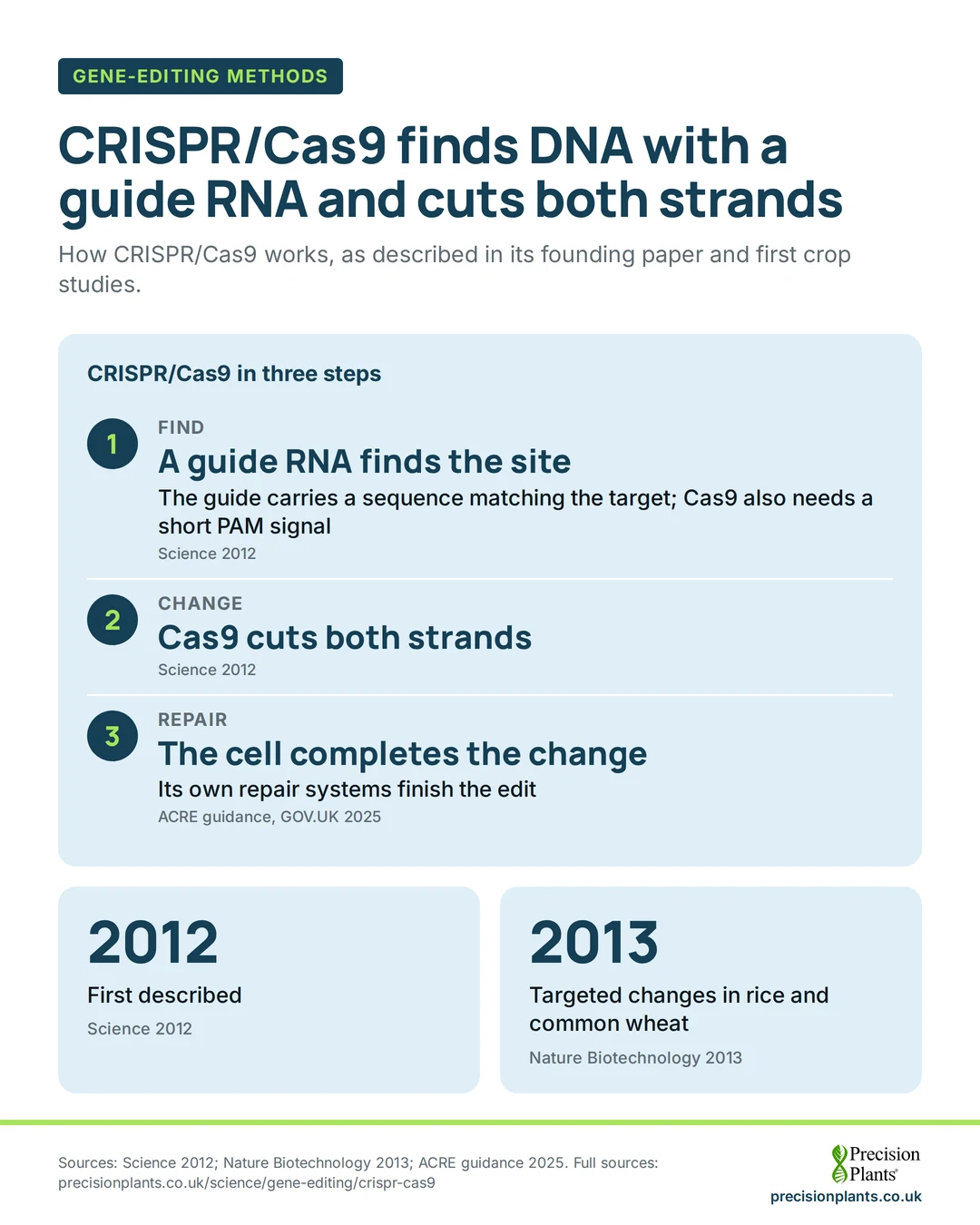
Infographic: Precision Plants. Sources: Science (2012); Nature Biotechnology (2013); Advisory Committee on Releases to the Environment, GOV.UK (2025)
What it is
In bacteria, the Cas9 protein is part of an immune system. Researchers showed in 2012 that Cas9 can be programmed with a single guide RNA to cut a chosen DNA target [1]. In their natural form these genetic scissors recognise DNA from viruses, and Emmanuelle Charpentier and Jennifer Doudna showed they could be controlled to cut any DNA molecule at a predetermined site [6]. The discovery won the 2020 Nobel Prize in Chemistry [6].
How it works
The guide RNA carries a short sequence that matches the target. Cas9 also needs a short signal next to the target in the DNA, called a PAM [1]. Each of its two cutting domains cuts one strand, so together they break the double helix [1].
Use in crops
In 2013, researchers showed that custom guide RNAs could direct Cas9 to make sequence-specific changes in rice and common wheat, the two most widely grown food crops [7]. In England, guidance for plant breeders gives nuclease systems such as CRISPR/Cas9 as an example of tools that create DNA strand breaks at specific locations [9].
Limits
Like other nucleases, CRISPR-Cas nucleases are not perfectly precise and can cut DNA at sites that resemble the target [10]. Careful choice of target sequence remains the most important factor in reducing this [10]. A whole-genome study of edited cotton checked 4,413 possible off-target sites and confirmed only four true off-target changes [8].
How it compares with the other four
CRISPR/Cas9 is one of the five methods covered here. TALENs and zinc finger nucleases also cut both DNA strands, but find their target with custom proteins rather than a guide RNA [2][3]. Base editing and prime editing change the sequence without cutting both strands [4][5].
| Method | How it finds its target | What it does to the DNA | First described |
|---|---|---|---|
| CRISPR/Cas9 | A guide RNA pairs with the target sequence [1] | Cuts both DNA strands at the chosen site [1] | 2012 [1] |
| TALENs | A custom TAL effector protein that binds the target sequence [2] | A FokI cutting domain breaks both strands at the site [2] | 2010 [2] |
| Zinc finger nucleases | Zinc finger proteins built to match the target [3] | A FokI cutting domain cuts near the site [3] | 1996 [3] |
| Base editing | A guide RNA, as with CRISPR [4] | Converts one DNA base into another without cutting both strands [4] | 2016 [4] |
| Prime editing | A prime editing guide RNA that also carries the edit [5] | Writes a short new sequence into the site without cutting both strands [5] | 2019 [5] |
Frequently asked questions
Who discovered CRISPR/Cas9 gene editing?
Emmanuelle Charpentier and Jennifer Doudna, who were awarded the 2020 Nobel Prize in Chemistry for developing the method.
Does CRISPR/Cas9 add foreign DNA to a plant?
The tool itself cuts DNA and the cell repairs it. Under the rules in England, a plant is not precision bred if it still contains transgenic material, including the editing cassette.
Is CRISPR/Cas9 perfectly precise?
No method is. The nuclease can occasionally cut sites that resemble its target, which is why target choice and checking matter.
References
- Science (2012). A programmable dual-RNA-guided DNA endonuclease in adaptive bacterial immunity (Jinek and others)
- Genetics, via PubMed (2010). Targeting DNA double-strand breaks with TAL effector nucleases (Christian and others)
- Proceedings of the National Academy of Sciences (1996). Hybrid restriction enzymes: zinc finger fusions to Fok I cleavage domain (Kim, Cha and Chandrasegaran)
- Nature (2016). Programmable editing of a target base in genomic DNA without double-stranded DNA cleavage (Komor and others)
- Nature (2019). Search-and-replace genome editing without double-strand breaks or donor DNA (Anzalone and others)
- The Royal Swedish Academy of Sciences, NobelPrize.org (2020). Press release: The Nobel Prize in Chemistry 2020
- Nature Biotechnology (2013). Targeted genome modification of crop plants using a CRISPR-Cas system (Shan and others)
- Plant Biotechnology Journal, via PubMed Central (2019). Whole genome sequencing reveals rare off-target mutations and considerable inherent genetic or/and somaclonal variations in CRISPR/Cas9-edited cotton plants (Li and others)
- Advisory Committee on Releases to the Environment, GOV.UK (2025). ACRE guidance on producing precision bred plants
- Plant Cell Reports (2019). CRISPR/Cas precision and off-targeting in plants (Hahn and Nekrasov, title shortened)
Last reviewed 2026-09-26. Edited by Mark Turner.