How does gene editing work?
Published · Updated
Every method follows the same three steps: find the right place in the DNA, make a change there, and let the cell's own repair machinery finish the job.
How does gene editing work?
A gene-editing tool is steered to one DNA sequence, where it either cuts the DNA or changes a letter directly. The cell's own repair systems then complete the change. In plants, the editing tool is removed and the result is checked.
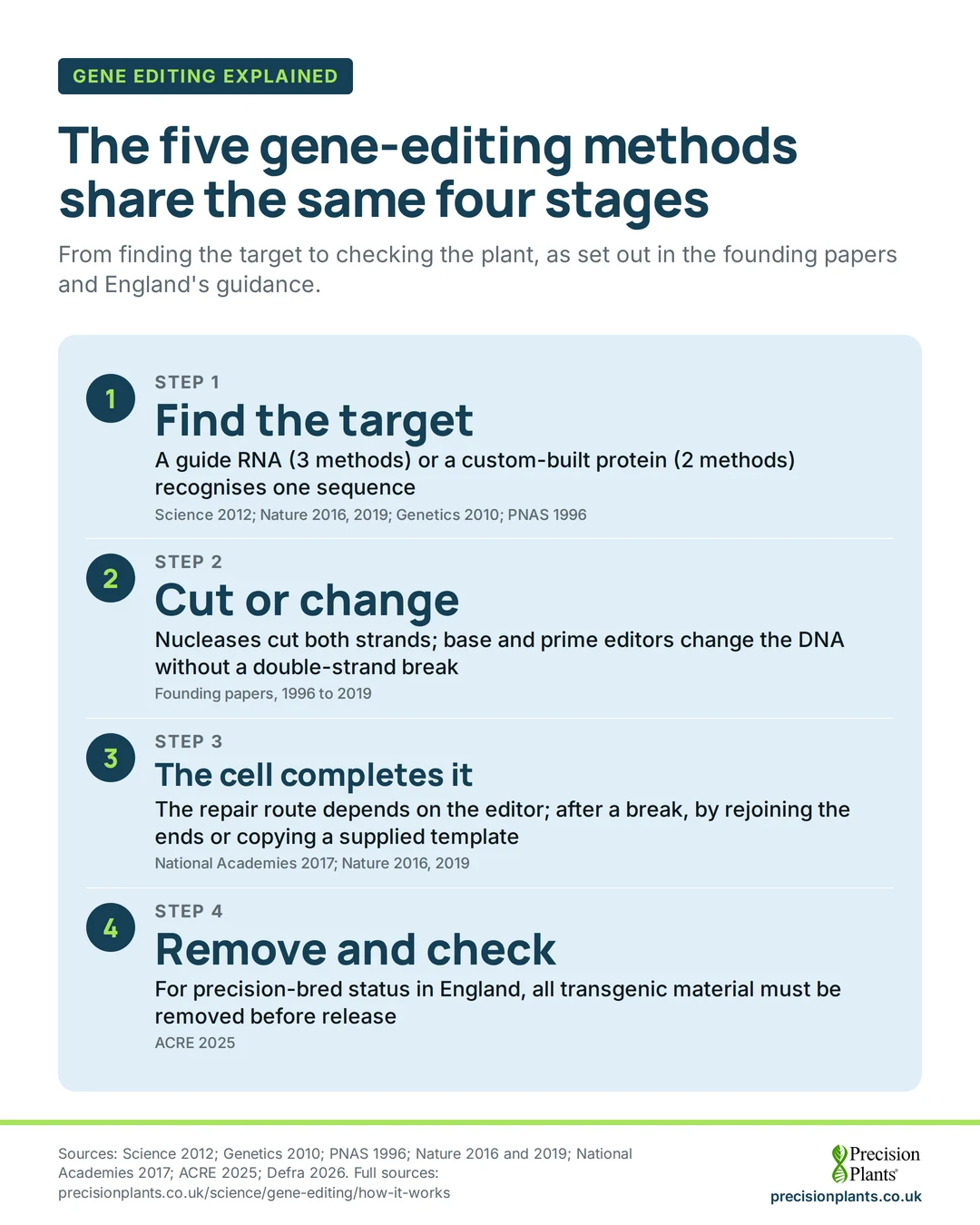
Animation: Precision Plants. Sources: Science (2012); Genetics, via PubMed (2010); Proceedings of the National Academy of Sciences (1996); Nature (2016); Nature (2019); National Academies of Sciences, Engineering, and Medicine (2017); Advisory Committee on Releases to the Environment, GOV.UK (2025); Department for Environment, Food and Rural Affairs, GOV.UK (2026)
Step 1: find the target
Each tool needs to recognise one sequence among millions. Three methods use a guide RNA that matches the target: CRISPR/Cas9, base editing and prime editing [1][4][5]. Two use a protein built to bind the target: TALENs and zinc finger nucleases [2][3].
Step 2: make the change
Nucleases cut both strands of the DNA at the target [1][2][3]. Base editors and prime editors instead change the sequence without a double-strand break or a donor template; prime editors, and later base editors, nick a single strand [4][5].
| Method | How it finds its target | What it does to the DNA | First described |
|---|---|---|---|
| CRISPR/Cas9 | A guide RNA pairs with the target sequence [1] | Cuts both DNA strands at the chosen site [1] | 2012 [1] |
| TALENs | A custom TAL effector protein that binds the target sequence [2] | A FokI cutting domain breaks both strands at the site [2] | 2010 [2] |
| Zinc finger nucleases | Zinc finger proteins built to match the target [3] | A FokI cutting domain cuts near the site [3] | 1996 [3] |
| Base editing | A guide RNA, as with CRISPR [4] | Converts one DNA base into another without cutting both strands [4] | 2016 [4] |
| Prime editing | A prime editing guide RNA that also carries the edit [5] | Writes a short new sequence into the site without cutting both strands [5] | 2019 [5] |
Step 3: the cell repairs the DNA
Cells have their own ways of repairing breaks in DNA, and these can be used to change the sequence [6]. After a double-strand break there are two main routes. With base and prime editors, the cell's repair of the edited strand completes the change instead [4][5].
Step 4: remove the tool and check
In England, a plant is not precision bred if it contains transgenic material, including editing cassettes, selectable markers and vector genes [8]. Transgenic intermediates used during editing are allowed only if all transgenic sequences are removed before release or marketing [8].
Before a plant is released, it must be analysed to confirm that no transgenes remain [9]. Developers also look for unintended changes elsewhere in the genome, called off-target changes [10].
Frequently asked questions
Does gene editing always cut DNA?
No. Nucleases cut both strands, but base editors and prime editors change the sequence without a double-strand break. Prime editors, and later versions of base editors, nick only one strand.
What does the cell do after DNA is cut?
After a nuclease cuts both strands, the cell repairs the break, either by rejoining the ends or by copying a template if one is supplied. Base and prime editors change the DNA without a double-strand break, and the cell's repair completes the change.
Is the editing tool left in the plant?
Not in a precision bred plant in England. Any transgenic material, including the editing cassette, must be removed before release or marketing.
References
- Science (2012). A programmable dual-RNA-guided DNA endonuclease in adaptive bacterial immunity (Jinek and others)
- Genetics, via PubMed (2010). Targeting DNA double-strand breaks with TAL effector nucleases (Christian and others)
- Proceedings of the National Academy of Sciences (1996). Hybrid restriction enzymes: zinc finger fusions to Fok I cleavage domain (Kim, Cha and Chandrasegaran)
- Nature (2016). Programmable editing of a target base in genomic DNA without double-stranded DNA cleavage (Komor and others)
- Nature (2019). Search-and-replace genome editing without double-strand breaks or donor DNA (Anzalone and others)
- National Academies of Sciences, Engineering, and Medicine (2017). Human genome editing: science, ethics, and governance. Appendix A: the basic science of genome editing
- EFSA Panel on Genetically Modified Organisms, EFSA Journal (2012). Scientific opinion addressing the safety assessment of plants developed using Zinc Finger Nuclease 3 and other Site-Directed Nucleases with similar function
- Advisory Committee on Releases to the Environment, GOV.UK (2025). ACRE guidance on producing precision bred plants
- Department for Environment, Food and Rural Affairs, GOV.UK (2026). Releasing precision bred plants into the environment
- Plant Physiology (2020). Plant genome editing and the relevance of off-target changes (Graham and others)
Last reviewed 2026-09-26. Edited by Mark Turner.