Zinc finger nucleases
Published · Updated
Before guide RNAs, there were proteins. Zinc finger nucleases, first built in 1996, showed that a chosen stretch of DNA could be cut on purpose.
What are zinc finger nucleases?
Zinc finger nucleases (ZFNs) are gene-editing tools that join designed zinc finger proteins, which bind a chosen DNA sequence, to the cutting domain of the FokI enzyme. They cut DNA near a predetermined site.
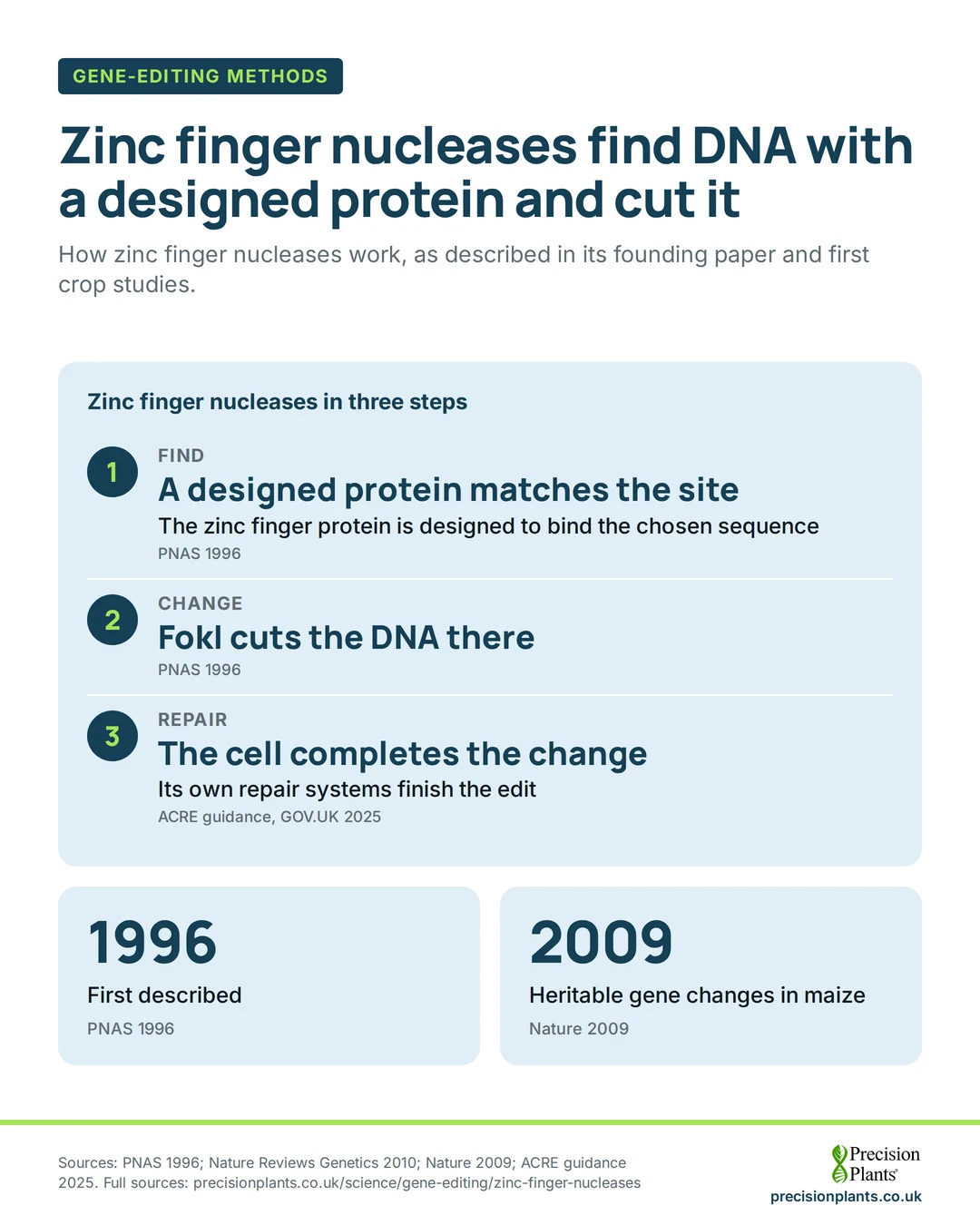
Infographic: Precision Plants. Sources: Proceedings of the National Academy of Sciences (1996); Nature Reviews Genetics (2010); Nature (2009); Advisory Committee on Releases to the Environment, GOV.UK (2025)
What it is
In 1996, researchers linked two different zinc finger proteins to the cleavage domain of the FokI enzyme and showed that the fusions cut DNA in a sequence-specific way [3]. They noted that this modular design makes it possible to create artificial nucleases that cut near a predetermined site [3]. A ZFN is an artificial endonuclease made of a designed zinc finger protein fused to that FokI domain [6].
How it works
The zinc finger protein is designed to bind the chosen sequence, and the FokI domain cuts there [6]. When the cell rejoins the broken ends, small deletions or insertions can result, which switches off the gene [6].
Use in crops
In 2009, researchers used designed ZFNs to modify genes in maize, and the modified plants passed the changes on to their offspring [7]. The European Food Safety Authority's 2012 opinion on inserting DNA with site-directed nucleases was framed around zinc finger nucleases and other tools with a similar function [8]. In England, guidance for plant breeders groups such tools as site-directed nucleases [9].
Limits
Every nuclease-based tool can cut DNA at sites that share similarity with the target [10]. Researchers note that using ZFNs in medicine requires versions that are highly specific in their action [6]. Each new target needs a new protein to be designed [3].
How it compares with the other four
Zinc finger nucleases are one of the five methods covered here. TALENs also use a custom protein and the FokI domain [2]. CRISPR/Cas9 finds its target with a guide RNA instead [1]. Base editing and prime editing change the sequence without cutting both strands [4][5].
| Method | How it finds its target | What it does to the DNA | First described |
|---|---|---|---|
| CRISPR/Cas9 | A guide RNA pairs with the target sequence [1] | Cuts both DNA strands at the chosen site [1] | 2012 [1] |
| TALENs | A custom TAL effector protein that binds the target sequence [2] | A FokI cutting domain breaks both strands at the site [2] | 2010 [2] |
| Zinc finger nucleases | Zinc finger proteins built to match the target [3] | A FokI cutting domain cuts near the site [3] | 1996 [3] |
| Base editing | A guide RNA, as with CRISPR [4] | Converts one DNA base into another without cutting both strands [4] | 2016 [4] |
| Prime editing | A prime editing guide RNA that also carries the edit [5] | Writes a short new sequence into the site without cutting both strands [5] | 2019 [5] |
Frequently asked questions
When were zinc finger nucleases invented?
The first zinc finger fusions to the FokI cutting domain were reported in 1996.
Why are they called zinc fingers?
The DNA-binding units are small protein folds held in shape by a zinc ion. Several are linked so that together they read a longer stretch of DNA.
Have zinc finger nucleases been used in crops?
Yes. A 2009 study used them to modify genes in maize, and the changes were passed on to the plants' offspring.
References
- Science (2012). A programmable dual-RNA-guided DNA endonuclease in adaptive bacterial immunity (Jinek and others)
- Genetics, via PubMed (2010). Targeting DNA double-strand breaks with TAL effector nucleases (Christian and others)
- Proceedings of the National Academy of Sciences (1996). Hybrid restriction enzymes: zinc finger fusions to Fok I cleavage domain (Kim, Cha and Chandrasegaran)
- Nature (2016). Programmable editing of a target base in genomic DNA without double-stranded DNA cleavage (Komor and others)
- Nature (2019). Search-and-replace genome editing without double-strand breaks or donor DNA (Anzalone and others)
- Nature Reviews Genetics (2010). Genome editing with engineered zinc finger nucleases (Urnov and others)
- Nature (2009). Precise genome modification in the crop species Zea mays using zinc-finger nucleases (Shukla and others)
- EFSA Panel on Genetically Modified Organisms, EFSA Journal (2012). Scientific opinion addressing the safety assessment of plants developed using Zinc Finger Nuclease 3 and other Site-Directed Nucleases with similar function
- Advisory Committee on Releases to the Environment, GOV.UK (2025). ACRE guidance on producing precision bred plants
- Plant Cell Reports (2019). CRISPR/Cas precision and off-targeting in plants (Hahn and Nekrasov, title shortened)
Last reviewed 2026-09-26. Edited by Mark Turner.