SDN-1, SDN-2 and SDN-3
Published
Regulators do not sort edits by the tool that made them. They sort them by what the cell was given to repair the break with.
What are SDN-1, SDN-2 and SDN-3?
SDN-1, SDN-2 and SDN-3 are three classes of edit made with site-directed nucleases. In SDN-1 the cell repairs the break unaided; in SDN-2 a short template guides a small change; in SDN-3 a long stretch of donor DNA is inserted at the site.
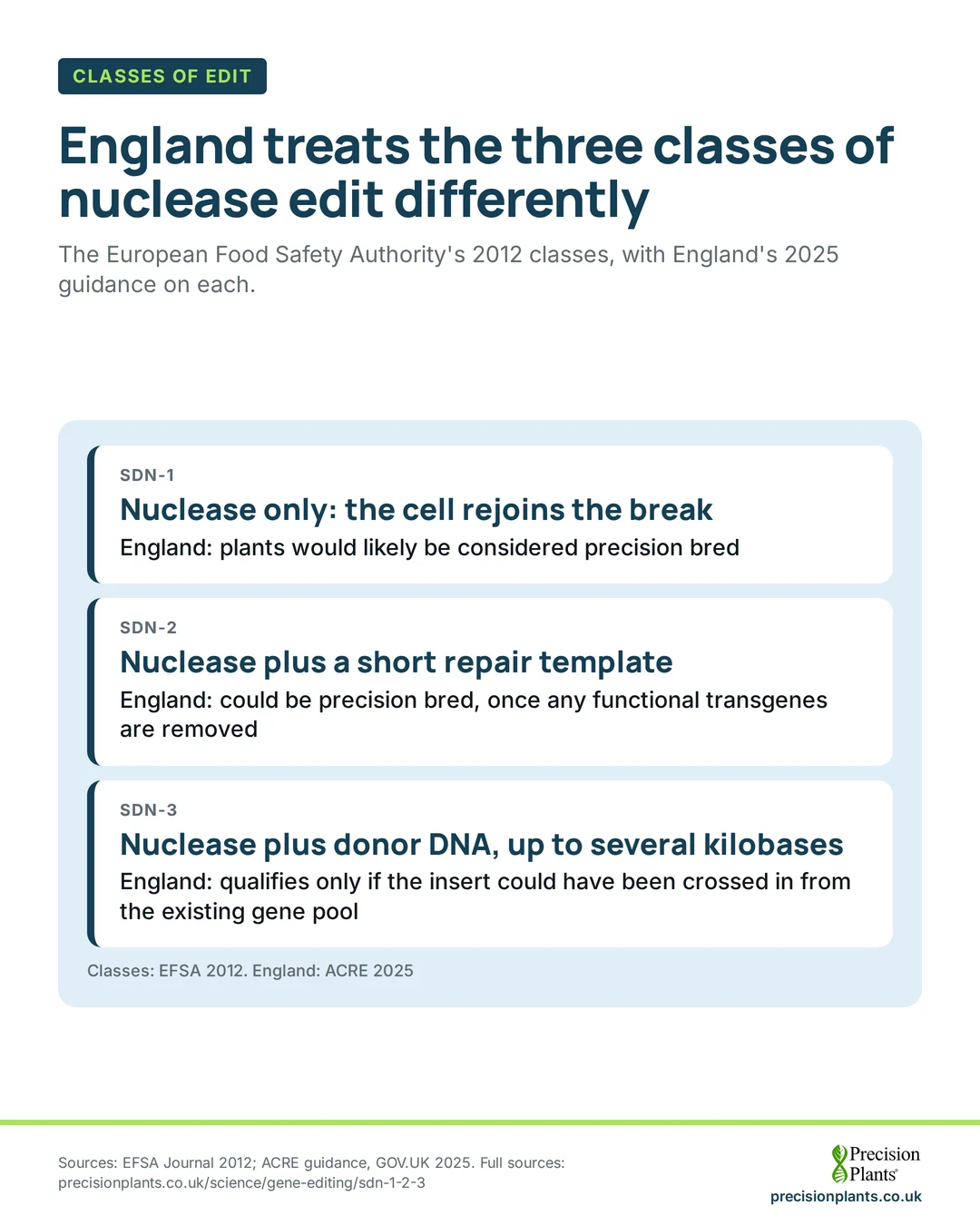
Infographic: Precision Plants. Sources: EFSA Panel on Genetically Modified Organisms, EFSA Journal (2012); Advisory Committee on Releases to the Environment, GOV.UK (2025)
What a site-directed nuclease is
A site-directed nuclease is an enzyme that breaks DNA at a chosen place. Zinc finger nucleases, TALENs and CRISPR/Cas9 all work this way [1][2][3]. The cell can repair the break by rejoining the ends or by using a matching template [6].
The three classes
The European Food Safety Authority set out the three classes in 2012 [6].
| Class | What is supplied | Result |
|---|---|---|
| SDN-1 | The nuclease only [6] | Site-specific changes from the cell rejoining the break [6] |
| SDN-2 | The nuclease and a short repair template [6] | Specific small sequence changes [6][7] |
| SDN-3 | The nuclease and a long stretch of donor DNA, up to several kilobases [6] | The donor DNA is inserted at a predefined site [6] |
How England's rules treat each class
Under the Genetic Technology (Precision Breeding) Act 2023, a plant is precision bred only if every change made with modern biotechnology could have resulted from traditional processes [9]. Guidance in England applies that test to each class [7].
- SDN-1: plants would likely be considered precision bred, because the repair aligns with traditional processes [7].
- SDN-2: plants could be considered precision bred, once any functional transgenes have been removed [7].
- SDN-3: can qualify only if the inserted genetic material could have been crossed in from the plant's existing gene pool [7].
Where the other methods fit
Base editing and prime editing nick one strand rather than breaking both, so they sit outside the three classes [4][5]. Guidance in England says that, as with SDN-1, they make the same type of genetic change that occurs naturally [7]. In 2020, the European Food Safety Authority concluded that SDN-1, SDN-2 and a related technique do not pose more hazards than conventional breeding [8].
Frequently asked questions
Which SDN class is closest to conventional breeding?
SDN-1, in which the cell repairs the break unaided. Guidance in England says such plants would likely be considered precision bred.
Does SDN-3 always make a GMO?
Not in England. An SDN-3 plant can be precision bred if the inserted DNA could have been crossed in from the plant's existing gene pool. Otherwise it is not.
Who created the SDN classes?
The three classes were set out by the European Food Safety Authority's panel on genetically modified organisms in its 2012 opinion.
References
- Science (2012). A programmable dual-RNA-guided DNA endonuclease in adaptive bacterial immunity (Jinek and others)
- Genetics, via PubMed (2010). Targeting DNA double-strand breaks with TAL effector nucleases (Christian and others)
- Proceedings of the National Academy of Sciences (1996). Hybrid restriction enzymes: zinc finger fusions to Fok I cleavage domain (Kim, Cha and Chandrasegaran)
- Nature (2016). Programmable editing of a target base in genomic DNA without double-stranded DNA cleavage (Komor and others)
- Nature (2019). Search-and-replace genome editing without double-strand breaks or donor DNA (Anzalone and others)
- EFSA Panel on Genetically Modified Organisms, EFSA Journal (2012). Scientific opinion addressing the safety assessment of plants developed using Zinc Finger Nuclease 3 and other Site-Directed Nucleases with similar function
- Advisory Committee on Releases to the Environment, GOV.UK (2025). ACRE guidance on producing precision bred plants
- European Food Safety Authority (2020). Existing guidance appropriate for assessment of genome editing in plants
- legislation.gov.uk (2023). Genetic Technology (Precision Breeding) Act 2023, section 1
Last reviewed 2026-09-26. Edited by Mark Turner.