Prime editing
Published · Updated
Described by its inventors as search and replace for DNA, prime editing carries its own template and writes the change in directly.
What is prime editing?
Prime editing is a gene-editing method that writes new genetic information into a chosen DNA site, using a modified Cas9 joined to a reverse transcriptase and a guide RNA that also carries the edit. It needs no double-strand break and no donor DNA.
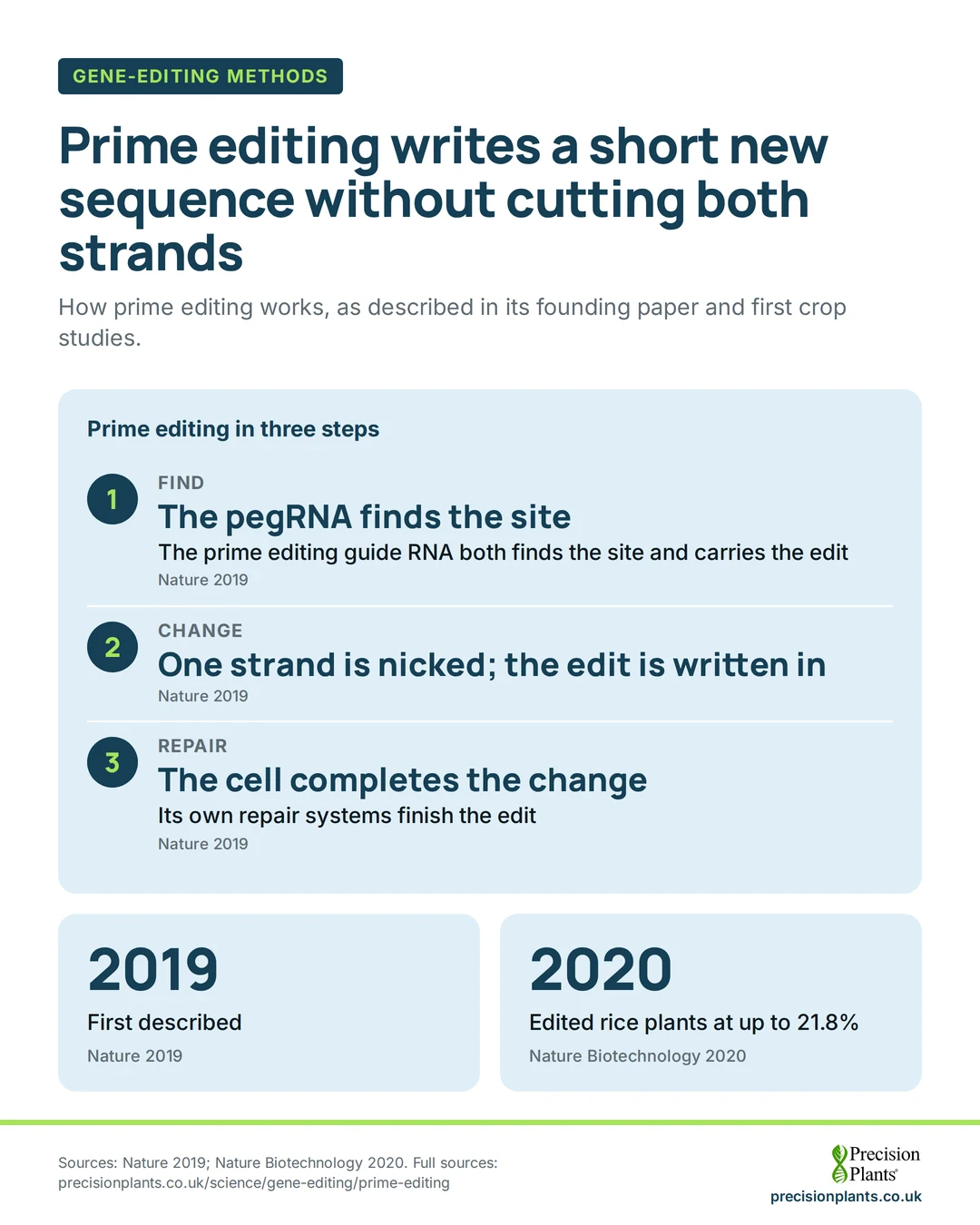
Infographic: Precision Plants. Sources: Nature (2019); Nature Biotechnology, via PubMed (2020)
What it is
Prime editing was reported in 2019 as a method that directly writes new genetic information into a specified DNA site [5]. It uses a Cas9 that can no longer cut both strands, fused to an engineered reverse transcriptase, and a prime editing guide RNA, or pegRNA, that both finds the site and encodes the edit [5]. The authors reported more than 175 examples of editing in human cells, including insertions, deletions and all 12 kinds of single-letter change [5].
How it works
The editor nicks one DNA strand and copies the new sequence from the template carried on the pegRNA [5]. Prime editors can make virtually any substitution, small insertion and small deletion [10].
Use in crops
In 2020, researchers adapted prime editors for plants, making single-letter changes, insertions and deletions in rice and wheat cells and obtaining edited rice plants at frequencies of up to 21.8% [6]. In England, guidance for plant breeders notes that prime editing makes the same type of genetic change that occurs naturally [9].
Limits
Efficiency has been the main constraint. Prime editing applications have been limited by low editing efficiency, and a 2021 study in rice raised it between 2.9-fold and 17.4-fold by redesigning the guide RNAs [8]. A 2021 study of 179 predicted off-target sites in rice found only low frequencies of off-target edits, none above 0.23% [7].
How it compares with the other four
Prime editing is one of the five methods covered here. Base editing also avoids cutting both strands, but converts only certain letters [4]. CRISPR/Cas9, TALENs and zinc finger nucleases cut both strands and rely on the cell's repair [1][2][3].
| Method | How it finds its target | What it does to the DNA | First described |
|---|---|---|---|
| CRISPR/Cas9 | A guide RNA pairs with the target sequence [1] | Cuts both DNA strands at the chosen site [1] | 2012 [1] |
| TALENs | A custom TAL effector protein that binds the target sequence [2] | A FokI cutting domain breaks both strands at the site [2] | 2010 [2] |
| Zinc finger nucleases | Zinc finger proteins built to match the target [3] | A FokI cutting domain cuts near the site [3] | 1996 [3] |
| Base editing | A guide RNA, as with CRISPR [4] | Converts one DNA base into another without cutting both strands [4] | 2016 [4] |
| Prime editing | A prime editing guide RNA that also carries the edit [5] | Writes a short new sequence into the site without cutting both strands [5] | 2019 [5] |
Frequently asked questions
What is a pegRNA?
A prime editing guide RNA. It finds the target site, like a normal guide RNA, and also carries the template for the new sequence.
How is prime editing different from base editing?
Both avoid cutting both DNA strands. Base editors convert certain letters into others, while prime editors can also make small insertions and deletions.
Is prime editing used in crops?
Yes. It has been adapted for rice and wheat, and researchers are working to raise its efficiency in plants.
References
- Science (2012). A programmable dual-RNA-guided DNA endonuclease in adaptive bacterial immunity (Jinek and others)
- Genetics, via PubMed (2010). Targeting DNA double-strand breaks with TAL effector nucleases (Christian and others)
- Proceedings of the National Academy of Sciences (1996). Hybrid restriction enzymes: zinc finger fusions to Fok I cleavage domain (Kim, Cha and Chandrasegaran)
- Nature (2016). Programmable editing of a target base in genomic DNA without double-stranded DNA cleavage (Komor and others)
- Nature (2019). Search-and-replace genome editing without double-strand breaks or donor DNA (Anzalone and others)
- Nature Biotechnology, via PubMed (2020). Prime genome editing in rice and wheat (Lin and others)
- Nature Biotechnology, via PubMed (2021). Genome-wide specificity of prime editors in plants (Jin and others)
- Nature Biotechnology (2021). High-efficiency prime editing with optimized, paired pegRNAs in plants (Lin and others)
- Advisory Committee on Releases to the Environment, GOV.UK (2025). ACRE guidance on producing precision bred plants
- Nature Reviews Genetics (2023). Prime editing for precise and highly versatile genome manipulation (Chen and Liu)
Last reviewed 2026-09-26. Edited by Mark Turner.