How gene edits are checked
Published · Updated
An edit is a claim about DNA. Checking it means reading that DNA, and then growing the plant to see what the change does.
How are gene edits checked?
Gene edits are checked by copying the target region with PCR and reading it by DNA sequencing, to confirm the intended change. Scientists also look for leftover DNA from the editing tool and for unintended changes elsewhere, then grow the plant to confirm the trait.
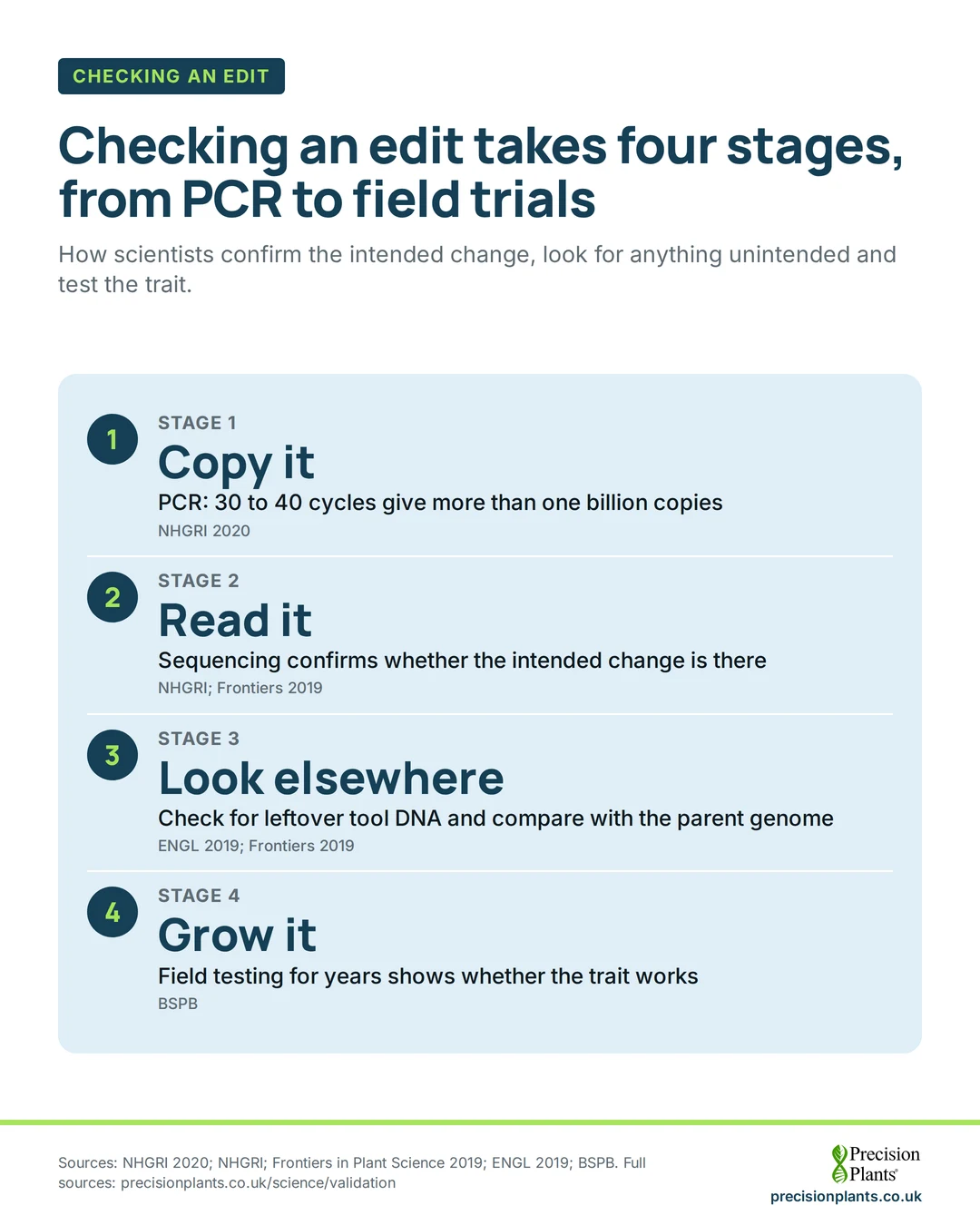
Infographic: Precision Plants. Sources: National Human Genome Research Institute (2020); National Human Genome Research Institute; Frontiers in Plant Science (2019); European Network of GMO Laboratories, European Commission Joint Research Centre (2019); British Society of Plant Breeders
Copy the region: PCR
The polymerase chain reaction copies a short stretch of DNA again and again. The NHGRI explains that 30 to 40 cycles produce ‘more than one billion exact copies of the original DNA segment’ in a few hours [1]. That gives enough material to read.
Read it: sequencing
DNA sequencing ‘determines the order of the four chemical building blocks’ that make up DNA [2]. Reading the target region confirms whether the intended change is there [2][3].
Grohmann and colleagues note that chain-termination (Sanger) sequencing suits targeted checks of known sequences ‘even if the modifications are small’, while whole-genome sequencing is the method of choice for untargeted searches, provided a good reference genome is available [3].
Look elsewhere
Two further questions follow: did any of the tool's DNA stay behind, and did anything change where it should not have? The ENGL report treats the absence of leftover vector DNA as a prerequisite for a genome-edited plant [4]. Off-target checks compare the edited plant's genome with that of its parent, looking for differences [3].
Grow it
DNA checks confirm the change, not its value. Breeding lines are still tested for years before they can become varieties [5].
Guides in this section
- DNA sequencing explained: How the order of DNA letters is read, and what it costs.
- Can gene-edited crops be detected?: What testing can and cannot tell about how a change was made.
Frequently asked questions
What is PCR used for in plant breeding?
PCR copies a chosen stretch of DNA many times so it can be read or tested, for example to check whether an edit or a leftover fragment is present.
Does sequencing prove a plant was gene-edited?
Not on its own. Sequencing shows a change is present, but the same small change can arise naturally or through conventional mutagenesis.
Is a DNA check enough to release a variety?
No. The plant still has to be grown and tested to show the trait works in the field.
Which gene-editing methods are there?
Five are widely described. Zinc finger nucleases, TALENs and CRISPR/Cas9 cut both DNA strands at a chosen site, while base editing and prime editing change the sequence without a double-strand break.
References
- National Human Genome Research Institute (2020). Polymerase chain reaction (PCR) fact sheet
- National Human Genome Research Institute. DNA sequencing fact sheet
- Frontiers in Plant Science (2019). Detection and identification of genome editing in plants: challenges and opportunities (Grohmann and others)
- European Network of GMO Laboratories, European Commission Joint Research Centre (2019). Detection of food and feed plant products obtained by new mutagenesis techniques
- British Society of Plant Breeders. R&D and investment
Last reviewed 2026-09-26. Edited by Mark Turner.