Getting editing tools into plant cells
Published · Updated
Designing an edit is the easy part. Getting the tool through a plant cell wall, and then growing a whole plant from that cell, is where most of the work goes.
How do gene-editing tools get into plant cells?
Editing tools are carried into plant cells by a soil bacterium called Agrobacterium, fired in on tiny metal particles, or delivered into protoplasts, which are cells with their walls removed. The edited cell then has to be regrown into a whole plant through tissue culture.
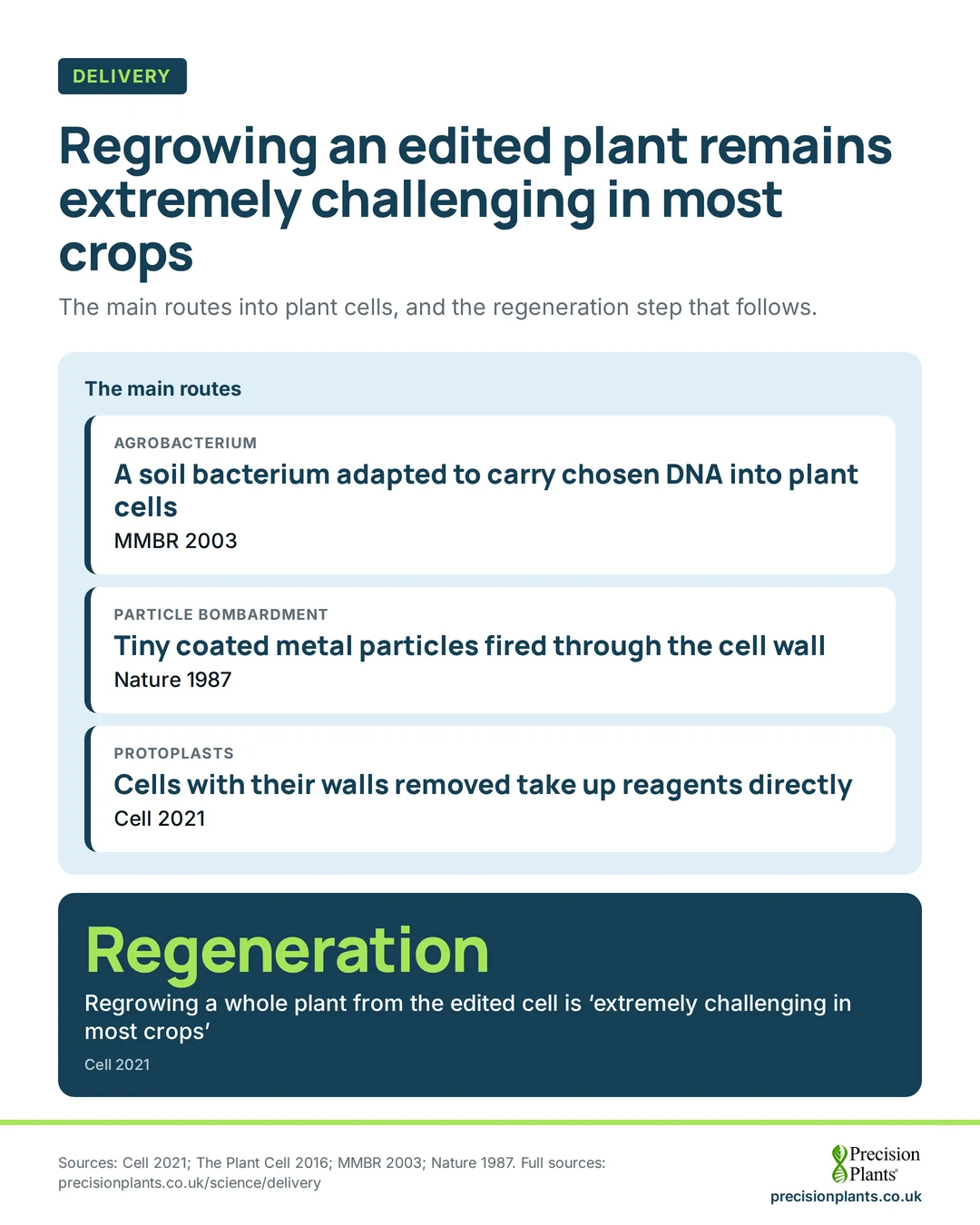
Infographic: Precision Plants. Sources: Cell (2021); The Plant Cell, via PubMed Central (2016); Microbiology and Molecular Biology Reviews (2003); Nature (1987)
The main routes
Gao's 2021 review lists the current delivery methods as particle bombardment, Agrobacterium-mediated transformation, polyethylene glycol, viral vectors and nanoparticles [1]. Two of them, Agrobacterium and particle bombardment, have been in use for more than three decades [2].
- Agrobacterium: a soil bacterium that naturally transfers a stretch of its own DNA into plant cells, adapted to carry chosen DNA instead [3].
- Particle bombardment: tiny metal particles coated with DNA or RNA are fired into cells, piercing the wall without killing them [4].
- Protoplasts: cells with their walls removed, which can take up editing reagents directly [1].
Delivering without DNA
The tool does not have to arrive as DNA. Gao explains that editing reagents can also be delivered as RNA or as a ready-made protein and RNA complex, and that these transient forms ‘do not result in genomic integration events into the plant genome’ [1]. The transgene-free page explains why this matters.
The real bottleneck: regrowing the plant
After delivery, the edited cell must grow back into a whole plant through tissue culture. Gao calls this regeneration step ‘extremely challenging in most crops’ [1].
Altpeter and colleagues list long tissue culture periods and low frequencies of stably transformed plants among the main challenges, and note that efficient Agrobacterium transformation is usually limited to a narrow range of genotypes within a species [2]. ‘Often, cells that are readily transformed cannot be regenerated, and vice versa’ [2].
Guides in this section
- Transgene-free gene editing: How the editing tool is kept out of, or removed from, the final plant.
Frequently asked questions
Why is it hard to get tools into plant cells?
Plant cells have a rigid wall. Bacteria, fast-moving particles or wall-free protoplasts are used to get past it.
Does every crop variety respond the same way?
No. Efficient transformation is often limited to a narrow range of genotypes within a species, and many established varieties are hard to regenerate.
Is the tool always delivered as DNA?
No. It can be delivered as RNA or as a protein and RNA complex, which does not integrate into the plant genome.
Which gene-editing methods are there?
Five are widely described. Zinc finger nucleases, TALENs and CRISPR/Cas9 cut both DNA strands at a chosen site, while base editing and prime editing change the sequence without a double-strand break.
References
- Cell (2021). Genome engineering for crop improvement and future agriculture (Gao)
- The Plant Cell, via PubMed Central (2016). Advancing crop transformation in the era of genome editing (Altpeter and others)
- Microbiology and Molecular Biology Reviews (2003). Agrobacterium-mediated plant transformation: the biology behind the gene-jockeying tool (Gelvin)
- Nature (1987). High-velocity microprojectiles for delivering nucleic acids into living cells (Klein and others)
Last reviewed 2026-09-26. Edited by Mark Turner.