DNA sequencing explained
Published
Sequencing turns a molecule into text: a string of A, C, G and T that can be read, compared and checked.
What is DNA sequencing?
DNA sequencing is the process of reading the order of the four chemical bases, A, C, G and T, along a stretch of DNA. Scientists use the sequence to find genes, spot differences between plants or people, and confirm whether a particular change is present.
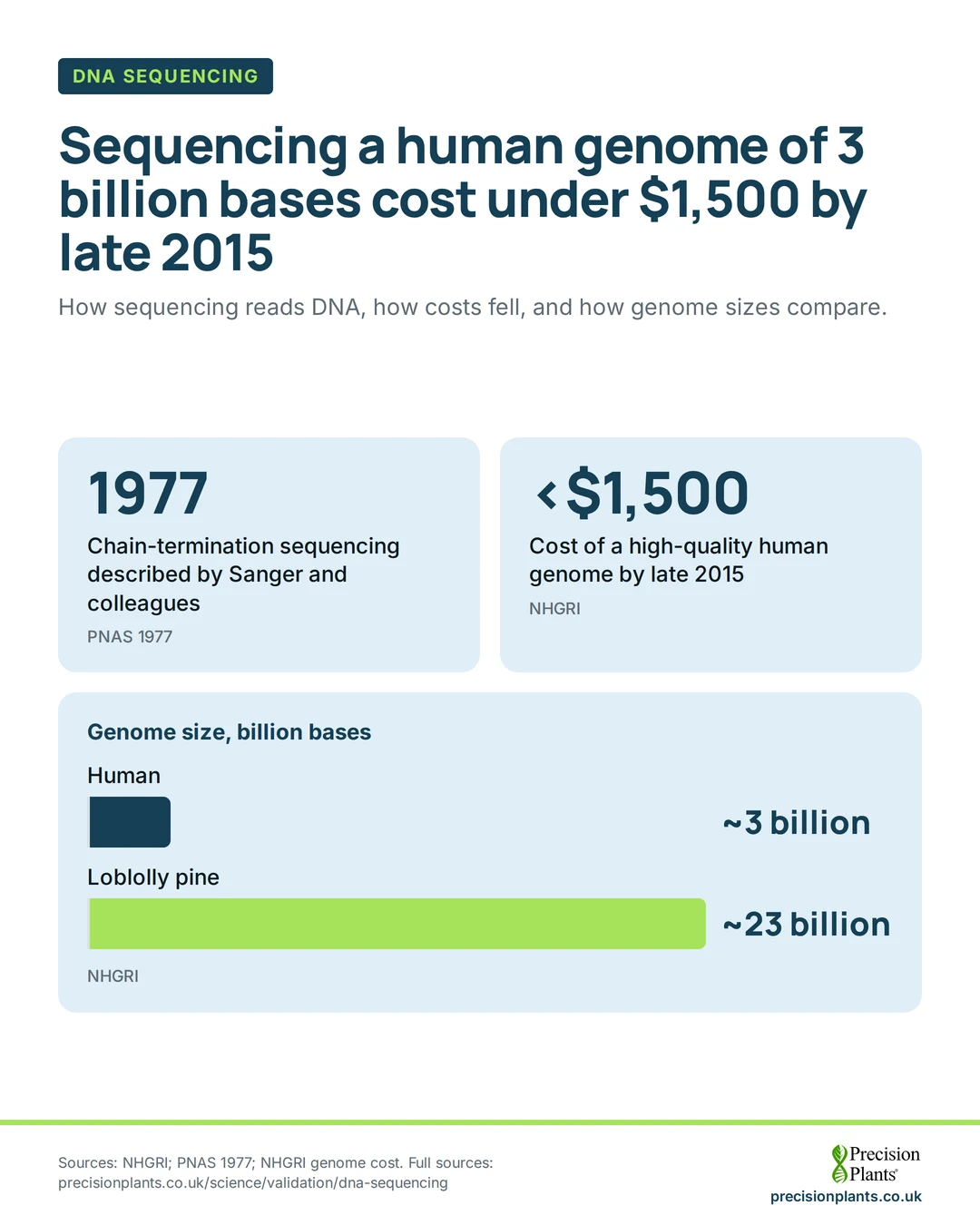
Infographic: Precision Plants. Sources: National Human Genome Research Institute; Proceedings of the National Academy of Sciences, via PubMed (1977); National Human Genome Research Institute
What sequencing reads
DNA sequencing ‘determines the order of the four chemical building blocks - called “bases” - that make up the DNA molecule’ [1]. Adenine pairs with thymine and cytosine with guanine, and that pairing underlies most sequencing methods [1].
How it works
In 1977 Frederick Sanger and colleagues described a method using chain-terminating versions of the DNA building blocks, which stop DNA copying at a known letter [2]. Chain-termination sequencing is still used for targeted reads of a known region [3].
Genomes are too long to read end to end. The NHGRI explains that DNA is broken into smaller pieces, each piece is read, and the reads, often numbering in the billions, are assembled back together by computer [4]. Newer methods watch DNA being copied in real time or thread single strands through nanopores [1].
Falling costs
Costs have fallen sharply. The NHGRI reports that the cost of a high-quality human genome sequence had fallen below $1,500 by late 2015 [4]. Its fact sheet adds that an entire genome can now be sequenced for just a few thousand dollars [1].
Genome size matters. A human genome is about 3 billion bases, while the loblolly pine's is about 23 billion [4].
How plant scientists use it
In plant breeding, sequencing confirms that an intended edit is present and looks for unintended changes or leftover DNA [3]. Whole-genome sequencing is the method of choice for untargeted searches, provided a good reference genome is available [3]. Sequencing shows what is there; it cannot on its own show how a small change arose [5].
Frequently asked questions
How much does it cost to sequence a genome?
The NHGRI reports that a high-quality human genome had fallen below $1,500 by late 2015. Costs vary with genome size and quality.
What is whole-genome sequencing?
Reading all of an organism's DNA, not just one region. The DNA is broken into pieces, each is read, and the reads are assembled by computer.
Can sequencing show that a plant was gene-edited?
Sequencing can show that a change is present, but not whether a small change came from editing, conventional mutagenesis or nature.
Which gene-editing methods are there?
Five are widely described. Zinc finger nucleases, TALENs and CRISPR/Cas9 cut both DNA strands at a chosen site, while base editing and prime editing change the sequence without a double-strand break.
References
- National Human Genome Research Institute. DNA sequencing fact sheet
- Proceedings of the National Academy of Sciences, via PubMed (1977). DNA sequencing with chain-terminating inhibitors (Sanger, Nicklen and Coulson)
- Frontiers in Plant Science (2019). Detection and identification of genome editing in plants: challenges and opportunities (Grohmann and others)
- National Human Genome Research Institute. The cost of sequencing a human genome
- European Network of GMO Laboratories, European Commission Joint Research Centre (2019). Detection of food and feed plant products obtained by new mutagenesis techniques
Last reviewed 2026-09-26. Edited by Mark Turner.