Off-target effects
Published · Updated
No method is perfectly precise. The useful question is how often unintended changes happen, how they are found, and how they compare with the changes breeding already makes.
What is an off-target effect?
An off-target edit is an unintended, nonspecific mutation at a DNA site that resembles the site being targeted. Studies that sequence whole plant genomes find such changes are rare.
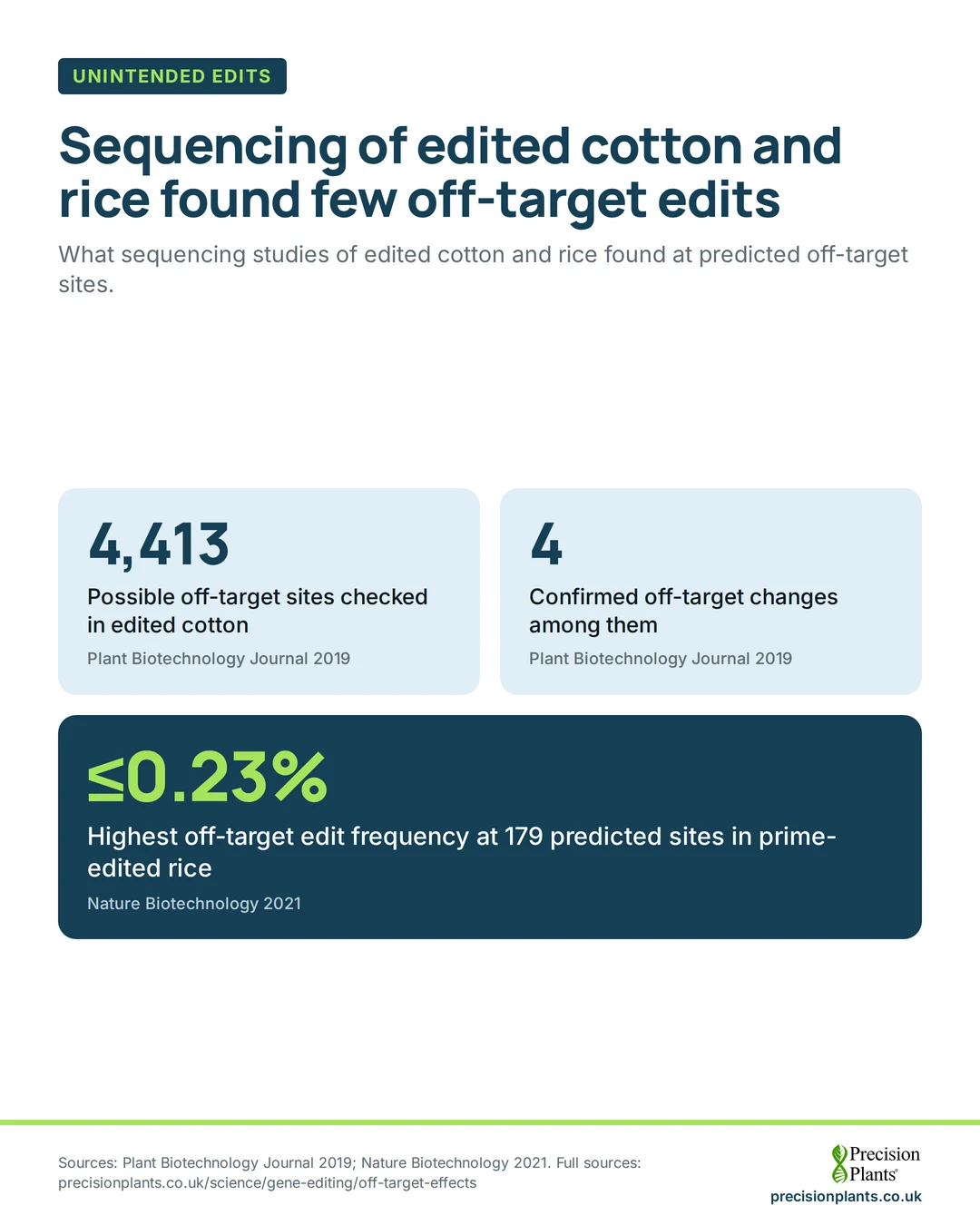
Infographic: Precision Plants. Sources: Plant Biotechnology Journal, via PubMed Central (2019); Nature Biotechnology, via PubMed (2021)
What it means
An off-target edit is an unintended, nonspecific mutation that occurs at a site with sequence similarity to the targeted region [6]. Every nuclease can do this, whether zinc finger nuclease, TALEN or CRISPR/Cas9 [1][2][3][11]. Base editors and prime editors have been checked for it too [4][5].
What studies in plants have found
The most thorough check is to sequence the whole genome and compare it with unedited plants.
| Study | What was checked | Finding |
|---|---|---|
| Edited cotton, 2019 | 4,413 possible off-target sites [7] | Four confirmed off-target changes [7] |
| Nuclease-edited plants, 2022 | Genome-wide, two nuclease systems [8] | Off-target mutations were rare [8] |
| Prime-edited rice, 2021 | 179 predicted off-target sites [9] | Off-target edits no higher than 0.23% [9] |
| Base-edited tomato, 2021 | Genome and transcriptome [10] | No evidence of true off-target mutations from the editor tested [10] |
Background change in every plant
Plants change on their own. Spontaneous mutations occur at rates of about one in 100 million to one in a billion per site per generation, and chemical or radiation mutagenesis raises that rate [6]. In the cotton study, most of the thousands of small differences found in edited plants were put down to variation already present or arising in tissue culture, not to the editing tool [7].
How it is managed
Careful choice of target sequence is the most important factor in reducing off-target cutting [11]. Applications for precision bred food in England describe the procedures used to minimise unintended changes, so-called off-target effects [12]. The European Food Safety Authority concluded in 2012 that off-target changes from nuclease insertion would be fewer than those from most mutagenesis techniques [13].
Frequently asked questions
Are off-target effects dangerous?
A review in Plant Physiology concluded that off-target edits in crops present no new safety concerns compared with other breeding practices, because plants already carry and gain many natural mutations.
How are off-target effects detected?
By sequencing predicted sites, or the whole genome, of edited plants and comparing them with unedited plants.
Does gene editing cause more changes than mutation breeding?
A review in Plant Physiology described genome editing as a targeted and more exact form of mutation breeding, which for decades has used chemicals or radiation to cause random changes.
References
- Science (2012). A programmable dual-RNA-guided DNA endonuclease in adaptive bacterial immunity (Jinek and others)
- Genetics, via PubMed (2010). Targeting DNA double-strand breaks with TAL effector nucleases (Christian and others)
- Proceedings of the National Academy of Sciences (1996). Hybrid restriction enzymes: zinc finger fusions to Fok I cleavage domain (Kim, Cha and Chandrasegaran)
- Nature (2016). Programmable editing of a target base in genomic DNA without double-stranded DNA cleavage (Komor and others)
- Nature (2019). Search-and-replace genome editing without double-strand breaks or donor DNA (Anzalone and others)
- Plant Physiology (2020). Plant genome editing and the relevance of off-target changes (Graham and others)
- Plant Biotechnology Journal, via PubMed Central (2019). Whole genome sequencing reveals rare off-target mutations and considerable inherent genetic or/and somaclonal variations in CRISPR/Cas9-edited cotton plants (Li and others)
- Scientific Reports (2022). Genome-wide specificity of plant genome editing by both CRISPR–Cas9 and TALEN
- Nature Biotechnology, via PubMed (2021). Genome-wide specificity of prime editors in plants (Jin and others)
- Plant Physiology (2021). Genome- and transcriptome-wide off-target analyses of an improved cytosine base editor (Randall and others)
- Plant Cell Reports (2019). CRISPR/Cas precision and off-targeting in plants (Hahn and Nekrasov, title shortened)
- Food Standards Agency (2023). Genetic Technology (Precision Breeding): board paper
- EFSA Panel on Genetically Modified Organisms, EFSA Journal (2012). Scientific opinion addressing the safety assessment of plants developed using Zinc Finger Nuclease 3 and other Site-Directed Nucleases with similar function
Last reviewed 2026-09-26. Edited by Mark Turner.