What is a genome?
Published · Updated
A thale cress plant fits its whole instruction set into about 125 million letters. Bread wheat needs around 17 billion. Size, it turns out, says more about history than about complexity.
What is a genome?
A genome is an organism's complete set of DNA. It includes every gene and all the DNA between them, packed into chromosomes. Virtually every cell carries a complete copy.
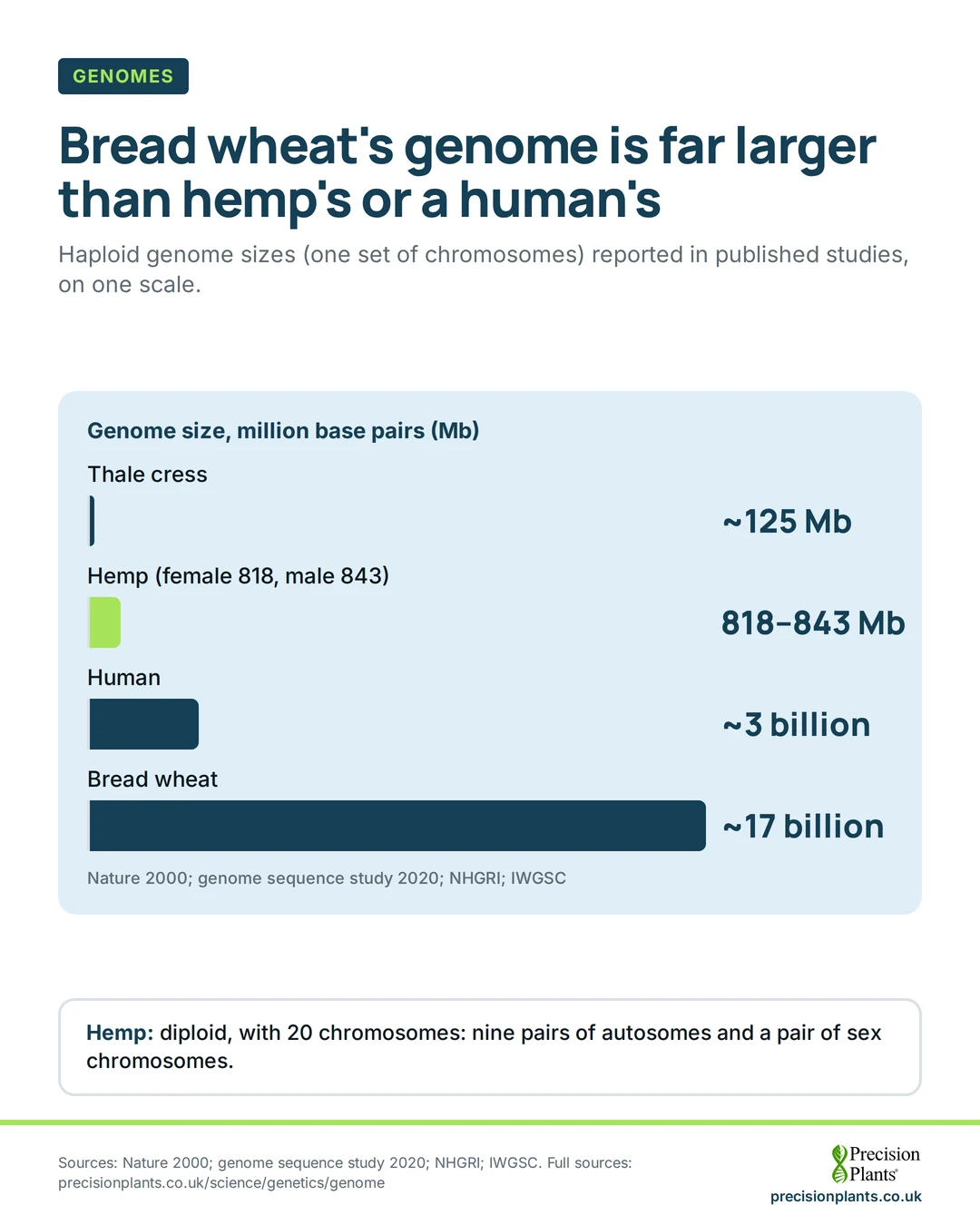
Infographic: Precision Plants. Sources: National Human Genome Research Institute; The Arabidopsis Genome Initiative, Nature 408 (2000); PubMed Central (2020); IWGSC
The complete set
An organism's complete set of DNA is called its genome [1]. Virtually every cell in the human body contains a complete copy of the approximately 3 billion base pairs that make up the human genome [1]. Plants work the same way: a leaf cell and a root cell carry the same genome, and use different parts of it.
Packed into chromosomes
Chromosomes are threadlike structures made of protein and a single molecule of DNA [2]. They vary in number and shape among living organisms [2]. Humans have 46, in 23 pairs [2]. Hemp and other cannabis plants are diploid, with 20 chromosomes: nine pairs of autosomes and a pair of sex chromosomes [4].
The packaging is essential. If all of the DNA molecules in a single human cell were unwound and placed end to end, they would stretch about 6 feet, or 1.8 metres [2].
Crop genomes compared
Genome sizes are measured in base pairs: megabases (Mb, millions) and gigabases (billions). The spread across plants is enormous.
| Organism | Genome size | Source |
|---|---|---|
| Thale cress (Arabidopsis thaliana) | About 125 Mb | Nature, 2000 [3] |
| Hemp and cannabis (Cannabis sativa) | 818 Mb (female) and 843 Mb (male), by flow cytometry | Genome sequence study, 2020 [4] |
| Human | About 3 billion base pairs | NHGRI [1] |
| Bread wheat (Triticum aestivum) | About 17 billion base pairs | International Wheat Genome Sequencing Consortium [5] |
Why size varies so much
Bread wheat is hexaploid: its genome combines three ancestral sub-genomes, called A, B and D [6]. Combining whole genomes in this way multiplies the amount of DNA a plant carries. A bigger genome is not a sign of a more advanced organism.
Reading a genome
Sequencing a genome means reading its bases in order. Arabidopsis was the first plant genome to be sequenced, and the publication in 2000 brought plant science into the genomics era [7]. The first fully annotated reference genome of bread wheat followed in 2018, covering an estimated 94% of the genome [6].
A reference genome is a map. It lets researchers find genes, compare varieties and see where the differences that matter to growers lie.
Frequently asked questions
How many chromosomes does hemp have?
Twenty. Cannabis sativa, which includes hemp, is diploid (2n = 20), with nine pairs of autosomes and a pair of sex chromosomes.
How big is the wheat genome?
Bread wheat's genome is about 17 billion base pairs, more than five times the size of the human genome.
What is a reference genome?
A high-quality genome sequence for one individual of a species, annotated with the positions of its genes. Researchers use it as a map to compare other plants against.
References
- National Human Genome Research Institute. A Brief Guide to Genomics
- National Human Genome Research Institute (2026). Chromosome (genetics glossary)
- The Arabidopsis Genome Initiative, Nature 408 (2000). Analysis of the genome sequence of the flowering plant Arabidopsis thaliana
- PubMed Central (2020). A new and improved genome sequence of Cannabis sativa
- IWGSC. International Wheat Genome Sequencing Consortium: milestones
- International Wheat Genome Sequencing Consortium, Science 361 (2018). Shifting the limits in wheat research and breeding using a fully annotated reference genome
- The Plant Cell, via PubMed Central (2020). Anno genominis XX: 20 years of Arabidopsis genomics
Last reviewed 2026-09-26. Edited by Mark Turner.