Can gene-edited crops be detected?
Published · Updated
Finding a change and proving how it was made are two different questions. Testing can often answer the first. The second is much harder.
Can gene-edited crops be detected?
A known edit can be found with PCR or sequencing. But a small edit can be identical to a natural or conventionally induced mutation, so testing alone often cannot show that a plant was gene-edited. England relies on public registers of precision bred organisms instead.
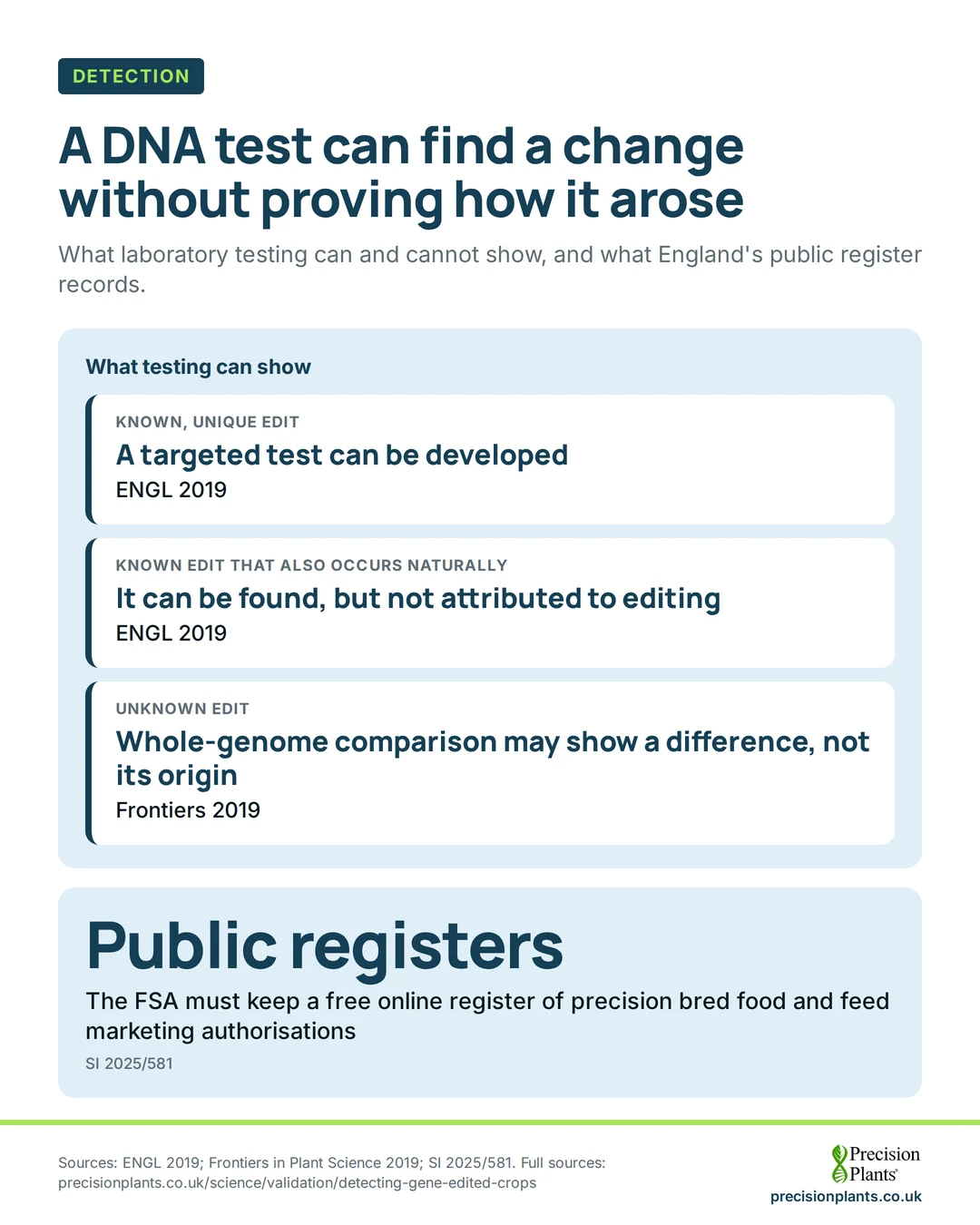
Infographic: Precision Plants. Sources: European Network of GMO Laboratories, European Commission Joint Research Centre (2019); Frontiers in Plant Science (2019); legislation.gov.uk (2025)
Why GMOs are easy to find
Classic GMOs carry foreign DNA inserted at a particular site, a combination that does not occur naturally. Grohmann and colleagues explain that PCR methods targeting that insertion site make them detectable, identifiable and quantifiable [2].
Why small edits are different
Many edits add no foreign DNA and change only one or a few letters. The European Network of GMO Laboratories concluded that, without prior knowledge, none of the techniques it described can tell whether such a change ‘is caused by genome editing, by classical breeding technologies or by natural mutation’ [1].
Grohmann and colleagues reach the same view: current methods can compare sequences, but ‘do not allow determining how a sequence alteration was introduced’ [2].
What testing can do
If the edit is known and unique, a specific test can be built for it. The ENGL report found that validating an event-specific method is feasible only for products ‘carrying a known DNA alteration that has been shown to be unique’, and that market control ‘will fail to detect unknown genome-edited plant products’ [1].
England's answer: registers
Rather than relying on testing, England's rules make precision bred organisms traceable on paper. The Food Standards Agency must keep a public register of food and feed marketing authorisations, free to view online, naming each authorised organism and linking to its entry on the precision breeding register [3].
Frequently asked questions
Can a lab test tell if my food is gene-edited?
Only in some cases. A known, unique edit can be tested for, but a small edit that also occurs naturally cannot be attributed to editing.
Why can GMOs be detected but not all edits?
GMOs carry inserted foreign DNA at a known site. Many edits change only a letter or two, which can match natural variation.
How are precision bred foods tracked in England?
The Food Standards Agency keeps a public online register of authorised precision bred food and feed, linked to the precision breeding register.
Which gene-editing methods are there?
Five are widely described. Zinc finger nucleases, TALENs and CRISPR/Cas9 cut both DNA strands at a chosen site, while base editing and prime editing change the sequence without a double-strand break.
References
- European Network of GMO Laboratories, European Commission Joint Research Centre (2019). Detection of food and feed plant products obtained by new mutagenesis techniques
- Frontiers in Plant Science (2019). Detection and identification of genome editing in plants: challenges and opportunities (Grohmann and others)
- legislation.gov.uk (2025). The Genetic Technology (Precision Breeding) Regulations 2025, regulation 35
Last reviewed 2026-09-26. Edited by Mark Turner.