Plant genetics, from the ground up
Published
Every crop in every field is running the same four-letter code. Here is how that code is written, read and copied, and why small changes in it have shaped almost everything we eat.
What is plant genetics?
Plant genetics is the study of how plants store, use and pass on the information in their DNA. That information is written in four chemical bases, grouped into genes, and packed into chromosomes. The full set is the plant's genome.
The first plant genome to be sequenced was the small weed Arabidopsis thaliana, in 2000. Its 125-megabase genome contains about 25,500 protein-coding genes.
Animation: Precision Plants. Sources: MedlinePlus Genetics, US National Library of Medicine; National Human Genome Research Institute; MedlinePlus Genetics, US National Library of Medicine; The Arabidopsis Genome Initiative, Nature 408 (2000); National Human Genome Research Institute
A code with four letters
DNA is the hereditary material in humans and almost all other organisms [1]. Its information is stored as a sequence of four chemical bases: adenine (A), guanine (G), cytosine (C) and thymine (T) [1]. The order of those bases carries meaning in the same way the order of letters does in a word [2].
Plants use the same four bases as animals, fungi and bacteria. That shared chemistry is why a discovery made in one organism so often turns out to be useful in another.
Four levels, smallest to largest
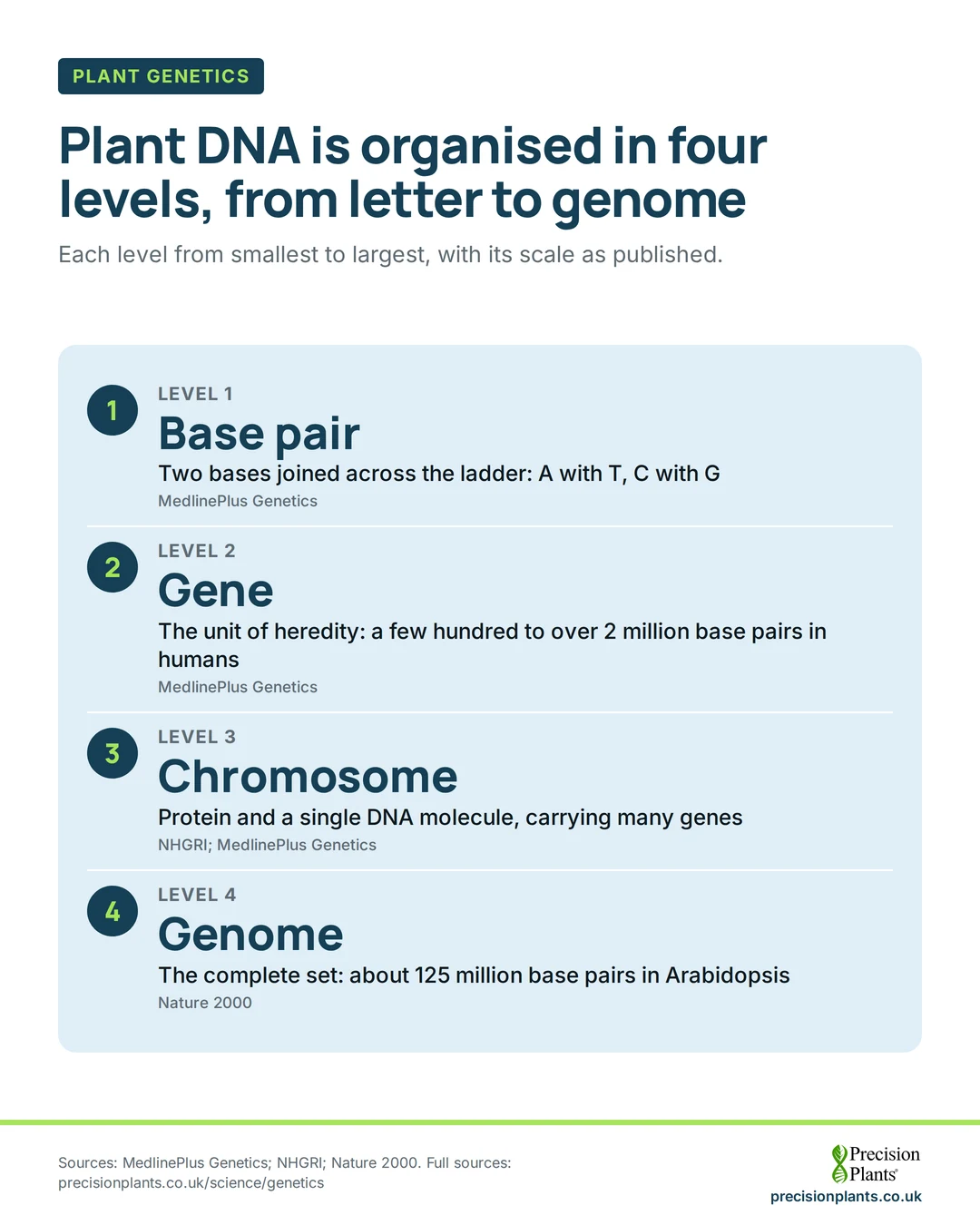
It helps to picture genetics as a set of nested containers. Each level is covered in its own guide.
| Level | What it is | Scale |
|---|---|---|
| Base pair | Two bases joined across the DNA ladder: A with T, C with G [1] | The single letter |
| Gene | The basic physical and functional unit of heredity, made of DNA [3] | From a few hundred to over 2 million base pairs in humans [3] |
| Chromosome | A threadlike structure of protein and a single DNA molecule [5] | Many genes on each one [3] |
| Genome | An organism's complete set of DNA [2] | About 125 million base pairs in Arabidopsis [4] |
Why this matters for crops
Many of the traits a farmer cares about, from height and flowering time to disease resistance, trace back in part to differences in DNA sequence. Plant breeding is the work of finding useful differences and bringing them together in one plant.
One example shows the scale of the effect. Two dwarfing gene variants in wheat, first introduced into breeding programmes in the 1930s, remain the most widely used dwarfing genes in wheat varieties today [6].
Where to start
If you are new to the subject, read the guides in order: DNA, then genes, then genomes, then mutations. The glossary is there whenever a term gets in the way.
Guides in this section
- What is DNA?: The molecule, its four bases and the double helix.
- What is a gene?: How a stretch of DNA becomes an instruction.
- What is a genome?: The complete set, and why crop genomes vary so much in size.
- What is a mutation?: How DNA changes, and why breeders depend on it.
- Genetics glossary: Plain-English definitions of the terms used across this section.
Frequently asked questions
Do plants have DNA like humans?
Yes. Plants store their hereditary information in DNA written with the same four bases, A, T, C and G, that humans and almost all other organisms use.
What was the first plant genome sequenced?
Arabidopsis thaliana, a small flowering weed used widely in research. Its genome sequence was published in Nature in 2000.
Is genetics the same as genomics?
Not quite. Genetics usually looks at individual genes and how they are inherited. Genomics studies the whole genome, including how genes interact with each other and with the environment.
References
- MedlinePlus Genetics, US National Library of Medicine. What is DNA?
- National Human Genome Research Institute. A Brief Guide to Genomics
- MedlinePlus Genetics, US National Library of Medicine. What is a gene?
- The Arabidopsis Genome Initiative, Nature 408 (2000). Analysis of the genome sequence of the flowering plant Arabidopsis thaliana
- National Human Genome Research Institute. Chromosome (genetics glossary)
- Journal of Experimental Botany, via PubMed Central (2021). Rht18 and the future of wheat dwarfing (commentary on Tang et al.)
Last reviewed 2026-09-26. Edited by Mark Turner.