Genetics glossary
Published
The words that come up most often in plant genetics, defined in a sentence or two and sourced.
What do the main genetics terms mean?
DNA is the molecule that carries hereditary information. A gene is a unit of heredity made of DNA. A chromosome is a packaged molecule of DNA. A genome is the complete set. An allele is one version of a gene.
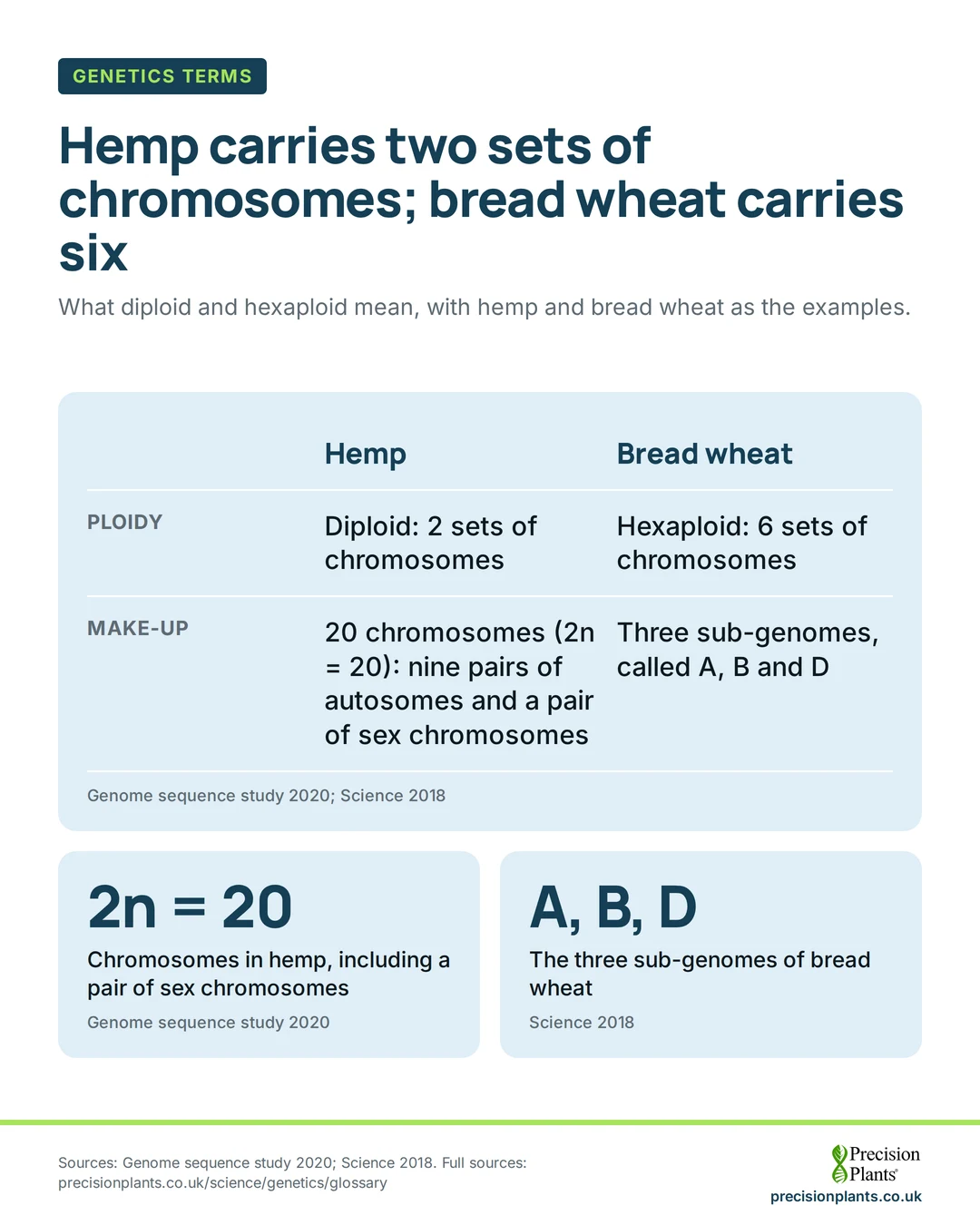
Infographic: Precision Plants. Sources: PubMed Central (2020); International Wheat Genome Sequencing Consortium, Science 361 (2018)
A to D
| Term | Meaning |
|---|---|
| Allele | One form of a gene, differing from other forms by small changes in its DNA sequence [1]. |
| Autosome | Any chromosome that is not a sex chromosome. Humans have 22 pairs [3]; hemp has nine pairs [5]. |
| Base | One of the four chemical letters of DNA: adenine (A), cytosine (C), guanine (G) and thymine (T) [2]. |
| Base pair | Two bases joined across the two strands of DNA, A with T or C with G [4]. |
| Chromosome | A threadlike structure made of protein and a single molecule of DNA, which carries genomic information from cell to cell [3]. |
| De novo variant | A new variant found in an offspring but in neither parent [6]. |
| Diploid | Carrying two sets of chromosomes, one from each parent. Hemp is diploid, with 20 chromosomes (2n = 20) [5]. |
| DNA | Deoxyribonucleic acid, the molecule that carries genetic information for the development and functioning of an organism [2]. |
| Double helix | The twisted-ladder shape formed by DNA's two linked strands [2]. |
G to M
| Term | Meaning |
|---|---|
| Gene | The basic physical and functional unit of heredity, made of DNA [1]. |
| Gene variant | A permanent change in the DNA sequence that makes up a gene. Older texts call it a mutation [6]. |
| Genome | An organism's complete set of DNA [7]. |
| Genomics | The study of all of an organism's genes, including how they interact with each other and with the environment [7]. |
| Germline variant | An inherited variant, present in egg or sperm cells and passed on to offspring [6]. |
| Hexaploid | Carrying six sets of chromosomes. Bread wheat is hexaploid, combining three sub-genomes called A, B and D [8]. |
| Megabase (Mb) | One million base pairs, the usual unit for plant genome size. |
| Mutation breeding | A long-standing technique that induces genetic diversity in crops so breeders can select improved varieties [9]. |
N to Z
| Term | Meaning |
|---|---|
| Nucleotide | A base, a sugar and a phosphate joined together: the single building block of DNA [4]. |
| Protein | A molecule made using the instructions in a gene. Proteins are needed for an organism to function [1]. |
| Replication | DNA making a copy of itself, with each strand serving as a pattern for the new one [4]. |
| Sex chromosomes | The chromosome pair that differs between the sexes. In hemp, as in humans, these are X and Y [3][5]. |
| Somatic variant | A variant that arises during an individual's life in cells other than eggs or sperm, and is not passed on to offspring [6]. |
Frequently asked questions
What is the difference between a gene and a genome?
A gene is one unit of heredity. A genome is the organism's complete set of DNA, containing all of its genes.
Is a mutation the same as a variant?
Yes. Gene variant is the newer term for a permanent change in a gene's DNA sequence. It is preferred because such changes do not always cause harm.
References
- MedlinePlus Genetics, US National Library of Medicine. What is a gene?
- National Human Genome Research Institute (2026). Deoxyribonucleic Acid (DNA) (genetics glossary)
- National Human Genome Research Institute (2026). Chromosome (genetics glossary)
- MedlinePlus Genetics, US National Library of Medicine. What is DNA?
- PubMed Central (2020). A new and improved genome sequence of Cannabis sativa
- MedlinePlus Genetics, US National Library of Medicine. What is a gene variant and how do variants occur?
- National Human Genome Research Institute. A Brief Guide to Genomics
- International Wheat Genome Sequencing Consortium, Science 361 (2018). Shifting the limits in wheat research and breeding using a fully annotated reference genome
- International Atomic Energy Agency, via Mirage News (2026). IAEA upgrades database for climate-smart crops
Last reviewed 2026-09-26. Edited by Mark Turner.