What is a mutation?
Published · Updated
The word sounds alarming. In practice, small changes in DNA are the raw material of crop breeding, from the first domesticated grains to modern wheat.
What is a mutation?
A mutation, now usually called a gene variant, is a permanent change in the DNA sequence that makes up a gene. Variants can affect one or more DNA building blocks, and many have no harmful effect.
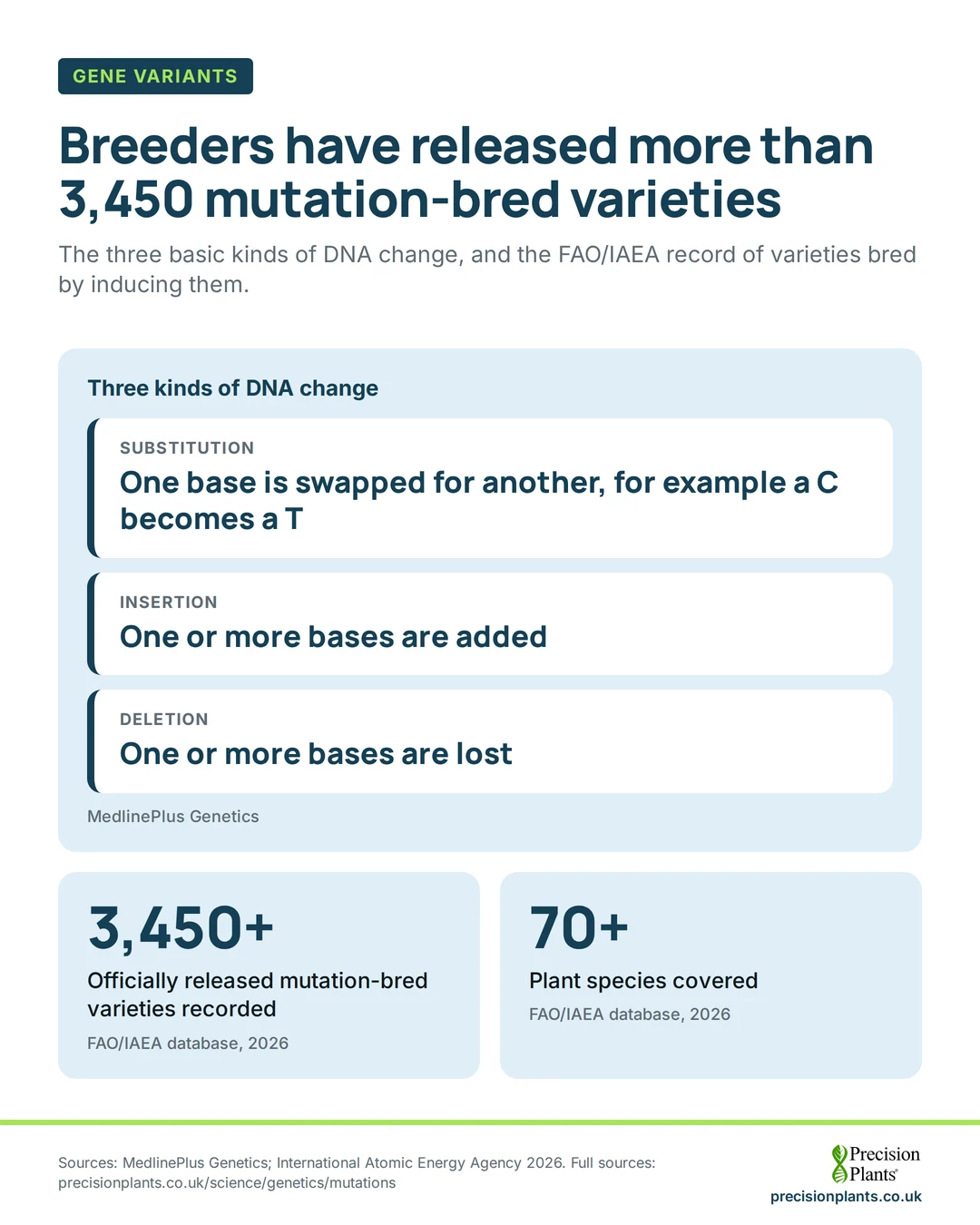
Infographic: Precision Plants. Sources: International Atomic Energy Agency, via Mirage News (2026); MedlinePlus Genetics, US National Library of Medicine
Mutation or variant?
A gene variant is a permanent change in the DNA sequence that makes up a gene [1]. This kind of change used to be known as a gene mutation. Because changes in DNA do not always cause disease, gene variant is now thought to be the more accurate term [1]. Both words are still in common use.
Variants can affect one DNA building block, a nucleotide, or several [1].
How variants arise
Some variants arise from environmental factors such as ultraviolet radiation from the sun. Others arise when an error is made as DNA copies itself during cell division [1].
- Inherited variants are passed from parent to offspring and are present in virtually every cell [1].
- Non-inherited, or somatic, variants occur during an individual's life, are present only in certain cells and are not passed on to offspring [1].
- New, or de novo, variants are found in offspring but in neither parent [1].
Why breeders depend on them
The genetic differences between two varieties of a crop began as changes in DNA. Breeding is the work of finding useful changes and bringing them together. Wheat shows how long a single useful change can last: two dwarfing alleles first introduced into breeding in the 1930s are still the most widely used dwarfing genes in wheat varieties today [2].
Breeders also create new variation on purpose. Mutation breeding is a long-standing technique that induces genetic diversity in crops, so that breeders can develop varieties with improved traits [3]. For over 60 years, the Joint FAO/IAEA Centre has kept a database of officially released varieties bred this way. It now holds more than 3,450 records across more than 70 plant species [3].
Common kinds of DNA change
Geneticists describe changes by what happens to the sequence.
| Kind | What happens |
|---|---|
| Substitution | One base is swapped for another, for example a C becomes a T [4] |
| Insertion | One or more bases are added to the sequence [4] |
| Deletion | One or more bases are lost from the sequence [4] |
Frequently asked questions
Are all mutations harmful?
No. Changes in DNA do not always cause disease, which is why many scientists now prefer the term gene variant. Some changes have no visible effect, and some are useful.
What causes mutations in plants?
Variants can arise from environmental factors such as ultraviolet light, or from errors made as DNA copies itself when cells divide.
What is mutation breeding?
A long-standing technique that induces new genetic variation in crops, so that breeders can select plants with improved traits. The FAO/IAEA Mutant Variety Database holds more than 3,450 records of released varieties.
References
- MedlinePlus Genetics, US National Library of Medicine. What is a gene variant and how do variants occur?
- Journal of Experimental Botany, via PubMed Central (2021). Rht18 and the future of wheat dwarfing (commentary on Tang et al.)
- International Atomic Energy Agency, via Mirage News (2026). IAEA upgrades database for climate-smart crops
- MedlinePlus Genetics, US National Library of Medicine. What kinds of gene variants are possible?
Last reviewed 2026-09-26. Edited by Mark Turner.