What is a gene?
Published · Updated
If DNA is the alphabet, a gene is a sentence that means something. Some sentences build things. Others tell the rest of the book when to speak.
What is a gene?
A gene is the basic physical and functional unit of heredity. Genes are made of DNA. Some genes are instructions for making proteins, while many others do not code for proteins and instead help control other genes.
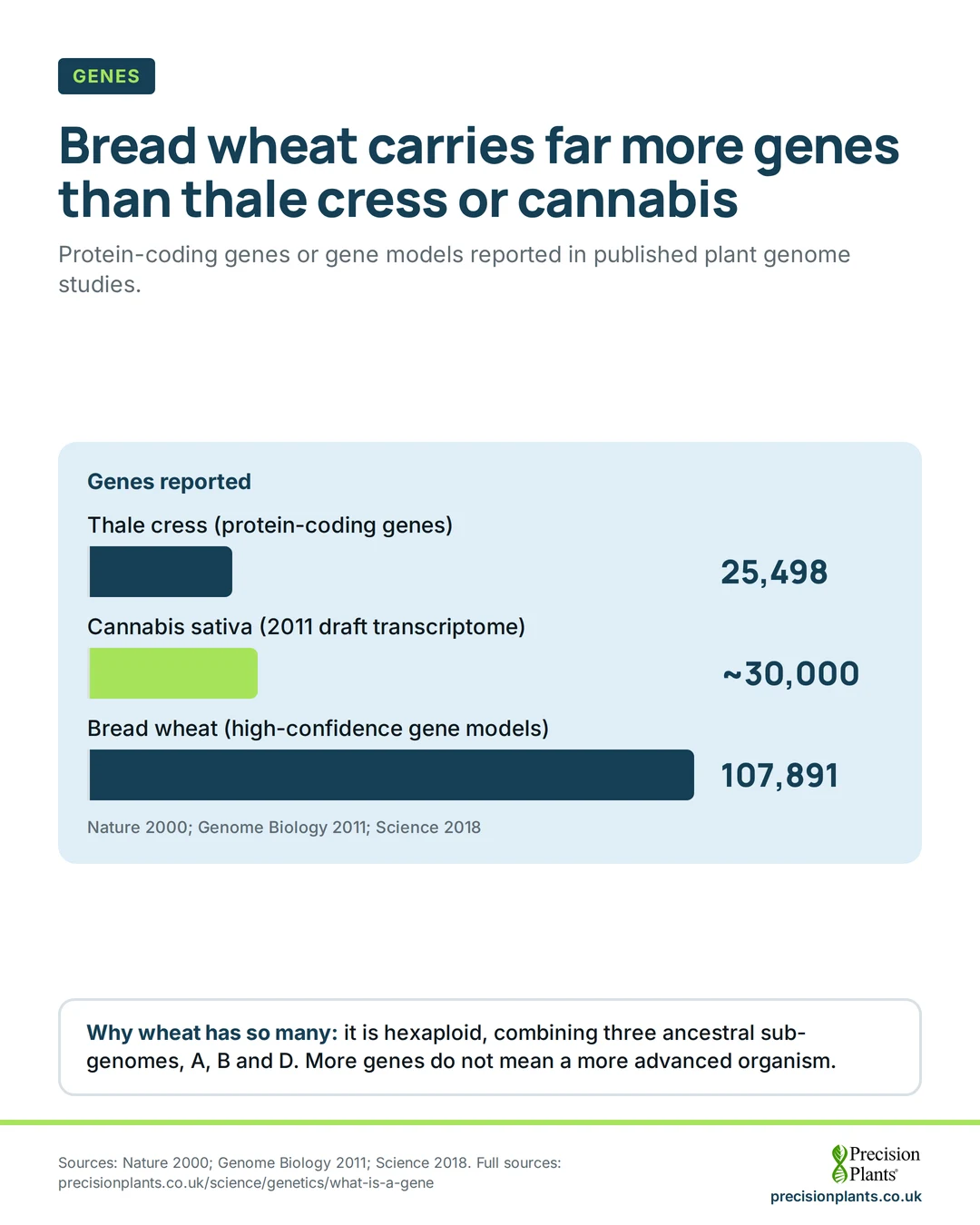
Infographic: Precision Plants. Sources: The Arabidopsis Genome Initiative, Nature 408 (2000); van Bakel et al., Genome Biology 12 (2011); International Wheat Genome Sequencing Consortium, Science 361 (2018)
Two kinds of job
Some genes act as instructions to make molecules called proteins [1]. Proteins do much of the work in a living cell.
Many genes do not code for proteins at all. Instead, they help control other genes [1], switching them on or off, or turning them up or down.
From gene to protein
A cell reads a protein-coding gene in two steps. First, an enzyme copies the information in the gene's DNA into a messenger molecule. Then that message is used to string together the building blocks of a protein, in the order the gene specifies [2].
Because the process runs through a copy, the original DNA stays safely in the nucleus while the message does the work elsewhere in the cell.
Alleles: versions of the same gene
Forms of the same gene with small differences in their DNA sequence are called alleles [1]. In diploid organisms, including people and hemp, each individual usually carries two copies of each gene, one from each parent [1][5].
Alleles are what breeders work with. The famous wheat dwarfing genes are a good example: particular alleles of two genes, first introduced into breeding in the 1930s, remain the most widely used dwarfing genes in wheat today [3].
How big, and how many?
Genes vary enormously in size. In humans, they range from a few hundred base pairs to more than 2 million [1]. Gene numbers also vary between species.
| Organism | Genes reported | Source |
|---|---|---|
| Thale cress (Arabidopsis thaliana) | 25,498 protein-coding genes | Nature, 2000 [4] |
| Cannabis sativa, 2011 draft genome and transcriptome | A transcriptome of about 30,000 genes | Genome Biology, 2011 [5] |
| Bread wheat (Triticum aestivum) | 107,891 high-confidence gene models | Science, 2018 [6] |
| Human | An estimated 20,000 to 25,000 genes | NHGRI [2] |
Why wheat has so many
Bread wheat is hexaploid. Its genome combines three ancestral sub-genomes, called A, B and D [6], so many of its genes are present in more than one similar copy. More genes do not make an organism more advanced. They reflect its history.
Frequently asked questions
What is the difference between a gene and an allele?
A gene is a stretch of DNA with a job. An allele is one version of that gene, differing from other versions by small changes in its DNA sequence.
Do all genes make proteins?
No. Some genes are instructions for proteins, but many do not code for proteins and instead help control other genes.
Do plants have more genes than humans?
Many do. Published counts include 25,498 protein-coding genes for Arabidopsis and 107,891 high-confidence gene models for bread wheat, against an estimated 20,000 to 25,000 genes in humans.
References
- MedlinePlus Genetics, US National Library of Medicine. What is a gene?
- National Human Genome Research Institute. A Brief Guide to Genomics
- Journal of Experimental Botany, via PubMed Central (2021). Rht18 and the future of wheat dwarfing (commentary on Tang et al.)
- The Arabidopsis Genome Initiative, Nature 408 (2000). Analysis of the genome sequence of the flowering plant Arabidopsis thaliana
- van Bakel et al., Genome Biology 12 (2011). The draft genome and transcriptome of Cannabis sativa
- International Wheat Genome Sequencing Consortium, Science 361 (2018). Shifting the limits in wheat research and breeding using a fully annotated reference genome
Last reviewed 2026-09-26. Edited by Mark Turner.