What is DNA?
Published
Two strands, four letters and one very long twist. DNA is the reason a hemp seed grows into hemp and not into barley.
What is DNA?
DNA, or deoxyribonucleic acid, is the molecule that carries genetic information for the development and functioning of an organism. It is made of two strands that wind around each other into a double helix, and its information is written in four bases: A, C, G and T.
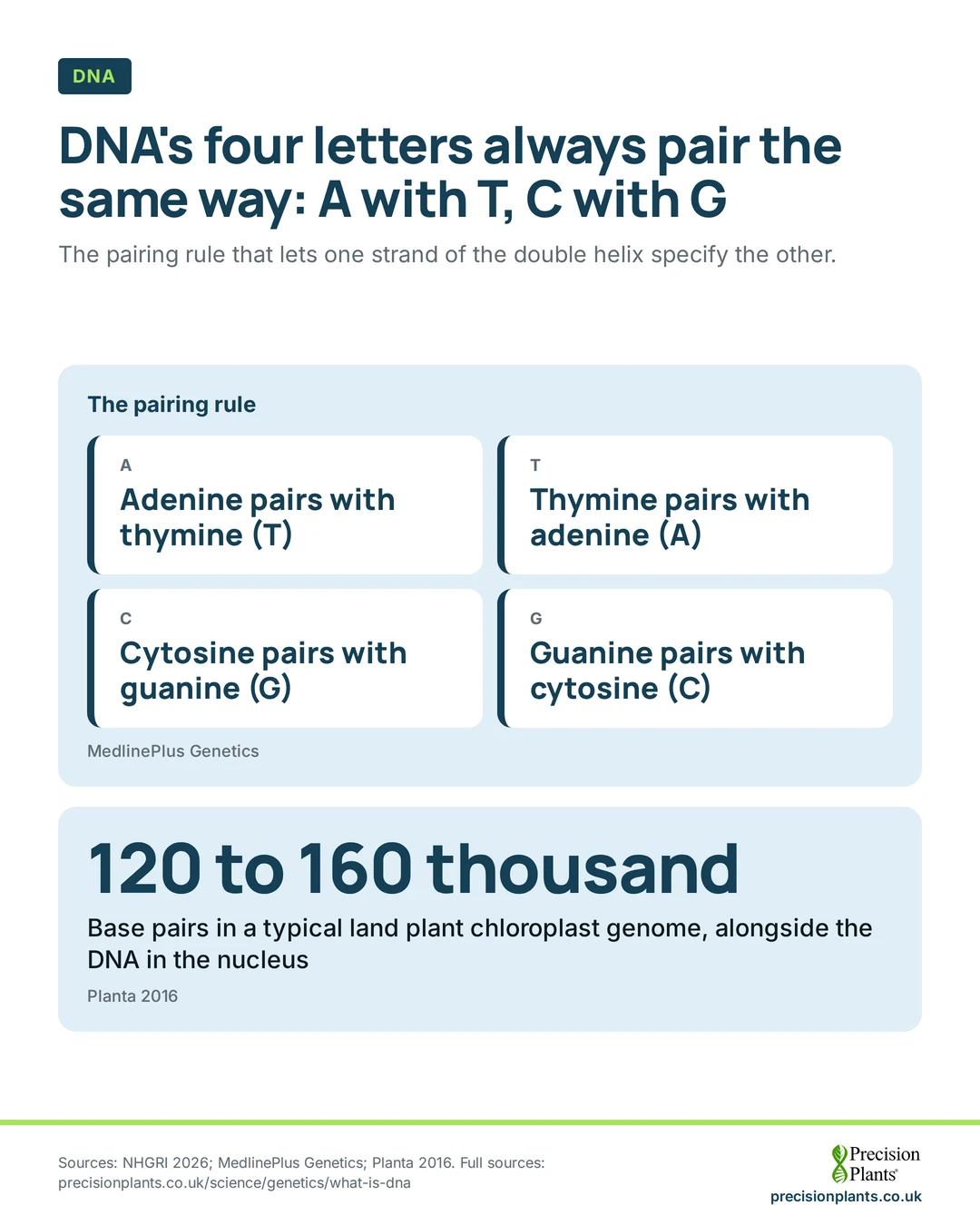
Infographic: Precision Plants. Sources: National Human Genome Research Institute (2026); MedlinePlus Genetics, US National Library of Medicine; Planta, Springer (2016)
A twisted ladder
DNA is made of two linked strands that wind around each other to resemble a twisted ladder, a shape known as a double helix [1]. Each strand has a backbone of alternating sugar (deoxyribose) and phosphate groups [1].
Attached to each sugar is one of four bases: adenine (A), cytosine (C), guanine (G) or thymine (T) [1]. The bases on one strand bond to the bases on the other, and those pairs form the rungs of the ladder [2].
The pairing rule
The bases always pair the same way: A with T, and C with G [2]. That rule is one of the most useful facts in biology. If you know the sequence of one strand, you know the other.
Together, a base, a sugar and a phosphate are called a nucleotide, and nucleotides are arranged in two long strands that form the double helix [2].
| Base | Letter | Always pairs with |
|---|---|---|
| Adenine | A | Thymine (T) |
| Thymine | T | Adenine (A) |
| Cytosine | C | Guanine (G) |
| Guanine | G | Cytosine (C) |
How a sequence carries meaning
The order, or sequence, of the bases determines the information available for building and maintaining an organism, in a similar way to how letters in a certain order form words and sentences [2]. The sequence along the backbone encodes biological information, such as the instructions for making a protein or an RNA molecule [1].
Copying itself
An important property of DNA is that it can replicate, or make copies of itself [2]. Each strand in the double helix can serve as a pattern for duplicating the sequence of bases [2]. This matters every time a cell divides, because each new cell needs its own copy.
Copying is very accurate but not perfect. Occasional errors are one of the ways new variation arises.
Where DNA sits in a plant cell
In plants and animals, chromosomes, which are made of protein and a single DNA molecule, reside in the nucleus of cells [3]. Plant cells also carry small amounts of DNA in two other places: the mitochondria, which convert energy from food into a form cells can use [2], and the chloroplasts, which carry out photosynthesis. In land plants, the chloroplast genome is usually circular and about 120 to 160 thousand base pairs long [4].
Frequently asked questions
What does DNA stand for?
Deoxyribonucleic acid. The ‘deoxyribo’ part refers to deoxyribose, the sugar in its backbone.
What are the four bases of DNA?
Adenine (A), cytosine (C), guanine (G) and thymine (T). A always pairs with T, and C always pairs with G.
Do plants have more than one kind of DNA?
Plant cells keep most of their DNA in the nucleus, with smaller, separate genomes in their mitochondria and chloroplasts.
References
- National Human Genome Research Institute (2026). Deoxyribonucleic Acid (DNA) (genetics glossary)
- MedlinePlus Genetics, US National Library of Medicine. What is DNA?
- National Human Genome Research Institute (2026). Chromosome (genetics glossary)
- Planta, Springer (2016). Plastid genome structure and evolution (review)
Last reviewed 2026-09-26. Edited by Mark Turner.