Gene-edited crops
Published · Updated
The clearest way to see what gene editing does is to read the notices. Each one names the crop, the trait and the intended use.
What are examples of gene-edited crops?
England's precision breeding register lists marketing notices for a tomato with more pro-vitamin D3, wheat with less free asparagine, barley with more lipid, a strawberry with a longer harvest season, a blight-resistant potato and a banana that browns less. Japan decided in December 2020 not to regulate a high-GABA tomato as genetically engineered.
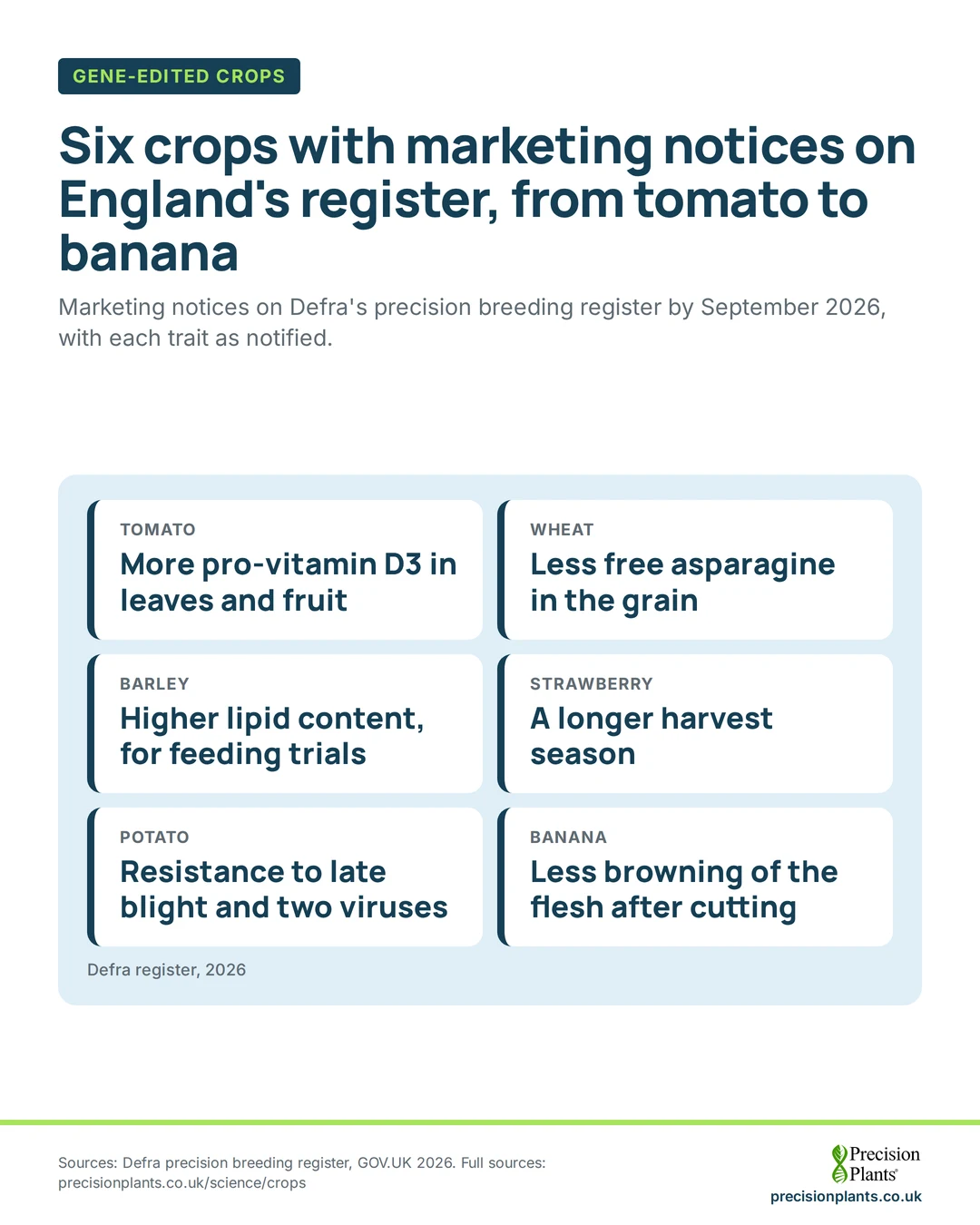
Infographic: Precision Plants. Sources: Department for Environment, Food and Rural Affairs, GOV.UK (2026); Department for Environment, Food and Rural Affairs, GOV.UK (2026); Department for Environment, Food and Rural Affairs, GOV.UK (2026); Department for Environment, Food and Rural Affairs, GOV.UK (2026); Department for Environment, Food and Rural Affairs, GOV.UK (2026); Department for Environment, Food and Rural Affairs, GOV.UK (2026); Department for Environment, Food and Rural Affairs, GOV.UK (2026)
On England's register
Defra publishes every release and marketing notice it receives [1]. Among the marketing notices listed by September 2026 are these:
- Tomato: increased accumulation of pro-vitamin D3, especially in leaves and fruit [2].
- Wheat: reduced free asparagine in the grain, which means less potential for acrylamide in flour [3].
- Barley: higher lipid content, for animal feeding trials [4].
- Strawberry: a longer harvest season from an altered flowering pattern [5].
- Potato: resistance to late blight and two viruses, from a stack of cisgenes [6].
- Banana: less browning of the flesh after it is cut or bruised, from edits to all three copies of the PPO1 gene [8].
What the examples share
The six notices cover nutrition, food safety, feed quality, harvest season, disease resistance and fruit browning [2][3][4][5][6][8]. Some traits already exist in relatives: the strawberry notice says remontancy exists in many wild varieties and some commercial ones [5].
Beyond England
In December 2020 Japan's health and agriculture ministries decided that a genome-edited tomato with raised GABA content would not be regulated as a genetically engineered product [7].
Guides in this section
- Gene-edited food in the UK: What has to happen before precision bred food reaches a shop.
- The gene-edited tomato: Vitamin D tomatoes in England and a high-GABA tomato in Japan.
- Gene editing for climate-resilient crops: Drought and water-use studies in maize, rice and grapevine.
Frequently asked questions
Are there gene-edited crops in the UK?
Yes. Defra's precision breeding register lists release and marketing notices for crops including tomato, wheat, barley, strawberry, potato and banana.
Can I buy gene-edited food in the UK?
Precision bred food needs a marketing authorisation, applied for through the Food Standards Agency, before sale. The FSA reported its first applications under validation in September 2026.
Where can I check a gene-edited crop?
Defra's precision breeding register on GOV.UK publishes each notice, with ACRE advice and the decision.
Which gene-editing methods are there?
Five are widely described. Zinc finger nucleases, TALENs and CRISPR/Cas9 cut both DNA strands at a chosen site, while base editing and prime editing change the sequence without a double-strand break.
References
- Department for Environment, Food and Rural Affairs, GOV.UK (2026). Precision breeding register: notices and decisions
- Department for Environment, Food and Rural Affairs, GOV.UK (2026). Precision bred organism marketing notice (reference: PBM/26/SOLY/001)
- Department for Environment, Food and Rural Affairs, GOV.UK (2026). Precision bred organism marketing notice (reference: PBM/26/TRAE/001)
- Department for Environment, Food and Rural Affairs, GOV.UK (2026). Precision bred organism marketing notice (reference: PBM/25/HOVU/001)
- Department for Environment, Food and Rural Affairs, GOV.UK (2026). Precision bred organism marketing notice (reference: PBM/26/FRAN/008)
- Department for Environment, Food and Rural Affairs, GOV.UK (2026). Precision bred organism marketing notice (reference: PBM/25/SOTU/002)
- US Department of Agriculture, Foreign Agricultural Service (2020). Japan determines genome edited tomato will not be regulated as GE
- Department for Environment, Food and Rural Affairs, GOV.UK (2026). Precision bred organism marketing notice (reference: PBM/26/MUAC/001)
Last reviewed 2026-09-27. Edited by Mark Turner.