Gene editing law in the UK
Published · Updated
England now has its own route for gene-edited plants. Each step is public, and each one is written down in law or official guidance.
Is gene editing legal in the UK?
In England, gene-edited plants that meet the Precision Breeding Act 2023 test are regulated as precision bred organisms, not GMOs. Rules for plants came into force on 13 November 2025. Developers notify Defra, and food or feed also needs Food Standards Agency authorisation.
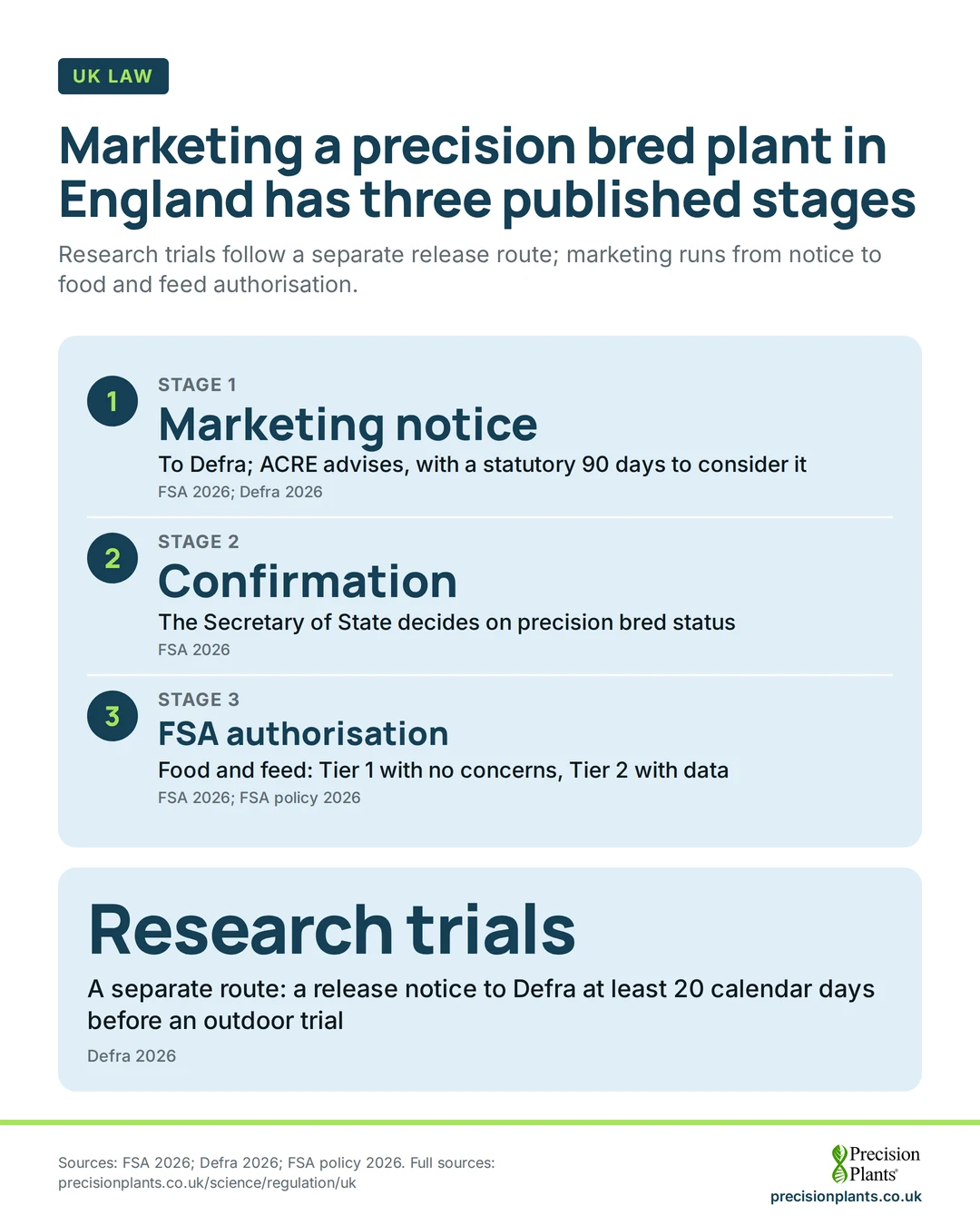
Animation: Precision Plants. Sources: Food Standards Agency (2026); Department for Environment, Food and Rural Affairs, GOV.UK (2026); Food Standards Agency, GOV.UK (2026)
What counts as precision bred
The Genetic Technology (Precision Breeding) Act 2023 treats an organism as precision bred if every feature of its genome produced by modern biotechnology is stable and could have resulted from traditional processes, with or without selection techniques [1]. Traditional processes include sexual fertilisation, spontaneous mutation, induced mutagenesis, embryo rescue and cell fusion [1].
Plants containing DNA not present in the unmodified organism or in sexually compatible species stay classed as GMOs [3].
The notices and decisions
Each stage has its own notice or authorisation, and each is published. Field trials and marketing follow separate routes.
- Research trials: a release notice to Defra at least 20 calendar days before an outdoor research and development trial begins [4].
- Marketing: to market a precision bred plant, a marketing notice to Defra instead; the Advisory Committee on Releases to the Environment advises, with a statutory 90 days to consider it [3][4].
- Confirmation: the Secretary of State decides whether to issue a precision bred confirmation [3].
- Food and feed: a separate marketing authorisation from the Food Standards Agency, which needs that confirmation first [3].
Food and feed: two tiers
Applicants triage their organism against criteria on novelty, nutrition, allergenicity, toxicity and other safety concerns [5]. With no concerns, it is suitable for a Tier 1 application, which can be authorised without an FSA safety assessment. Where a concern is found, a Tier 2 application with supporting data is needed [5].
In September 2026 the FSA told its board that its first applications were undergoing validation checks [6].
Everything is public
Defra publishes release notices, marketing notices, ACRE advice and decisions on the precision breeding register [7]. The FSA must also keep a public register of food and feed marketing authorisations, free to view online [8].
Scotland, Wales and Northern Ireland
Precision breeding is a devolved matter, and the Act generally applies in relation to England only [2]. Under the UK Internal Market Act 2020, precision bred plants and food lawfully marketed in England can be placed on the market in Scotland and Wales. Movements to Northern Ireland must comply with the Windsor Framework [2].
Frequently asked questions
When did the Precision Breeding Regulations come into force?
The Regulations came into force on 13 November 2025, allowing businesses to apply for precision bred food and feed marketing authorisations.
Who decides whether a plant is precision bred?
The Secretary of State for Environment, Food and Rural Affairs, after advice from the Advisory Committee on Releases to the Environment.
Can precision bred food be sold in Scotland?
Under the UK Internal Market Act 2020, precision bred food lawfully marketed in England can also be placed on the market in Scotland and Wales.
Does the law in England favour one gene-editing method?
No. The Act sets the same conditions whatever tool is used: among them, every feature of the genome that results from modern biotechnology must be stable and could have resulted from traditional processes. Zinc finger nucleases, TALENs, CRISPR/Cas9, base editing and prime editing all face that same test.
References
- legislation.gov.uk (2023). Genetic Technology (Precision Breeding) Act 2023, section 1
- legislation.gov.uk (2023). Genetic Technology (Precision Breeding) Act 2023, explanatory notes: territorial extent and application
- Food Standards Agency (2026). Apply for a marketing authorisation (precision bred organisms)
- Department for Environment, Food and Rural Affairs, GOV.UK (2026). Releasing precision bred plants into the environment
- Food Standards Agency, GOV.UK (2026). Policy development: precision breeding
- Food Standards Agency, GOV.UK (2026). Chief Executive's report to the Board: September 2026
- Department for Environment, Food and Rural Affairs, GOV.UK (2026). Precision breeding register: notices and decisions
- legislation.gov.uk (2025). The Genetic Technology (Precision Breeding) Regulations 2025, regulation 35
Last reviewed 2026-09-26. Edited by Mark Turner.