Trait stacking
Published · Updated
One good trait helps. Several in the same plant can help more, and sometimes make each one last longer.
What is trait stacking in crops?
Trait stacking, also called gene stacking or pyramiding, means combining two or more useful genes or traits in a single plant. Breeders do it by crossing parents that each carry a trait, or by adding several changes to the same line, so one variety carries all of them.
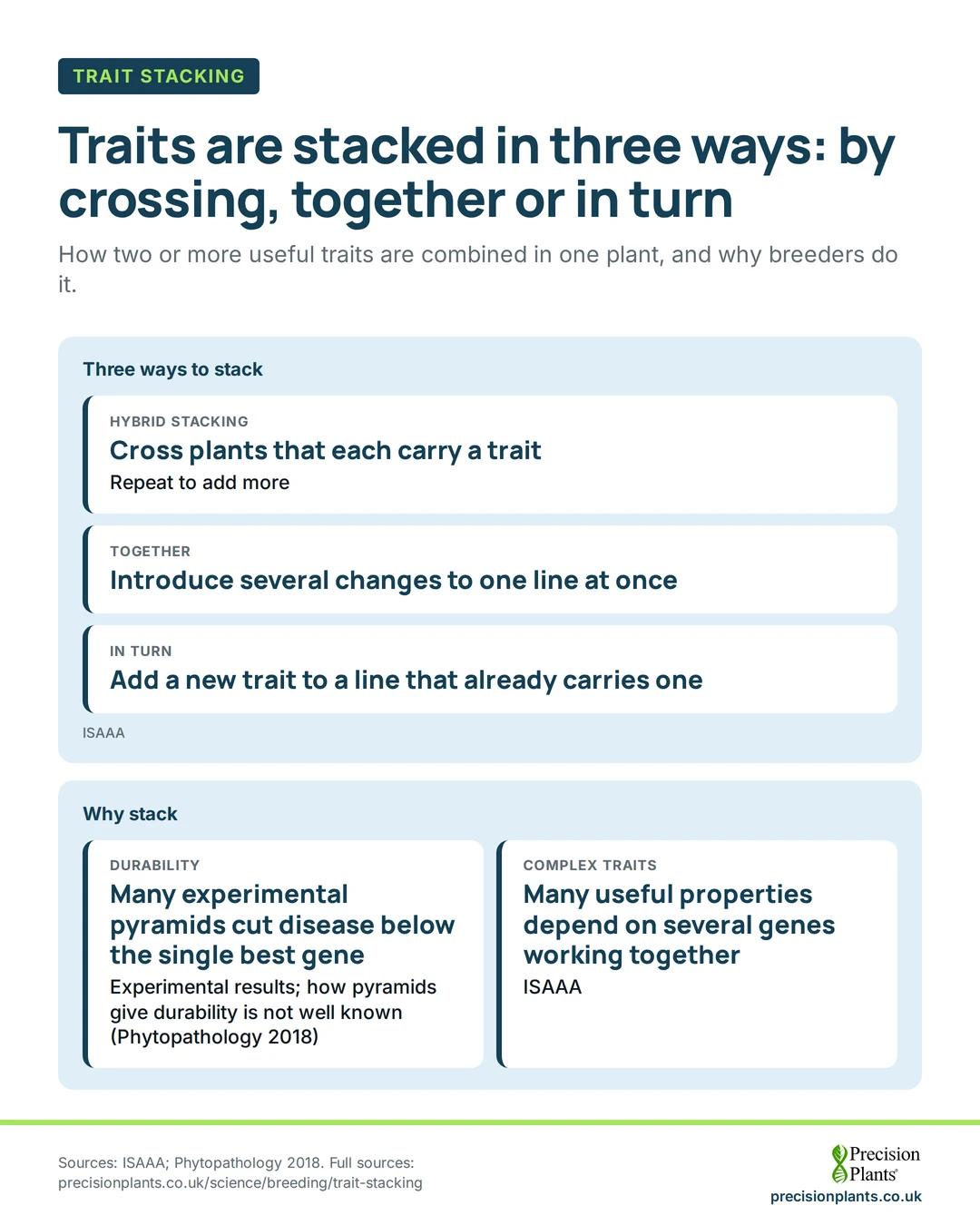
Infographic: Precision Plants. Sources: International Service for the Acquisition of Agri-biotech Applications; Phytopathology (2018)
What stacking means
The International Service for the Acquisition of Agri-biotech Applications defines gene stacking as ‘the process of combining two or more genes of interest into a single plant’, and notes that gene pyramiding refers to the same process [1]. The combined traits are called stacked traits [1].
How traits are combined
The quickest route is to cross parents that carry different traits, an approach known as hybrid stacking [1]. Traits can also be added together or one after another to the same line [1].
DNA markers make stacking practical, because a breeder can check a seedling for every wanted gene at once instead of waiting for each trait to show in the field [2].
Why stack traits?
Durability is the classic reason. Mundt's 2018 review calls combining resistance genes into pyramids ‘an important way to increase durability of resistance’, and reports that many experimental pyramids reduce disease below the level of the single best gene [3].
Complex traits are the other reason. Many useful properties depend on several genes working together, so a single change is not enough [1].
Limits
Stacking is not a shortcut. Mundt notes that the mechanisms by which pyramids give durability ‘are not well known’, and that published examples of classic pyramids succeeding in practice are rare [3]. Each extra trait also means more crosses and more testing, in a process that already takes from six to 20 years [4].
In England, each change made with modern biotechnology must be stable and could have resulted from traditional processes; the test applies to every feature, not just the first [5].
Frequently asked questions
Is trait stacking the same as gene pyramiding?
Yes. The scientific literature uses gene stacking, gene pyramiding and multigene transfer for the same process.
Why does stacking resistance genes help?
A pathogen has to overcome several defences at once. Many experimental pyramids reduce disease below the level of the single best gene.
Does stacking make breeding slower?
Each extra trait needs its own crosses, checks and trials, on top of a process that already takes years.
Which gene-editing methods are there?
Five are widely described. Zinc finger nucleases, TALENs and CRISPR/Cas9 cut both DNA strands at a chosen site, while base editing and prime editing change the sequence without a double-strand break.
References
- International Service for the Acquisition of Agri-biotech Applications. Pocket K No. 42: Stacked traits in biotech crops
- Philosophical Transactions of the Royal Society B, via CGSpace (2008). Marker-assisted selection: an approach for precision plant breeding in the twenty-first century (Collard and Mackill)
- Phytopathology (2018). Pyramiding for resistance durability: theory and practice (Mundt)
- British Society of Plant Breeders. R&D and investment
- legislation.gov.uk (2023). Genetic Technology (Precision Breeding) Act 2023, section 1
Last reviewed 2026-09-26. Edited by Mark Turner.