Gene-edited food in the UK
Published · Updated
A gene-edited food cannot simply appear on a shelf. Two public decisions stand between the field and the shop.
Is gene-edited food sold in the UK?
Precision bred food and feed can be sold in England only after Defra confirms precision bred status and the Food Standards Agency grants a marketing authorisation. In September 2026 the FSA reported that its first applications were undergoing validation checks.
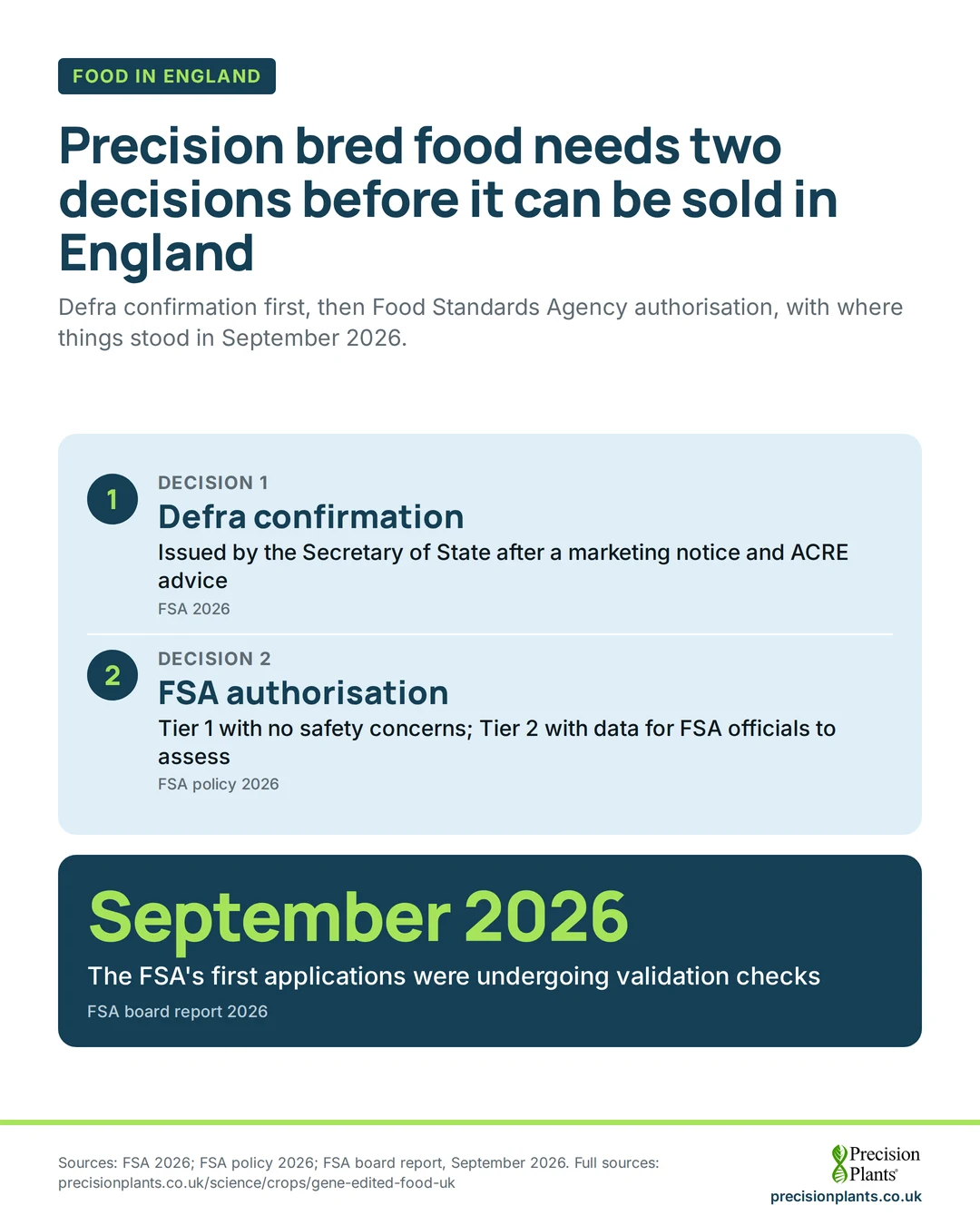
Infographic: Precision Plants. Sources: Food Standards Agency (2026); Food Standards Agency, GOV.UK (2026); Food Standards Agency, GOV.UK (2026)
Two decisions, in order
Before applying to the FSA, a developer needs a precision bred confirmation from the Secretary of State, issued after a marketing notice to Defra and advice from ACRE [1]. Applications without that confirmation are not valid [1].
How the FSA decides
Applicants triage the organism against safety criteria for novelty, nutrition, allergenicity, toxicity and other safety concerns [2]. With no concerns, a Tier 1 application can be authorised without an FSA safety assessment; any concern means a Tier 2 application with data for FSA officials to assess [2].
Where things stand
The FSA told its board in September 2026 that it had received its first market authorisation applications for precision bred organisms, and that they were undergoing validation checks [3].
Confirmation comes first and does not make a plant food. A reduced-browning banana, confirmed precision bred in a letter dated 17 July 2026 and published on Defra's register on 25 September 2026, still needs FSA authorisation before it can be sold as food [5][6].
How to check a product
The FSA must keep a public register of authorised precision bred food and feed, free to view online, linked to each organism's entry on the precision breeding register [4]. Defra's register lists every notice and decision [5].
Frequently asked questions
Who authorises gene-edited food in England?
The Food Standards Agency, after Defra has issued a precision bred confirmation for the organism.
What is a Tier 1 application?
An application for a precision bred organism with no safety concerns identified in triage, which can be authorised without an FSA safety assessment.
Where can I see authorised precision bred food?
On the FSA's public register of precision bred food and feed authorisations, which links to Defra's precision breeding register.
Does the law in England favour one gene-editing method?
No. The Act sets the same conditions whatever tool is used: among them, every feature of the genome that results from modern biotechnology must be stable and could have resulted from traditional processes. Zinc finger nucleases, TALENs, CRISPR/Cas9, base editing and prime editing all face that same test.
References
- Food Standards Agency (2026). Apply for a marketing authorisation (precision bred organisms)
- Food Standards Agency, GOV.UK (2026). Policy development: precision breeding
- Food Standards Agency, GOV.UK (2026). Chief Executive's report to the Board: September 2026
- legislation.gov.uk (2025). The Genetic Technology (Precision Breeding) Regulations 2025, regulation 35
- Department for Environment, Food and Rural Affairs, GOV.UK (2026). Precision breeding register: notices and decisions
- Department for Environment, Food and Rural Affairs, GOV.UK (2026). Precision bred organism marketing notice (reference: PBM/26/MUAC/001)
Last reviewed 2026-09-27. Edited by Mark Turner.