The gene-edited tomato
Published · Updated
Two tomatoes show how gene editing reaches regulators: one in Japan in 2020, one in England in 2026.
What is the gene-edited vitamin D tomato?
Researchers at the John Innes Centre switched off one enzyme in tomato, Sl7-DR2, so that provitamin D3 builds up in the fruit and leaves. After UVB light, one tomato held vitamin D equivalent to two medium eggs. A marketing notice for the tomato appears on England's precision breeding register.
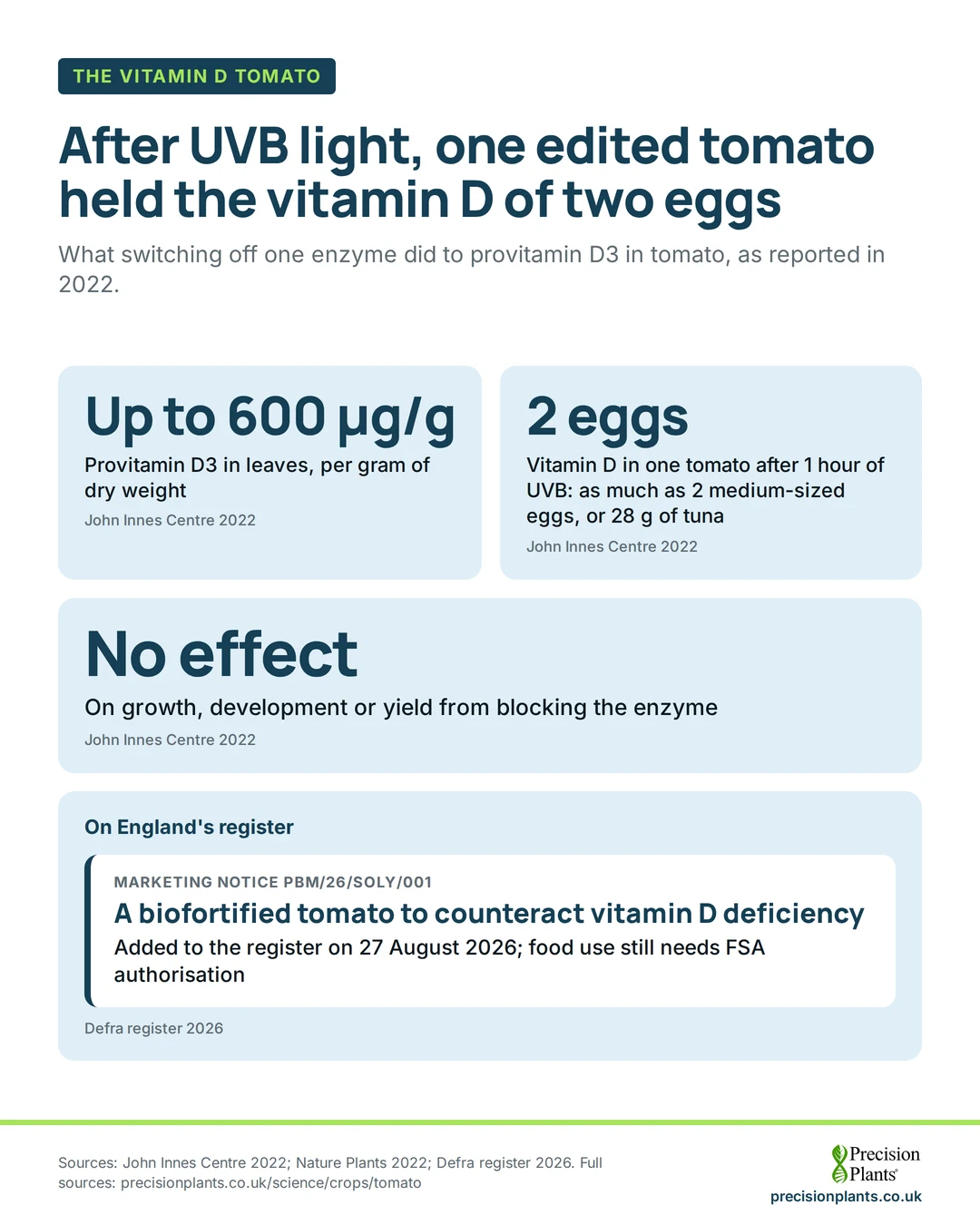
Infographic: Precision Plants. Sources: John Innes Centre (2022); Nature Plants, via PubMed (2022); Department for Environment, Food and Rural Affairs, GOV.UK (2026); Department for Environment, Food and Rural Affairs, GOV.UK (2026)
A tomato with provitamin D3
Tomatoes naturally make a vitamin D building block, provitamin D3 or 7-dehydrocholesterol (7-DHC), at very low levels [1]. The enzyme Sl7-DR2 normally converts it into other molecules; switching that enzyme off lets 7-DHC accumulate in the fruit [1]. The work was published in Nature Plants in 2022 [2].
Leaves of the edited plants contained up to 600 micrograms of provitamin D3 per gram of dry weight [1]. After an hour of UVB light, one tomato contained vitamin D equivalent to two medium-sized eggs or 28 g of tuna [1]. Blocking the enzyme had no effect on growth, development or yield [1].
On England's register
Marketing notice PBM/26/SOLY/001 from the John Innes Centre describes a tomato with ‘increased accumulation of pro-Vitamin D3 in plant tissues, especially leaves and fruits’, intended as a biofortified food to counteract vitamin D deficiency [3]. The notice was added to the register on 27 August 2026 [4].
Japan's high-GABA tomato
On 11 December 2020, Japan's Ministry of Health, Labour and Welfare and its agriculture ministry determined that a genome-edited tomato with increased gamma-aminobutyric acid (GABA) would not be regulated as a genetically engineered product [5].
Frequently asked questions
Can I buy the vitamin D tomato in the UK?
A marketing notice is on Defra's register, but food use also needs a marketing authorisation, applied for through the Food Standards Agency, before sale.
What is 7-DHC?
7-dehydrocholesterol, also called provitamin D3, is a vitamin D building block that UVB light converts into vitamin D3.
Does the change affect how the plant grows?
According to the John Innes Centre, blocking the enzyme had no effect on growth, development or yield.
Which gene-editing methods are there?
Five are widely described. Zinc finger nucleases, TALENs and CRISPR/Cas9 cut both DNA strands at a chosen site, while base editing and prime editing change the sequence without a double-strand break.
References
- John Innes Centre (2022). Gene-edited tomatoes could be a new source of vitamin D
- Nature Plants, via PubMed (2022). Biofortified tomatoes provide a new route to vitamin D sufficiency (Li and others)
- Department for Environment, Food and Rural Affairs, GOV.UK (2026). Precision bred organism marketing notice (reference: PBM/26/SOLY/001)
- Department for Environment, Food and Rural Affairs, GOV.UK (2026). Precision breeding register: notices and decisions
- US Department of Agriculture, Foreign Agricultural Service (2020). Japan determines genome edited tomato will not be regulated as GE
Last reviewed 2026-09-26. Edited by Mark Turner.