Gene editing for climate-resilient crops
Published · Updated
Hotter, drier summers are coming to the UK. A handful of studies show what gene editing can and cannot yet do about drought.
Can gene editing make crops more climate resilient?
Published studies show gains for single traits. In one field study, edited maize gave about five bushels an acre more grain under drought stress at flowering, with no yield loss when plants were well watered.
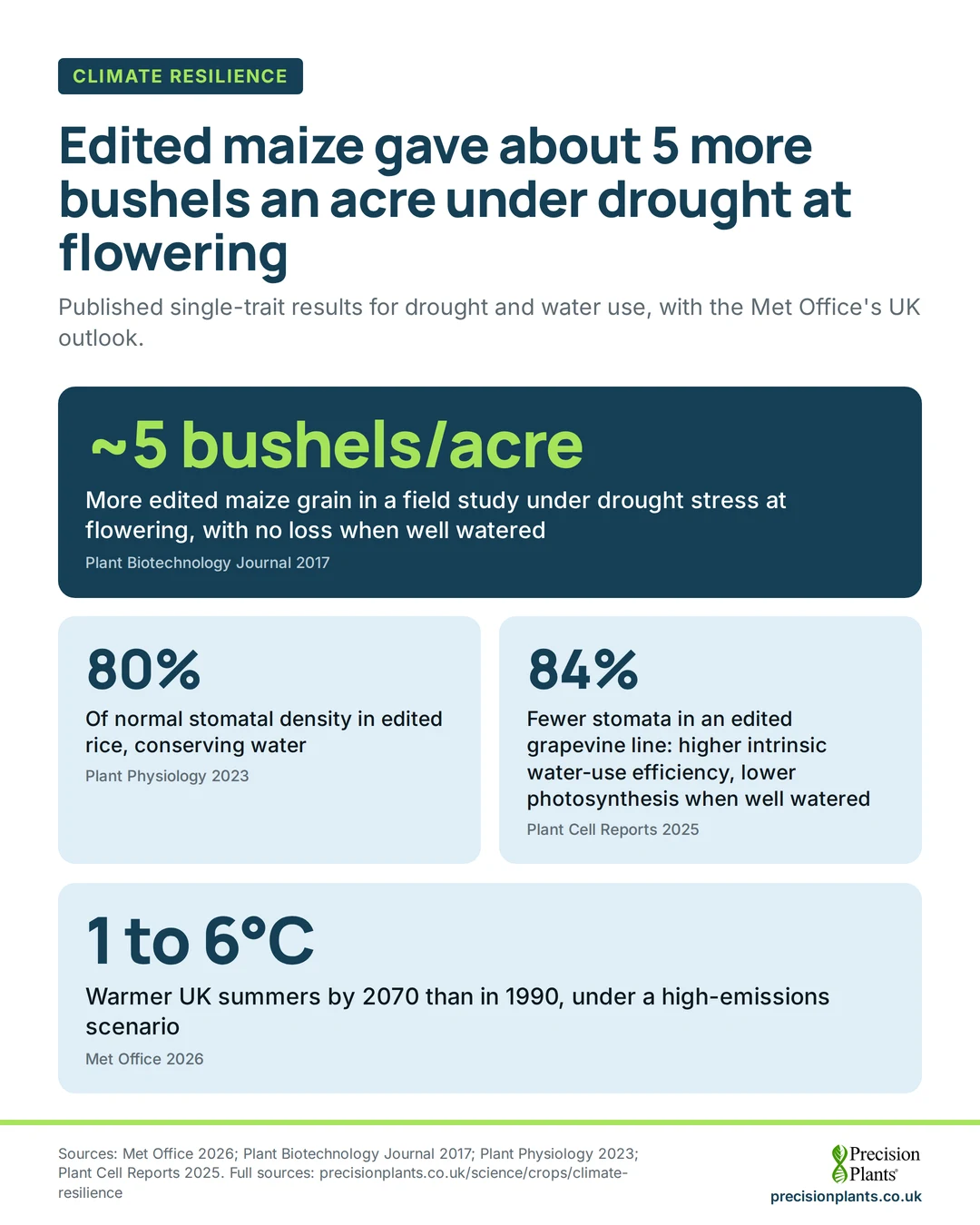
Infographic: Precision Plants. Sources: Met Office (2026); Plant Biotechnology Journal, via PubMed Central (2017); Plant Physiology (2023); Plant Cell Reports, via PubMed Central (2025)
Why climate traits matter in the UK
Met Office projections under a high-emissions scenario put UK summers 1 to 6°C warmer by 2070 than in 1990, and up to 60% drier depending on the region [1]. Hot summer days are projected to be 4 to 7°C warmer [1].
The Met Office expects more droughts to disrupt the growing season, and says some crops grown today may not suit higher temperatures [1]. Globally, the Intergovernmental Panel on Climate Change (IPCC) finds that human-induced warming has slowed growth of agricultural productivity over the past 50 years [2].
Five gene-editing methods in crop research
Plant scientists group gene-editing tools into families. Zinc finger nucleases (ZFNs), TALENs and CRISPR/Cas9 cut DNA at a chosen site, and the plant's own repair makes the change [8]. Base editing and prime editing change DNA letters without a double-strand break [8][9].
A 2023 review of drought, heat, salt and cold tolerance in crops explains all five methods [8]. England's Precision Breeding Act applies the same test whichever method is used: every feature of the plant's genome resulting from modern biotechnology must be stable and could have resulted from traditional processes [10].
Drought: maize with a stronger ARGOS8 gene
ARGOS8 is a maize gene that dampens the plant's response to the stress hormone ethylene [4]. Researchers inserted maize's own GOS2 promoter in front of ARGOS8, or used it to replace the native promoter, so the gene was expressed at a moderate, steady level throughout the plant [3].
In a field study the edited maize gave five bushels per acre more grain than unedited plants under drought stress at flowering, with no yield loss when well watered [3].
Water use: fewer leaf pores
Plants lose most of their water through stomata, the small pores on their leaves. Fewer stomata can save water, but can also cut the carbon dioxide a leaf takes in for photosynthesis.
In rice, switching off the gene EPFL10 left plants with 80% of the normal stomatal density [5]. These lines conserved water about as well as lines with far fewer stomata, without the drop in stomatal conductance, carbon assimilation or leaf cooling seen in those lines [5].
In grapevine, a line with 84% fewer stomata after editing the gene EPFL9-2 showed higher intrinsic water-use efficiency under both well-watered and water-stressed conditions, although its photosynthesis was lower when well watered [6]. A line with about 60% fewer stomata kept photosynthesis comparable to unedited vines [6].
From the lab to the field
The IPCC's assessment is cautious. It finds that genetic improvements for climate adaptation using modern biotechnology have not reliably translated into the field, while conventional breeding has made good progress [2]. It adds that gene editing may in future improve that translation, with medium agreement and limited evidence [2].
When the Precision Breeding Act became law in 2023, the UK government said gene editing could help develop crop varieties more resilient to drought and heat as the climate changes [7].
Frequently asked questions
Which gene-editing methods does climate-trait research discuss?
Reviews of drought, heat and salt tolerance discuss five methods: zinc finger nucleases, TALENs, CRISPR/Cas9, base editing and prime editing. The first three cut DNA at a chosen site; base and prime editing change DNA letters without a double-strand break.
How will UK summers change?
Under a high-emissions scenario, the Met Office projects summers 1 to 6°C warmer by 2070 than in 1990, and up to 60% drier depending on the region.
Do fewer stomata mean less photosynthesis?
Not always. Rice lines with 80% of the normal stomatal density kept normal photosynthesis at current carbon dioxide levels, and a grapevine line with about 60% fewer stomata matched unedited vines.
Are gene-edited drought-tolerant crops on farms yet?
Field results are still few. The IPCC's 2022 assessment found that biotechnology gains for climate adaptation have not reliably translated into the field, though gene editing may help in future.
References
- Met Office (2026). Climate change in the UK
- Intergovernmental Panel on Climate Change (2022). Chapter 5: Food, Fibre and Other Ecosystem Products (AR6 Working Group II)
- Plant Biotechnology Journal, via PubMed Central (2017). ARGOS8 variants improve maize grain yield under field drought stress conditions (Shi and others, title shortened)
- Genetics and Molecular Biology, via PubMed Central (2023). Genome editing in maize: toward improving complex traits in a global crop (Hernandes-Lopes and others)
- Plant Physiology (2023). Paralog editing tunes rice stomatal density to maintain photosynthesis and improve drought tolerance (Karavolias and others)
- Plant Cell Reports, via PubMed Central (2025). Reduced stomatal density improves water-use efficiency in grapevine under climate scenarios of decreased water availability (Shahbaz and others)
- Department for Environment, Food and Rural Affairs, GOV.UK (2023). Genetic Technology Act key tool for UK food security
- Life, via PubMed Central (2023). Genome Editing and Improvement of Abiotic Stress Tolerance in Crop Plants (Yadav and others)
- Frontiers in Genome Editing (2025). A long journey towards genome editing technologies in plants: a technical and critical review of genome editing technologies (Gallo and others)
- legislation.gov.uk (2023). Genetic Technology (Precision Breeding) Act 2023, section 1
Last reviewed 2026-09-26. Edited by Mark Turner.