Gene editing regulation
Published · Updated
The same edit can be a conventional plant in one country and a GMO in another. What decides it is the law, not the laboratory.
How is gene editing regulated?
Many regulators ask whether an edited plant could have arisen by traditional breeding. England treats such plants as precision bred rather than GMOs. The EU has adopted rules that treat category 1 NGT plants like conventional ones from July 2028. Japan excludes simple edits without foreign DNA from GMO rules.
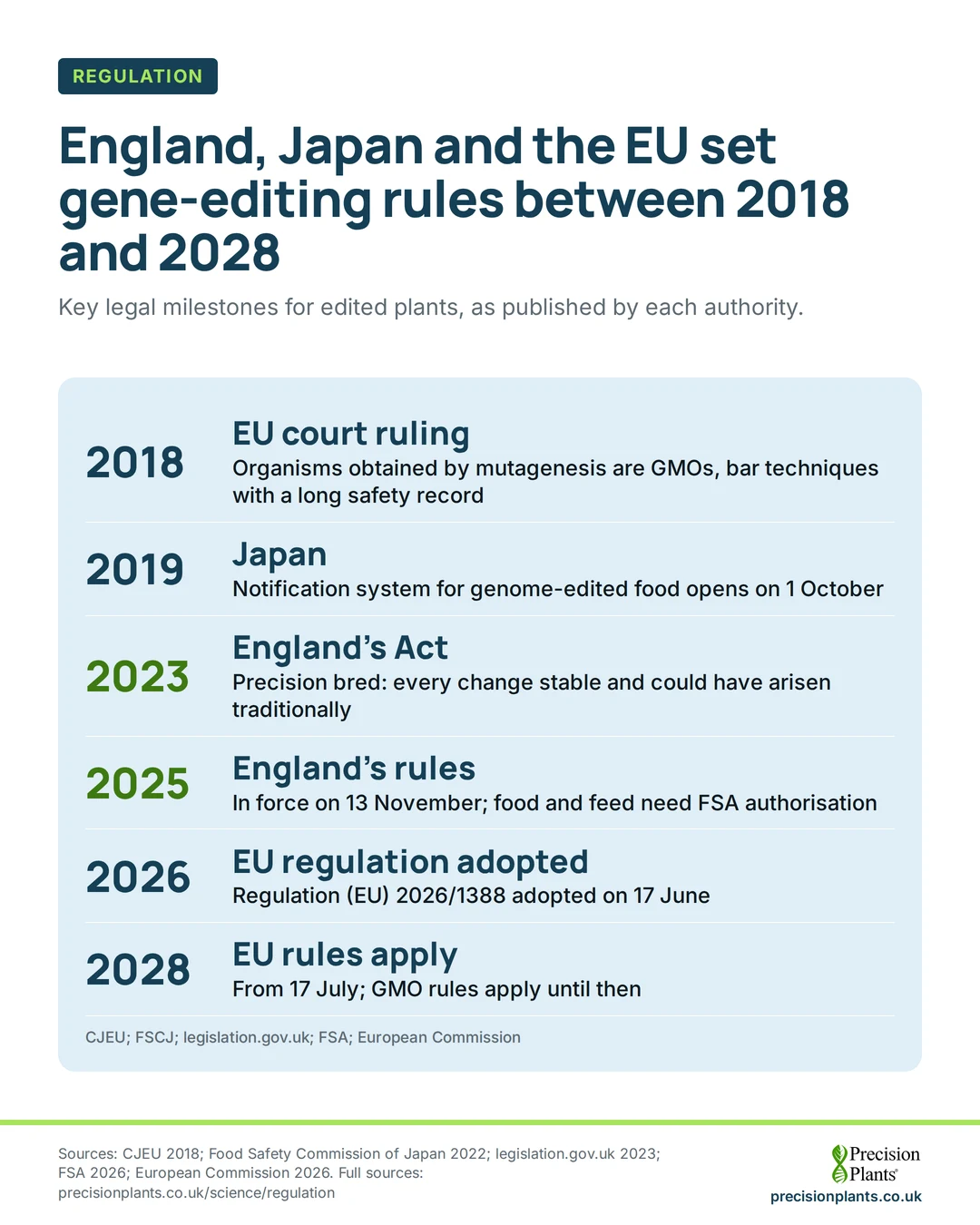
Animation: Precision Plants. Sources: legislation.gov.uk (2023); Food Standards Agency (2026); Court of Justice of the European Union (2018); European Commission, Directorate-General for Health and Food Safety (2026); Food Safety, Food Safety Commission of Japan, via J-STAGE (2022)
The question regulators ask
Older GMO laws were written around the process used. Newer rules look more at the result: whether the plant carries DNA from an unrelated species, and whether its changes could have come about through traditional breeding. England's Act defines a precision bred organism in exactly these terms [1].
England
England's Precision Breeding Regulations 2025 came into force on 13 November 2025 [2]. A plant is precision bred only if every change made with modern biotechnology is stable and could have resulted from traditional processes [1]. Food and feed from such plants still needs a Food Standards Agency authorisation [2].
European Union
In 2018 the Court of Justice of the European Union ruled that organisms obtained by mutagenesis are GMOs, apart from techniques with a long safety record [3]. On 17 June 2026 the EU adopted Regulation (EU) 2026/1388, which entered into force on 16 July 2026 and will apply from 17 July 2028 [4]. Until then, such plants remain subject to the existing GMO rules [4].
Japan
Japan began its pre-submission consultation and notification system for genome-edited food on 1 October 2019 [5]. Products with no remaining foreign genes can be sold after notification; products that keep foreign DNA are treated as GM foods and assessed as such [5].
Guides in this section
- Gene editing law in the UK: The Precision Breeding Act, notices, the register and food authorisation.
- EU new genomic techniques: Regulation (EU) 2026/1388: the two categories, labelling and dates.
Frequently asked questions
Are gene-edited plants GMOs?
Legal status depends on the jurisdiction. England treats qualifying plants as precision bred, not GMOs; EU GMO rules apply until July 2028; Japan excludes simple edits without foreign DNA.
When does the EU's new genomic techniques law apply?
Regulation (EU) 2026/1388 entered into force on 16 July 2026 and applies from 17 July 2028.
Does England's law cover Scotland and Wales?
England's rules apply in England. Under the UK Internal Market Act 2020, products lawfully marketed in England can also be placed on the market in Scotland and Wales.
Does the law in England favour one gene-editing method?
No. The Act sets the same conditions whatever tool is used: among them, every feature of the genome that results from modern biotechnology must be stable and could have resulted from traditional processes. Zinc finger nucleases, TALENs, CRISPR/Cas9, base editing and prime editing all face that same test.
References
- legislation.gov.uk (2023). Genetic Technology (Precision Breeding) Act 2023, section 1
- Food Standards Agency (2026). Apply for a marketing authorisation (precision bred organisms)
- Court of Justice of the European Union (2018). Organisms obtained by mutagenesis are GMOs and are, in principle, subject to the obligations laid down by the GMO Directive (Case C-528/16)
- European Commission, Directorate-General for Health and Food Safety (2026). EU legislation on new genomic techniques for plants
- Food Safety, Food Safety Commission of Japan, via J-STAGE (2022). Japanese regulatory framework and approach for genome-edited foods based on latest scientific findings (Kondo and Taguchi)
Last reviewed 2026-09-26. Edited by Mark Turner.