The EU's new genomic techniques regulation
Published · Updated
After years of debate, the EU has a law for gene-edited plants. It is in force, but most of it does not apply until July 2028.
What is the EU NGT regulation?
Regulation (EU) 2026/1388 sets rules for plants obtained by targeted mutagenesis and cisgenesis. Category 1 plants, comparable to conventional ones, will be treated like conventional plants once verified; category 2 plants stay under GMO rules. The regulation entered into force on 16 July 2026 and applies from 17 July 2028.
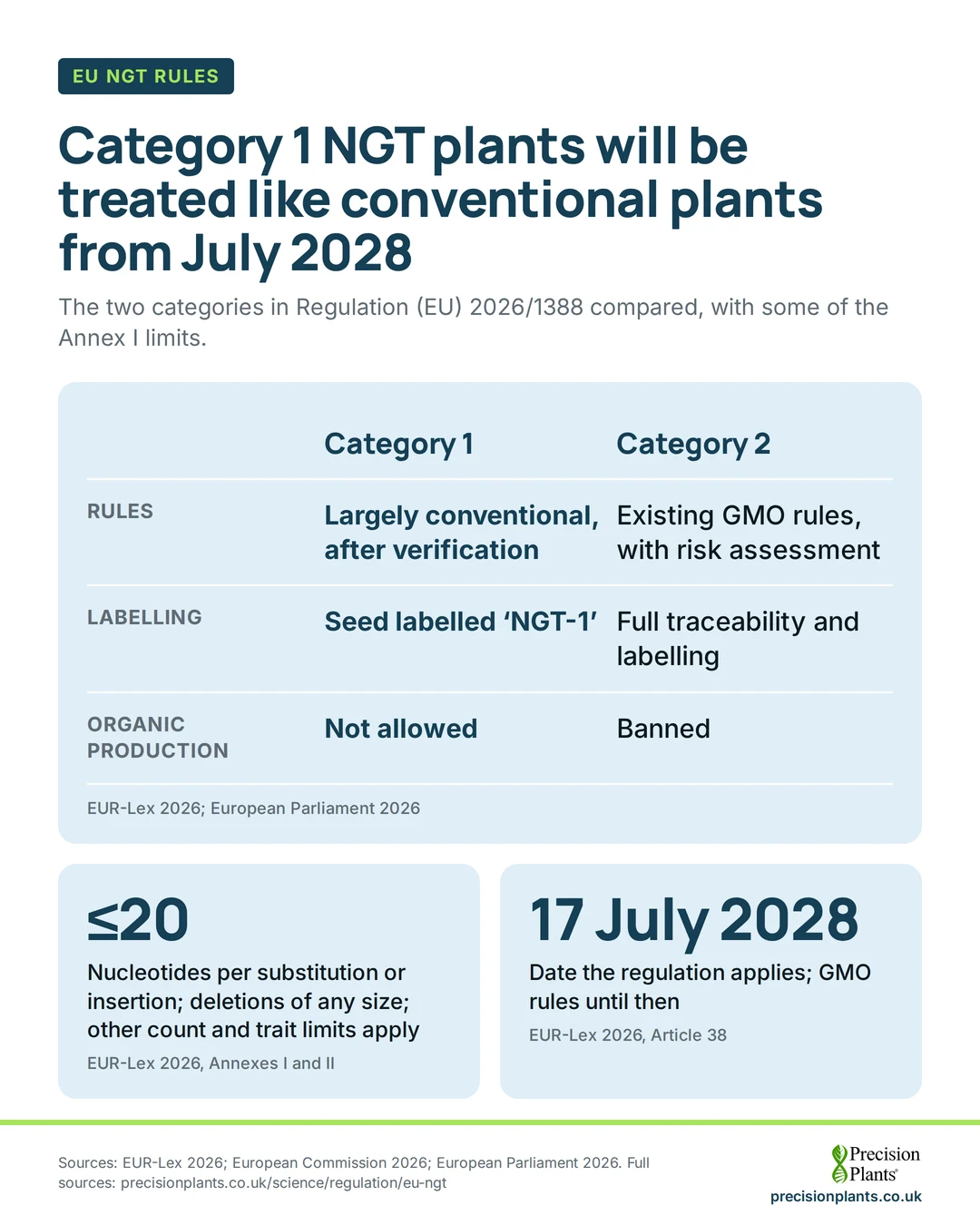
Infographic: Precision Plants. Sources: EUR-Lex, Official Journal of the European Union (2026); European Commission, Directorate-General for Health and Food Safety (2026); European Parliament press room (2026)
The key dates
The European Parliament and the Council adopted the regulation on 17 June 2026 [2]. It was published in the Official Journal on 26 June 2026 and entered into force 20 days later [3]. Article 38 sets the date of application at 17 July 2028, with a few articles applying from 16 July 2026 [1]. Until 2028, these plants remain subject to the existing GMO rules [2].
What it covers
The regulation covers plants obtained by targeted mutagenesis and cisgenesis, including intragenesis [3], and to their food, feed and other products [1]. Plants carrying genetic material from non-crossable species are still treated as classical GMOs [3].
Category 1: comparable to conventional
Annex I sets the equivalence criteria. For targeted mutagenesis, each change must be a substitution or insertion of no more than 20 nucleotides, or a deletion of any size, with no more than three per protein-coding sequence [1]. Across all types, the total must not exceed 20 per monoploid genome [1].
Plants with herbicide tolerance or producing a known insecticidal substance cannot be category 1 (Annex II) [1]. Once verified, GMO rules do not apply to a category 1 plant (Article 5) [1].
| Question | Category 1 | Category 2 |
|---|---|---|
| Which rules apply? | Largely those for conventional plants, after verification [1] | Existing GMO rules, with risk assessment [4] |
| Authorisation needed? | Verification of category 1 status [3] | Yes, before being sold in the EU [4] |
| Labelling | Seed and reproductive material labelled ‘NGT-1’ [1] | Full traceability and labelling [4] |
| Organic production | Not allowed; unavoidable traces are not non-compliance [1] | Banned [1] |
Labels, databases and national choices
Plant reproductive material containing category 1 NGT plants must carry the label ‘NGT-1’ with the plant's identification number (Article 10) [1]. The Commission will keep a database of category 1 decisions (Article 9) [1], and varieties will be listed in a public EU database [4]. Member states may restrict or prohibit cultivation of category 2 plants [4].
Patents are possible, except for traits or sequences occurring in nature or produced by biological means [4].
Frequently asked questions
Is gene-edited food allowed in the EU?
Under Regulation (EU) 2026/1388, category 1 plants will be treated like conventional plants from 17 July 2028. Until then, existing GMO rules apply.
Will NGT food be labelled in the EU?
Seed and reproductive material of category 1 plants must be labelled ‘NGT-1’. Category 2 products keep full GMO labelling and traceability.
Can NGT plants be grown organically?
No. NGTs are not allowed in organic production, though technically unavoidable presence of category 1 plants is not treated as non-compliance.
Which gene-editing methods are there?
Five are widely described. Zinc finger nucleases, TALENs and CRISPR/Cas9 cut both DNA strands at a chosen site, while base editing and prime editing change the sequence without a double-strand break.
References
- EUR-Lex, Official Journal of the European Union (2026). Regulation (EU) 2026/1388 on plants obtained by certain new genomic techniques and their products
- European Commission, Directorate-General for Health and Food Safety (2026). EU legislation on new genomic techniques for plants
- Federal Office of Consumer Protection and Food Safety (BVL), Germany (2026). New regulation on NGT plants in the EU
- European Parliament press room (2026). New genomic techniques for plants to boost innovation in sustainable agriculture
Last reviewed 2026-09-26. Edited by Mark Turner.