Gene editing vs GMO
Published · Updated
The difference is not the laboratory. It is what ends up in the plant, and whether the same change could have come from breeding.
What is the difference between gene editing and GMO?
A genetically modified organism carries genetic material altered in a way that does not occur naturally through mating, often with DNA from another species. A precision bred plant can contain only changes that could have arisen through traditional breeding, with no transgenic material left.
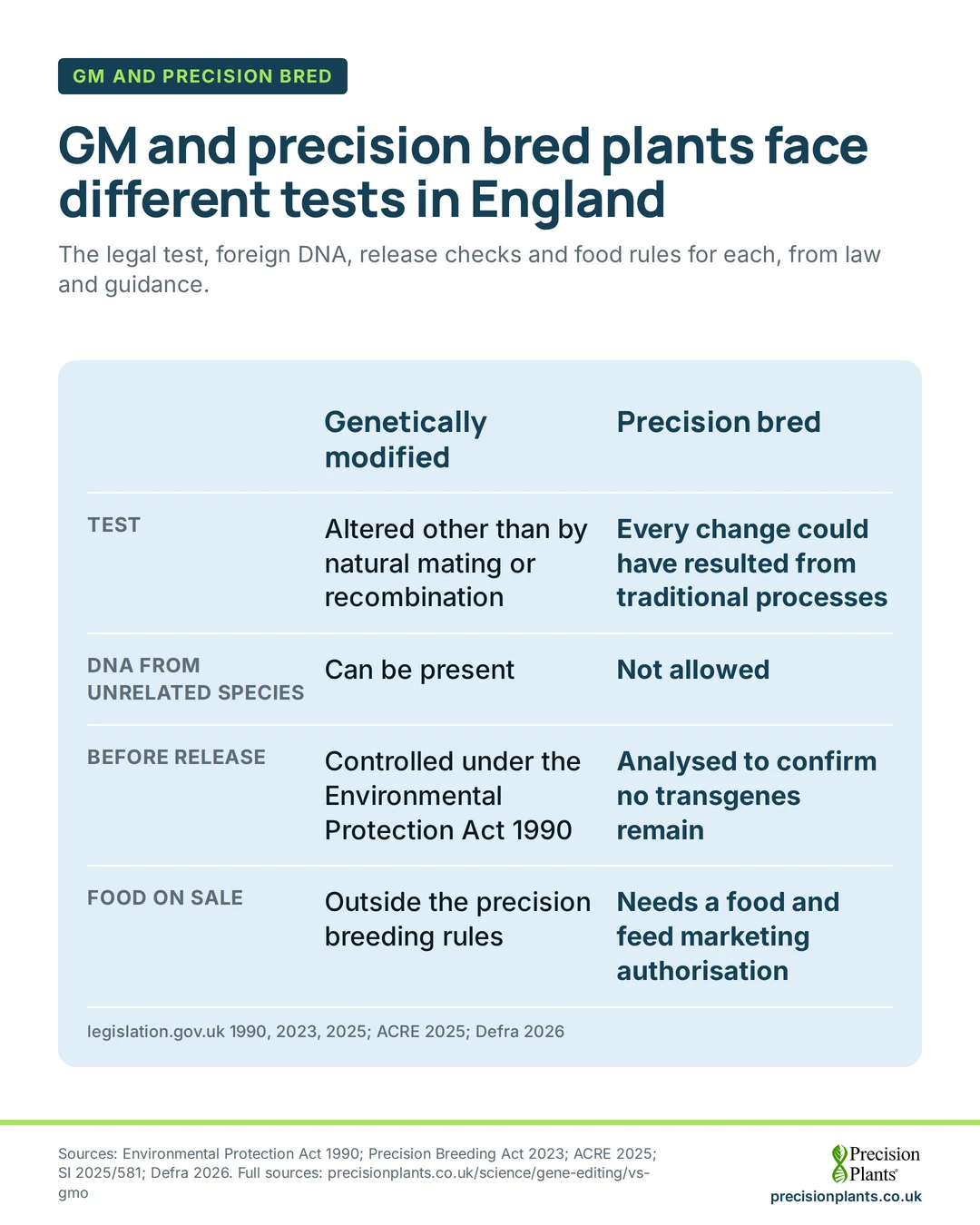
Infographic: Precision Plants. Sources: legislation.gov.uk (1990); legislation.gov.uk (2023); Advisory Committee on Releases to the Environment, GOV.UK (2025); legislation.gov.uk (2025); Department for Environment, Food and Rural Affairs, GOV.UK (2026)
What a GMO is in law
In UK law, an organism is genetically modified if any of its genetic material has been altered otherwise than by a process that occurs naturally in mating or natural recombination [1]. EU law uses a similar definition [2].
What precision bred means
The Genetic Technology (Precision Breeding) Act 2023 sets a four-part test. Each change made with modern biotechnology must be one that could have resulted from traditional processes, with or without selection techniques [3]. A plant is not precision bred if it contains transgenic material, and any inserted DNA must come from a sexually compatible species [4].
Side by side
The main differences, as set out in law and guidance.
| Genetically modified | Precision bred | |
|---|---|---|
| Test | Genetic material altered other than by natural mating or recombination [1] | Every change could have resulted from traditional processes [3] |
| DNA from unrelated species | Can be present, from any source [1] | Not allowed [4] |
| Before release | Controlled under the Environmental Protection Act 1990 [1] | Analysed to confirm no transgenes remain [8] |
| Food on sale | Outside the precision breeding rules [6] | Needs a food and feed marketing authorisation [6] |
The EU position
In 2018 the Court of Justice of the European Union ruled that organisms obtained by mutagenesis are GMOs under the GMO Directive, except for techniques with a long safety record [5]. A 2021 European Commission study found strong indications that the legislation is not fit for purpose for some new genomic techniques [7]. The EU then adopted Regulation (EU) 2026/1388 on new genomic techniques, which entered into force on 16 July 2026 and applies from 17 July 2028 [9].
Frequently asked questions
Is gene-edited food GMO?
In England, not if it meets the precision breeding test. In the EU, the 2018 court ruling placed such organisms under GMO law, and GMO rules apply until Regulation (EU) 2026/1388 on new genomic techniques applies from 17 July 2028.
Does the precision breeding law apply across the UK?
The rules for precision bred plants and food apply in England.
Can a gene-edited plant become a GMO?
Yes. If it still contains transgenic material, or a change that could not have come from traditional breeding, it is not precision bred.
Does the law in England favour one gene-editing method?
No. The Act sets the same conditions whatever tool is used: among them, every feature of the genome that results from modern biotechnology must be stable and could have resulted from traditional processes. Zinc finger nucleases, TALENs, CRISPR/Cas9, base editing and prime editing all face that same test.
References
- legislation.gov.uk (1990). Environmental Protection Act 1990, section 106
- EUR-Lex, Official Journal of the European Communities (2001). Directive 2001/18/EC on the deliberate release into the environment of genetically modified organisms
- legislation.gov.uk (2023). Genetic Technology (Precision Breeding) Act 2023, section 1
- Advisory Committee on Releases to the Environment, GOV.UK (2025). ACRE guidance on producing precision bred plants
- Court of Justice of the European Union (2018). Organisms obtained by mutagenesis are GMOs and are, in principle, subject to the obligations laid down by the GMO Directive (Case C-528/16)
- legislation.gov.uk (2025). The Genetic Technology (Precision Breeding) Regulations 2025, Part 7
- European Commission (2021). EC study on new genomic techniques
- Department for Environment, Food and Rural Affairs, GOV.UK (2026). Releasing precision bred plants into the environment
- EUR-Lex, Official Journal of the European Union (2026). Regulation (EU) 2026/1388 on plants obtained by certain new genomic techniques and their products
Last reviewed 2026-09-26. Edited by Mark Turner.