Plant breeding methods
Published · Updated
Every crop variety on a farm began as a choice: which plants to cross, which offspring to keep, and which to test again next year.
What are the main plant breeding methods?
Plant breeders cross parent plants and select the best offspring, sometimes adding variation by inducing mutations. DNA markers and genomic prediction help them choose earlier, and controlled lighting can shorten each generation. Precision breeding makes targeted changes that could have arisen through traditional processes.
Infographic: Precision Plants. Sources: British Society of Plant Breeders; Nature Plants (2018)
Crossing and selection
The oldest method is still the backbone of modern breeding: cross two parents, grow the offspring, and keep the best. English law lists sexual fertilisation, spontaneous mutation, induced mutagenesis, embryo rescue and cell fusion among the traditional processes of plant breeding [1].
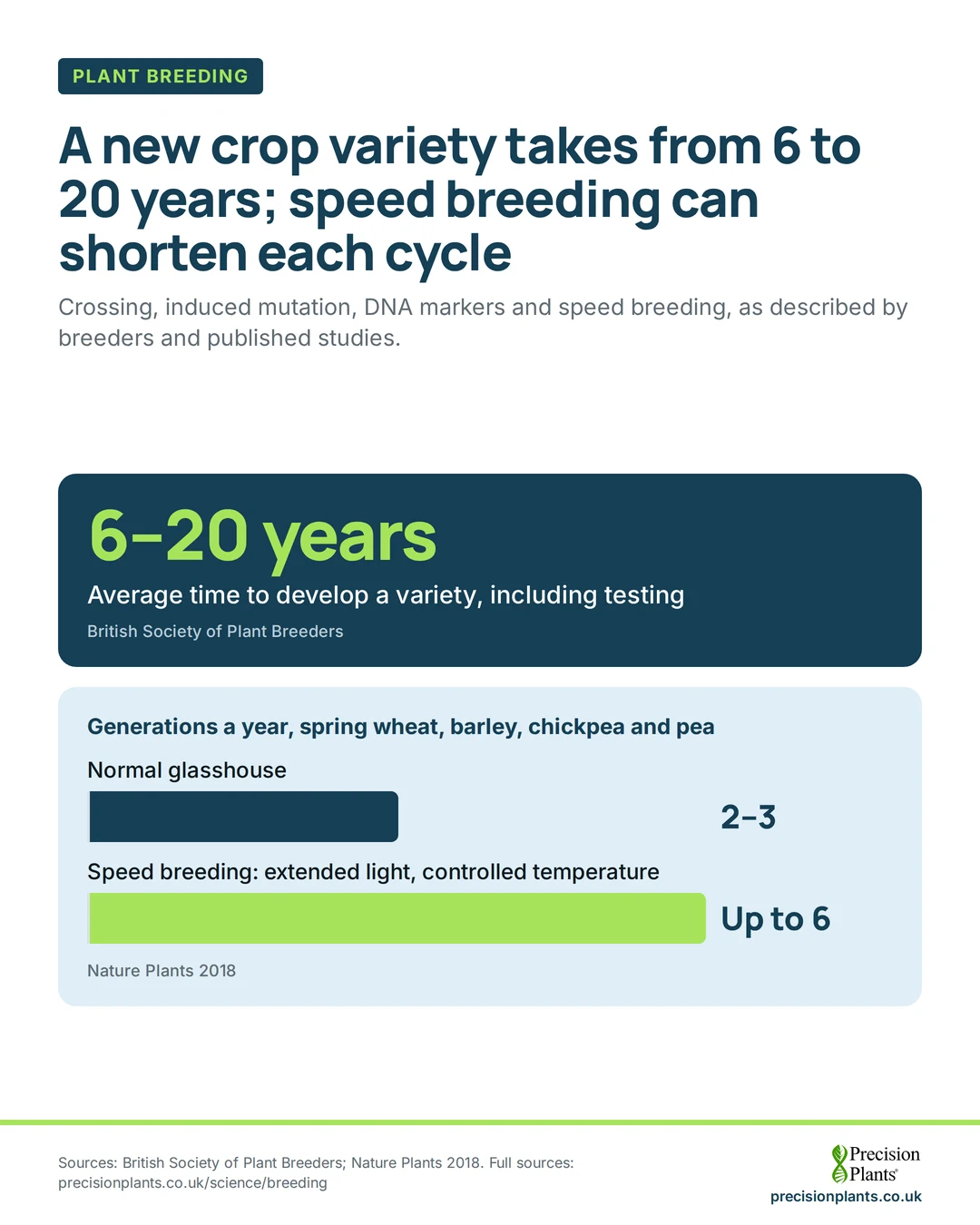
Selection is slow because most lines fail. The British Society of Plant Breeders puts the average time to develop a variety at as little as six years and, in some cases, as much as 20, including extensive testing [2].
Adding variation
Breeders can only select what already exists. Where the right variation is missing, mutations can be induced with radiation or chemicals. The FAO and IAEA note that induced mutations help ‘when conventional breeding techniques fail for the lack of appropriate genetic variation’ [3].
The joint FAO/IAEA database lists more than 3,200 officially released mutant varieties of agricultural and horticultural crops [3].
Choosing sooner, cycling faster
DNA markers let breeders check which versions of a gene a seedling carries before it ever reaches the field. Collard and Mackill described marker-assisted selection as a way to improve ‘the efficiency and precision of conventional plant breeding’ [4]. Genomic selection extends the idea to thousands of markers at once, which ‘facilitates the rapid selection of superior genotypes and accelerates the breeding cycle’ [5].
Speed breeding uses extended light and controlled temperature. It achieved up to six generations a year for spring wheat, durum wheat, barley, chickpea and pea, against two to three under normal glasshouse conditions [6].
Precision breeding
Precision breeding makes a targeted change to a plant's DNA. In England, a plant counts as precision bred only if every such change is stable and could have resulted from traditional processes [1]. The next pages compare it with conventional methods and explain how several traits are brought together in one variety.
Guides in this section
- Conventional vs precision breeding: What changes, what stays the same, and what the law compares.
- Trait stacking: How several useful traits are brought together in one variety.
Frequently asked questions
How long does it take to breed a new crop variety?
The British Society of Plant Breeders puts the average at as little as six years and, in some cases, as much as 20, including testing.
Is mutation breeding new?
No. The FAO and IAEA have kept a database of released mutant varieties for decades, and it now lists more than 3,200 of them.
What makes a plant precision bred in England?
Every change made with modern biotechnology must be stable and must be one that could have resulted from traditional processes.
Does the law in England favour one gene-editing method?
No. The Act sets the same conditions whatever tool is used: among them, every feature of the genome that results from modern biotechnology must be stable and could have resulted from traditional processes. Zinc finger nucleases, TALENs, CRISPR/Cas9, base editing and prime editing all face that same test.
References
- legislation.gov.uk (2023). Genetic Technology (Precision Breeding) Act 2023, section 1
- British Society of Plant Breeders. R&D and investment
- Joint FAO/IAEA Division of Nuclear Techniques in Food and Agriculture (2016). Mutation breeding for crop improvement
- Philosophical Transactions of the Royal Society B, via CGSpace (2008). Marker-assisted selection: an approach for precision plant breeding in the twenty-first century (Collard and Mackill)
- Trends in Plant Science, via FAO AGRIS (2017). Genomic selection in plant breeding: methods, models, and perspectives (Crossa and others)
- Nature Plants (2018). Speed breeding is a powerful tool to accelerate crop research and breeding (Watson and others)
Last reviewed 2026-09-26. Edited by Mark Turner.