Transgene-free gene editing
Published
The edit should stay. The tool that made it should not. There are two ways to get there.
What is transgene-free gene editing?
Transgene-free gene editing produces a plant that carries the intended edit but no DNA from the editing tool. Either the tool's DNA is bred out by crossing or selfing after the edit is made, or the tool is delivered as RNA or protein that never enters the genome.
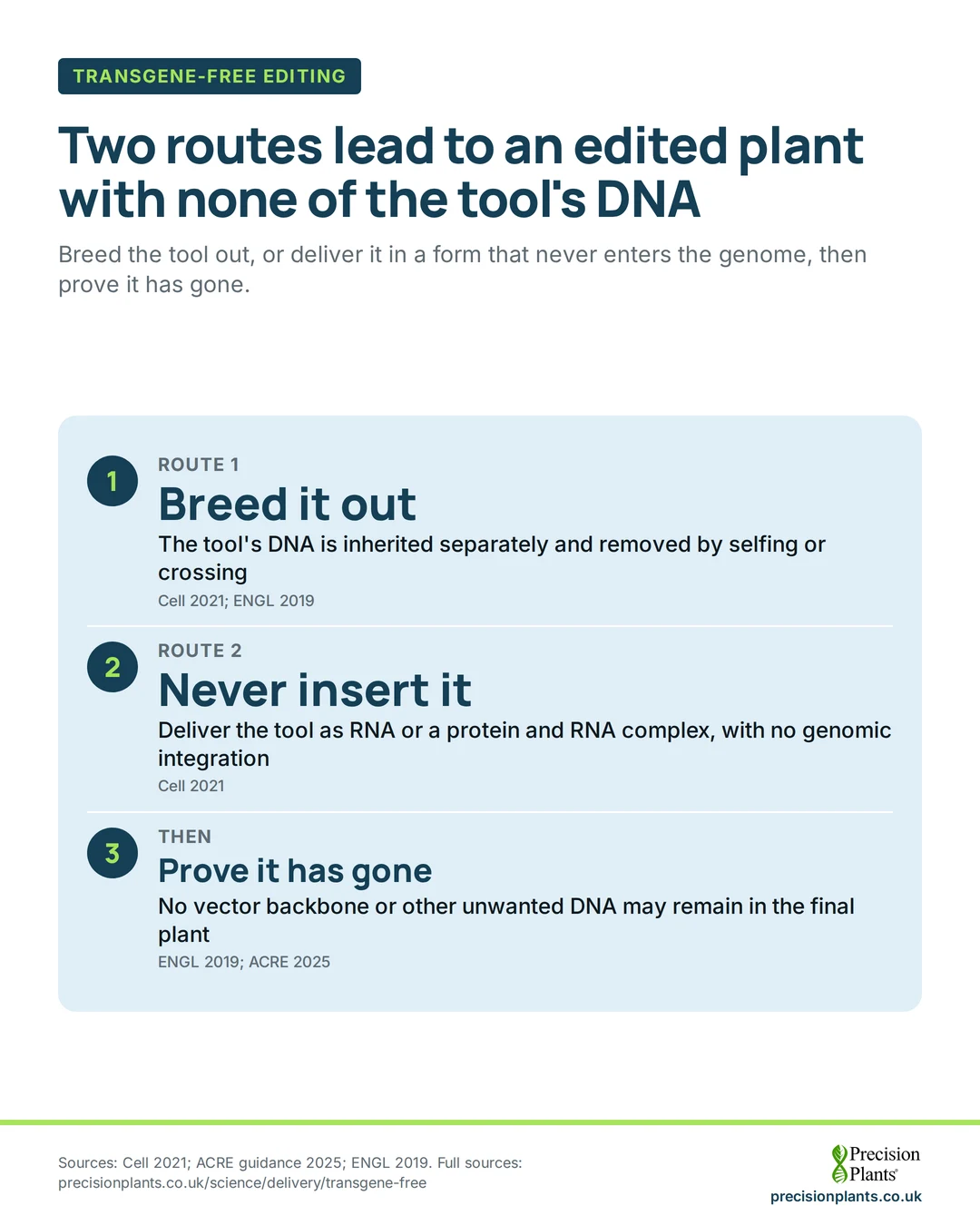
Infographic: Precision Plants. Sources: Cell (2021); Advisory Committee on Releases to the Environment, GOV.UK (2025); European Network of GMO Laboratories, European Commission Joint Research Centre (2019)
Why it matters
In England, a plant is not precision bred if it contains transgenic material. ACRE's guidance names editing cassettes, selectable markers and vector genes as examples [2]. Before a plant is released, it must be analysed to confirm that no transgenes remain [3].
Route 1: breed the tool out
Many edits start with the tool's DNA inserted in the genome, where it is inherited separately from the edit. Gao explains that the editing vectors ‘can be segregated out from the mutant genomes through selfing or crossing to obtain transgene-free mutant plants’ [1]. The ENGL report makes the same point: recombinant DNA ‘can be segregated away in subsequent generations’ [4].
Route 2: never insert it
The tool can instead be delivered as RNA or as a ready-made protein and RNA complex. According to Gao, these transient methods ‘do not result in genomic integration events’, so no selection agent is needed and the plants obtained are free of the tool's DNA [1]. Unlike DNA, Gao notes, these forms are delivered by particle bombardment rather than by Agrobacterium [1].
Confirming it is gone
Absence has to be shown, not assumed. The ENGL report sets as a prerequisite that no recombinant DNA from the vector backbone or other unwanted integrations remains in the final plant [4]. Sequencing and PCR are used to look for any leftover fragments, as the validation pages explain.
Frequently asked questions
Can an edited plant contain no foreign DNA at all?
Yes. The tool's DNA can be bred out after editing, or the tool can be delivered as RNA or protein that never enters the genome.
Why does England require transgene-free plants?
A plant containing transgenic material, such as an editing cassette or marker gene, is not precision bred under the rules.
How do scientists check the tool has gone?
By testing the plant's DNA for any leftover fragments of the vector, using methods such as PCR and sequencing.
Which gene-editing methods are there?
Five are widely described. Zinc finger nucleases, TALENs and CRISPR/Cas9 cut both DNA strands at a chosen site, while base editing and prime editing change the sequence without a double-strand break.
References
- Cell (2021). Genome engineering for crop improvement and future agriculture (Gao)
- Advisory Committee on Releases to the Environment, GOV.UK (2025). ACRE guidance on producing precision bred plants
- Department for Environment, Food and Rural Affairs, GOV.UK (2026). Releasing precision bred plants into the environment
- European Network of GMO Laboratories, European Commission Joint Research Centre (2019). Detection of food and feed plant products obtained by new mutagenesis techniques
Last reviewed 2026-09-26. Edited by Mark Turner.