Conventional breeding vs precision breeding
Published · Updated
Both routes can reach the same DNA change. The difference is how many other changes come along for the ride, and how long it takes to get there.
What is the difference between conventional breeding and gene editing?
Conventional breeding crosses whole plants or induces random mutations, then selects offspring that carry a useful change among thousands of others. Gene editing targets one chosen place in the DNA. England's law allows a precision bred plant only if its edits could have resulted from traditional processes.
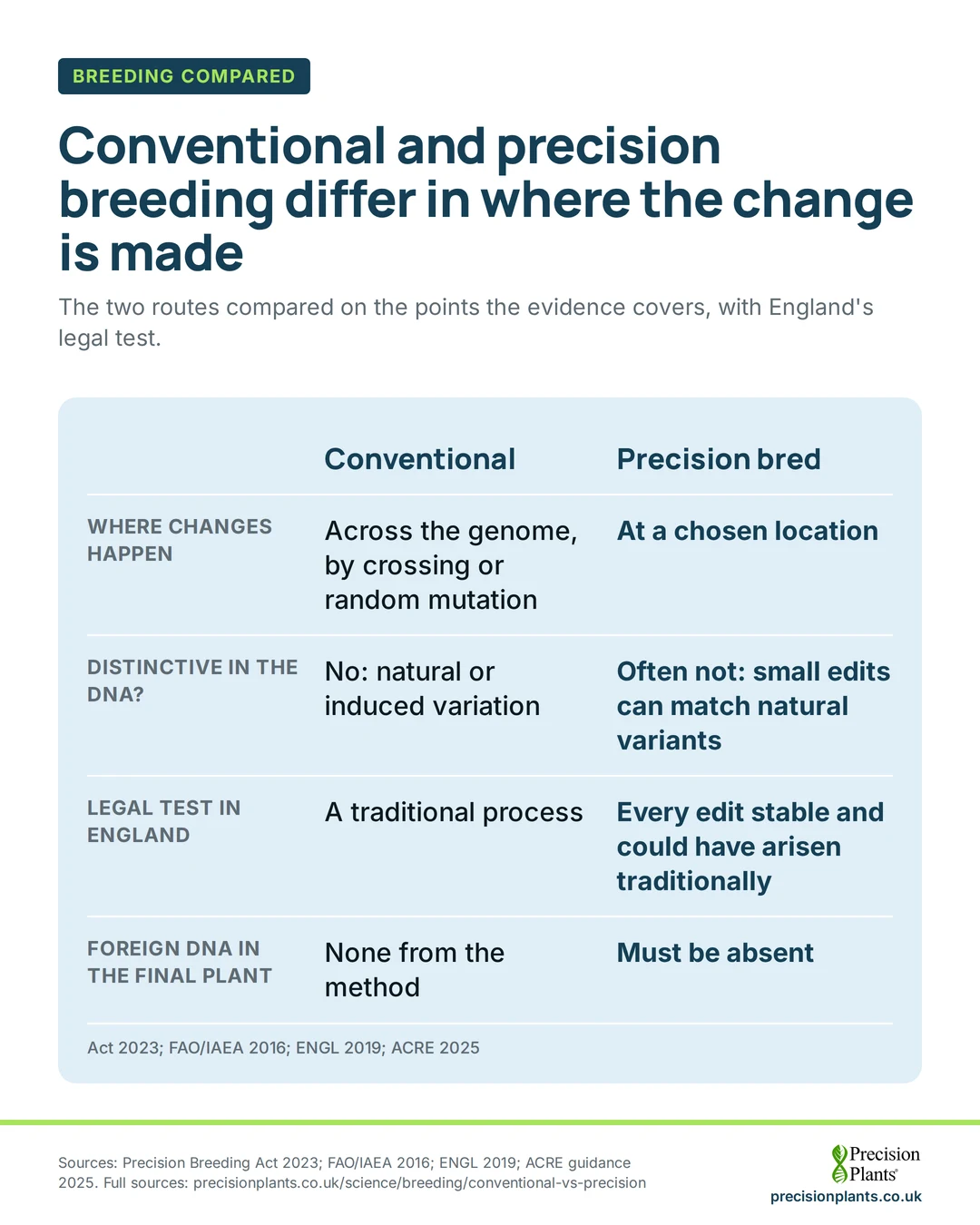
Infographic: Precision Plants. Sources: legislation.gov.uk (2023); Joint FAO/IAEA Division of Nuclear Techniques in Food and Agriculture (2016); European Network of GMO Laboratories, European Commission Joint Research Centre (2019); Advisory Committee on Releases to the Environment, GOV.UK (2025)
How conventional breeding works
A cross mixes the genomes of two parents, and each offspring inherits a different combination. Induced mutagenesis adds random changes across the genome with radiation or chemicals, and breeders then look for the rare plant with a useful one [2]. Both are traditional processes under the Precision Breeding Act [1].
Because the useful change arrives alongside many others, breeders back-cross and test for years. The average time to a variety runs from as little as six years to as much as 20 [3].
How precision breeding works
Precision breeding aims a change at one chosen stretch of DNA. The European Network of GMO Laboratories describes genome editing as techniques ‘that facilitate addition, removal, or alteration of DNA sequences at a specific location in the genome’ [4].
The editing tool itself need not stay in the plant. Where recombinant DNA was used, it ‘can be segregated away in subsequent generations’ [4]. In England, a precision bred plant must not contain transgenic material [5].
Side by side
The table compares the two routes on the points the evidence covers.
| Question | Conventional breeding | Precision breeding |
|---|---|---|
| Where do changes happen? | Across the genome, by crossing or random mutation [2] | At a chosen location [4] |
| Is the result distinctive in the DNA? | No; changes are natural or induced variation [2] | Often not; small edits can match natural variants [4] |
| Legal test in England | Traditional process [1] | Every edit must be stable and could have arisen traditionally [1] |
| Foreign DNA in the final plant | None from the method | Must be absent [5] |
Can you tell them apart?
Often not. The ENGL report concluded that, without prior knowledge, no technique it described could tell whether a single-letter change or a short insertion or deletion came from genome editing, classical breeding or natural mutation [4]. The page on detecting gene-edited crops explains what this means for testing.
Frequently asked questions
Is conventional breeding more natural than gene editing?
Both change DNA. Induced mutagenesis with radiation or chemicals counts as a traditional process under English law, even though its changes are random.
Does precision breeding replace conventional breeding?
No. An edited line is still crossed, selected and tested in the field before it can become a variety.
Can a lab tell a precision bred plant from a conventional one?
Often not without prior knowledge. A small edit can be identical to a natural or induced mutation.
Does the law in England favour one gene-editing method?
No. The Act sets the same conditions whatever tool is used: among them, every feature of the genome that results from modern biotechnology must be stable and could have resulted from traditional processes. Zinc finger nucleases, TALENs, CRISPR/Cas9, base editing and prime editing all face that same test.
References
- legislation.gov.uk (2023). Genetic Technology (Precision Breeding) Act 2023, section 1
- Joint FAO/IAEA Division of Nuclear Techniques in Food and Agriculture (2016). Mutation breeding for crop improvement
- British Society of Plant Breeders. R&D and investment
- European Network of GMO Laboratories, European Commission Joint Research Centre (2019). Detection of food and feed plant products obtained by new mutagenesis techniques
- Advisory Committee on Releases to the Environment, GOV.UK (2025). ACRE guidance on producing precision bred plants
Last reviewed 2026-09-26. Edited by Mark Turner.