Hemp plant science
Published · Updated
Hemp and drug cannabis are the same species. The difference lies in chemistry, and that chemistry is inherited.
What is hemp, scientifically?
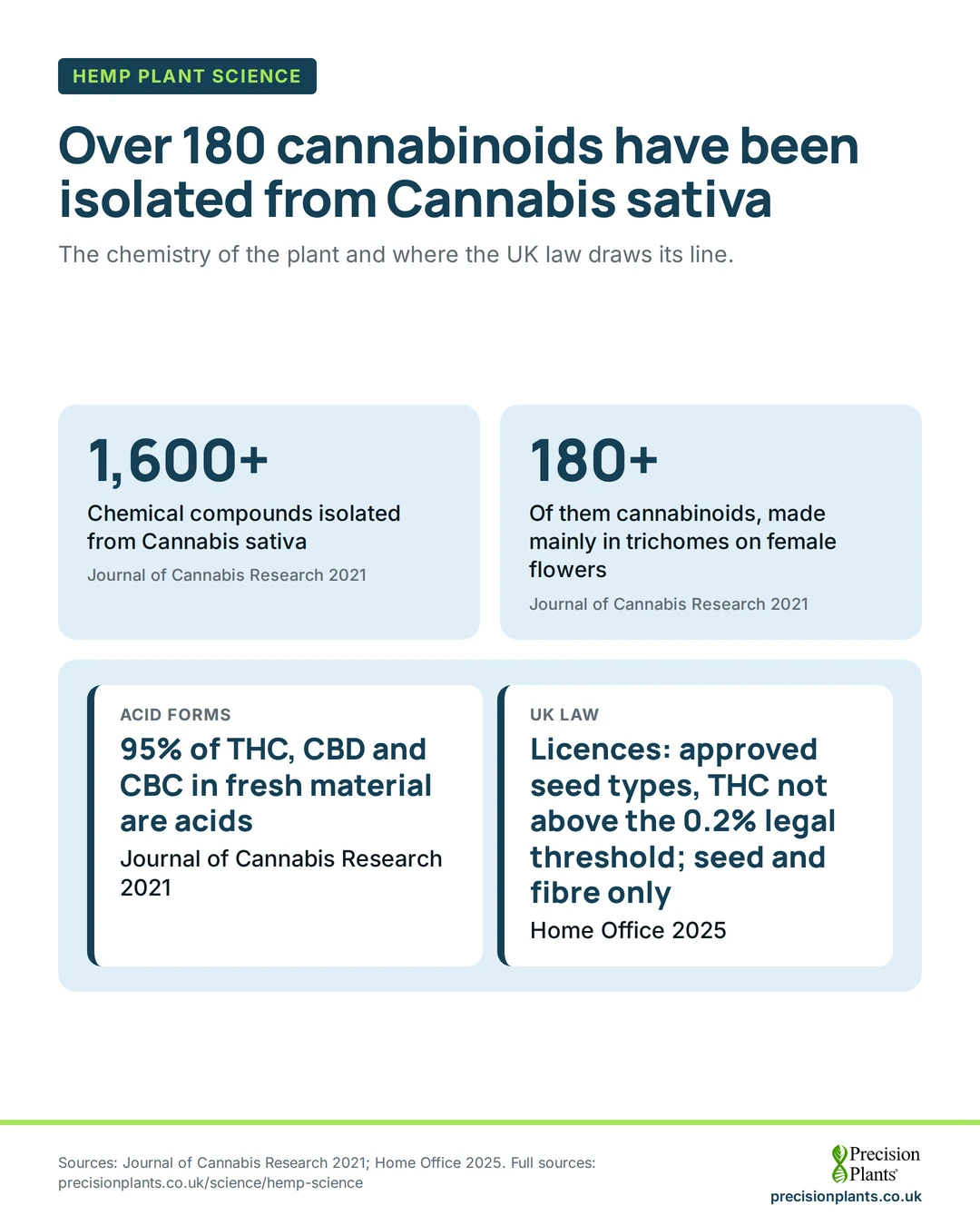
Hemp is Cannabis sativa grown for fibre and seed. Its cannabinoids are made mainly in glandular trichomes on female flowers. In the UK, licences cover approved seed types with THC not exceeding 0.2%, and only the seed and fibre may be used.
Infographic: Precision Plants. Sources: Journal of Cannabis Research (2021); Home Office, GOV.UK (2025)
One species, many uses
More than 1,600 chemical compounds have been isolated from Cannabis sativa, of which over 180 are cannabinoids [1]. The best known are THC, the main psychoactive cannabinoid, and CBD [1].
Where the chemistry happens
Cannabinoids are made in glandular trichomes, mostly on female flowers; male flowers are typically very low in cannabinoids [1]. In fresh plant material, 95% of THC, CBD and CBC exist as their acid forms, which convert during storage or on heating [1].
Chemistry is inherited
Whether a plant makes mainly THC or mainly CBD is inherited, and two synthase enzymes sit at the heart of it. The THCA synthase gene was cloned in 2004 [2], and CBDA synthase was described as the chemotype-determining enzyme in fibre-type hemp in 2007 [3].
Where science meets the law
The Home Office licenses cultivation only from approved seed types with THC not exceeding the level in the Misuse of Drugs (Fees) Regulations 2010, which at the time of drafting is 0.2% [4]. Licences allow use of the seed and fibre only; the leaves and flowers are controlled parts of the plant [4].
Guides in this section
- Cannabinoid biology: How hemp makes THC, CBD and their relatives, step by step.
Frequently asked questions
Is hemp the same plant as cannabis?
Yes, both are Cannabis sativa. Hemp is grown for fibre and seed, and UK licences cover only low-THC approved seed types.
What is the UK legal THC threshold for hemp?
Home Office licences cover approved seed types with THC not exceeding 0.2%, the level set in the Misuse of Drugs (Fees) Regulations 2010.
Which parts of hemp can be used in the UK?
Under a Home Office licence, the seed and fibre only. Leaves and flowers are controlled parts of the plant.
References
- Journal of Cannabis Research (2021). The biosynthesis of the cannabinoids (Tahir and others)
- Journal of Biological Chemistry, via PubMed (2004). The gene controlling marijuana psychoactivity: molecular cloning and heterologous expression of tetrahydrocannabinolic acid synthase (Sirikantaramas and others)
- FEBS Letters, via PubMed (2007). Cannabidiolic-acid synthase, the chemotype-determining enzyme in the fiber-type Cannabis sativa (Taura and others)
- Home Office, GOV.UK (2025). Low THC cannabis (industrial hemp) licensing factsheet
Last reviewed 2026-09-26. Edited by Mark Turner.