Cannabinoid biology
Published · Updated
Every cannabinoid in hemp begins as the same molecule. One enzyme decides what it becomes.
How does hemp make cannabinoids?
Hemp builds olivetolic acid, then adds a prenyl group to form cannabigerolic acid (CBGA). Synthase enzymes turn CBGA into THCA, CBDA or CBCA. These acids become THC, CBD and CBC during storage or on heating.
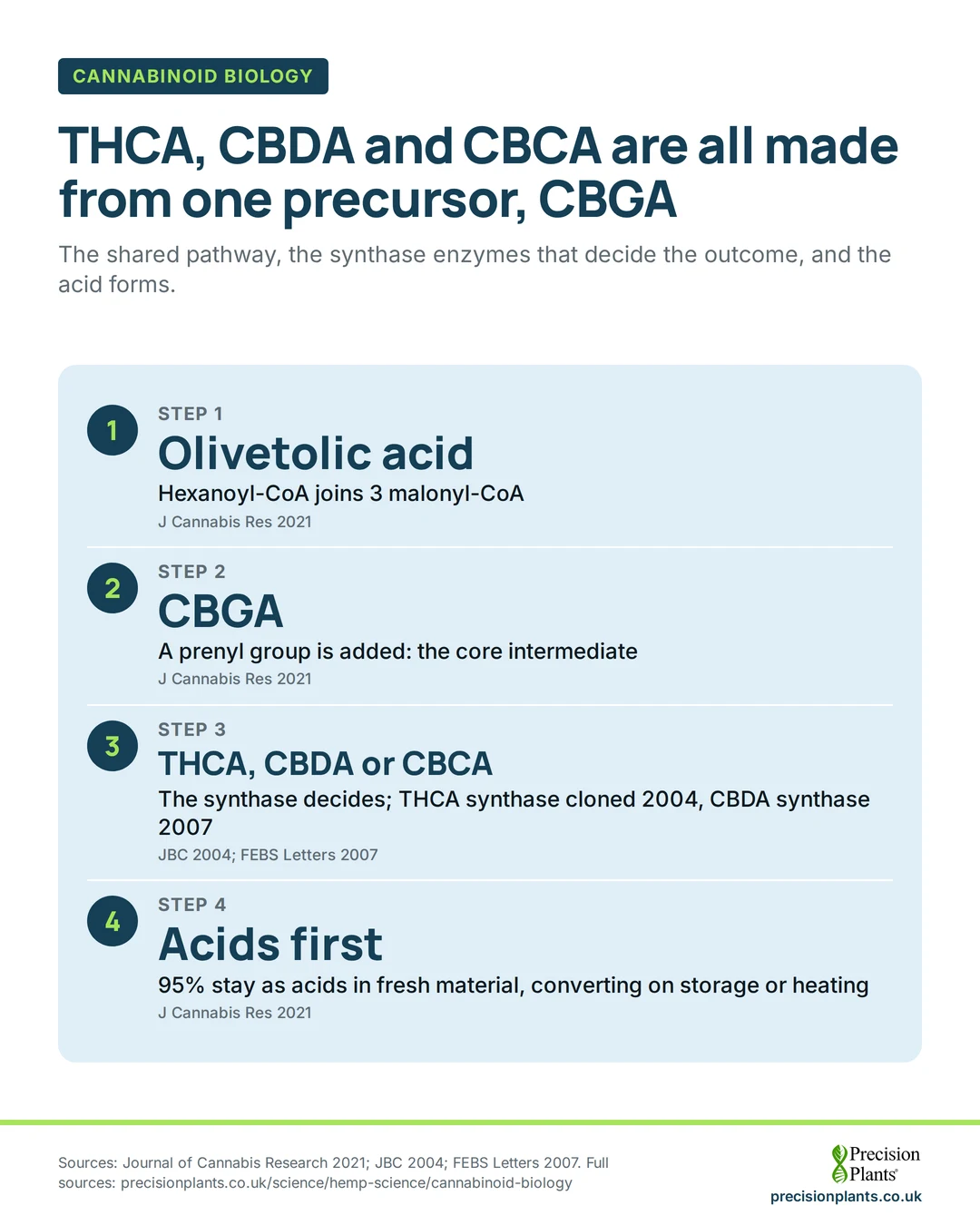
Animation: Precision Plants. Sources: Journal of Cannabis Research (2021); Journal of Biological Chemistry, via PubMed (2004); FEBS Letters, via PubMed (2007)
The shared pathway
Tetraketide synthase joins hexanoyl-CoA with three molecules of malonyl-CoA; olivetolic acid cyclase then forms olivetolic acid [1]. An aromatic prenyltransferase adds a prenyl group to make cannabigerolic acid (CBGA), the core intermediate [1].
The deciding enzymes
THCA synthase makes the precursor of THC; its gene was cloned and expressed in 2004 [2]. CBDA synthase was described in 2007 as the chemotype-determining enzyme in fibre-type Cannabis sativa [3].
How chemotype is inherited
De Meijer and colleagues crossed pure CBD and pure THC plants and followed the offspring [4]. The ratio of the two compounds segregated as if controlled by a single locus with two co-dominant alleles [4].
Acids first
In fresh plant material, 95% of THC, CBD and CBC exist as their acidic parents, THCA, CBDA and CBCA [1]. The acids decarboxylate to the familiar forms during storage, on heating or under alkaline conditions [1].
THC and CBD in UK law
Home Office licences cover approved seed types with THC not exceeding 0.2%, the UK legal threshold [5]. Only the seed and fibre may be used; the leaves and flowers are controlled parts of the plant [5].
The Food Standards Agency classes CBD extracts and isolates as novel foods needing authorisation; hemp seed oil and ground hemp seeds are not novel [6].
Frequently asked questions
What is CBGA?
Cannabigerolic acid is the shared precursor from which hemp's synthase enzymes make THCA, CBDA and CBCA.
Why do fresh hemp plants contain little THC as such?
About 95% of THC, CBD and CBC in fresh plant material is present as the acid forms, which convert on storage or heating.
Is hemp seed oil a novel food in the UK?
No. The Food Standards Agency lists hemp seeds, including hemp seed oil, as foods with a history of consumption.
References
- Journal of Cannabis Research (2021). The biosynthesis of the cannabinoids (Tahir and others)
- Journal of Biological Chemistry, via PubMed (2004). The gene controlling marijuana psychoactivity: molecular cloning and heterologous expression of tetrahydrocannabinolic acid synthase (Sirikantaramas and others)
- FEBS Letters, via PubMed (2007). Cannabidiolic-acid synthase, the chemotype-determining enzyme in the fiber-type Cannabis sativa (Taura and others)
- Genetics, via PubMed Central (2003). The inheritance of chemical phenotype in Cannabis sativa L. (de Meijer and others)
- Home Office, GOV.UK (2025). Low THC cannabis (industrial hemp) licensing factsheet
- Food Standards Agency, GOV.UK (2026). Cannabidiol (CBD) guidance
Last reviewed 2026-09-26. Edited by Mark Turner.