Is gene editing safe?
Published · Updated
Food safety bodies on both sides of the Channel have looked at the evidence. They reach similar conclusions, and England still checks every product before it can be sold.
Is gene-edited food safe?
The Food Standards Agency says current scientific evidence suggests precision bred organisms present no additional risk compared with traditionally bred ones. England still requires a food and feed marketing authorisation before any is sold.
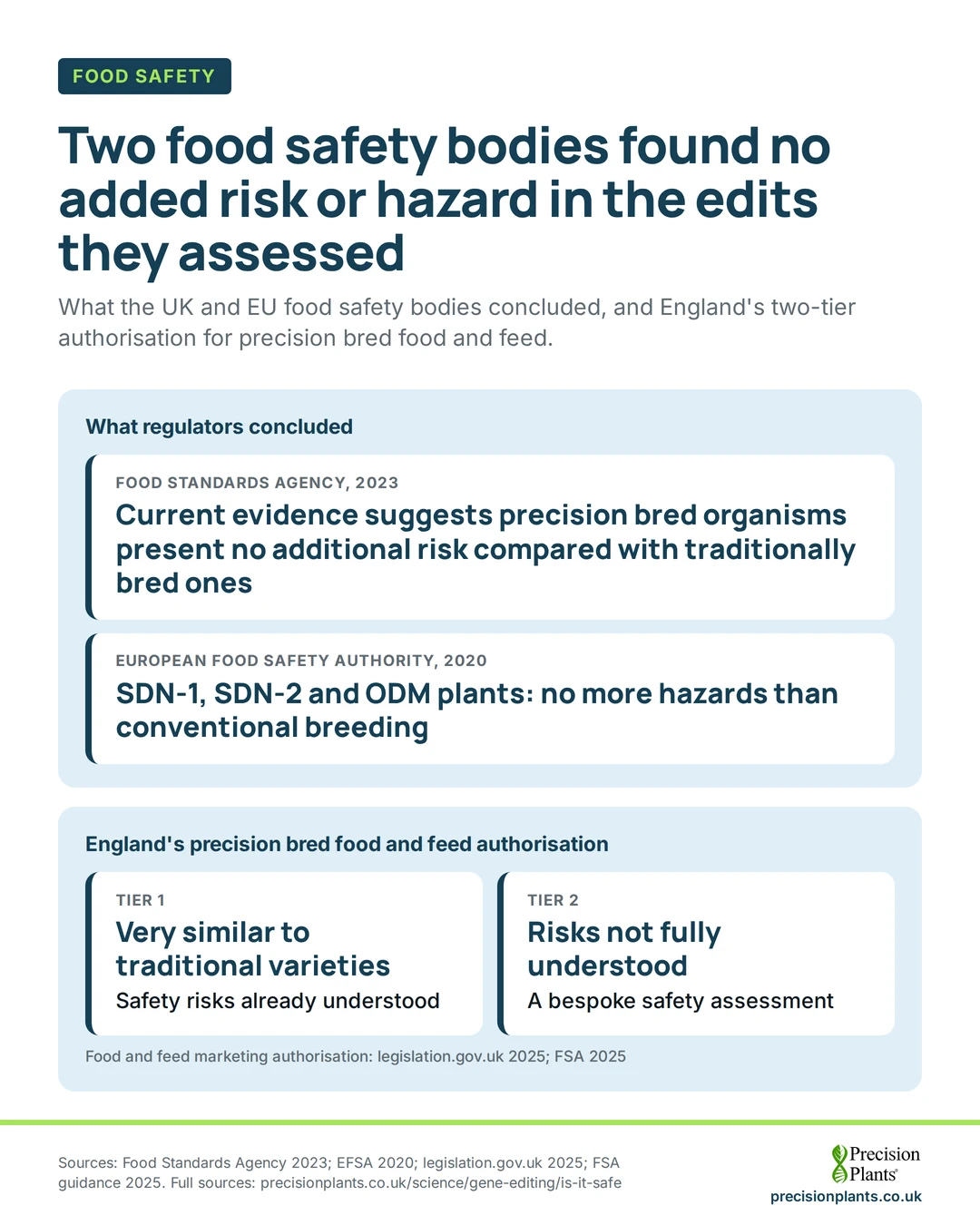
Infographic: Precision Plants. Sources: Food Standards Agency (2023); European Food Safety Authority (2020); legislation.gov.uk (2025); Food Standards Agency, GOV.UK (2025)
What the Food Standards Agency says
In 2023 the Food Standards Agency told its board that current scientific evidence suggests precision bred organisms present no additional risk when compared with traditionally bred organisms [1]. Because the technology is evolving quickly and consumers are interested in its benefits and risks, it agreed that a pre-market assessment is an important safeguard [1].
What European regulators say
In 2020 the European Food Safety Authority assessed plants produced by site-directed nuclease-1 and -2 (SDN-1, SDN-2) and oligonucleotide-directed mutagenesis (ODM), and concluded that these processes do not pose more hazards than conventional breeding [2]. A 2021 European Commission study noted EFSA's conclusion that plant products with similar risk profiles can come from conventional breeding, targeted mutagenesis and cisgenesis [3].
What the research says
A 2020 review in Plant Physiology set gene editing against the background of natural change. Spontaneous mutations occur in every generation, and mutation breeding has long raised the rate with chemicals or radiation [4]. The authors concluded that off-target changes in edited crops raise no new safety concerns compared with other breeding practices [4].
How England checks each product
No person may place food or feed from a precision bred organism on the market in England without a food and feed marketing authorisation [5]. The Food Standards Agency assesses applications in two tiers [6].
Frequently asked questions
Is gene-edited food on sale in England?
Only once it has a food and feed marketing authorisation. The rules for precision bred food came into force in England on 13 November 2025.
Is gene editing safer than genetic modification?
The two are assessed differently. Regulators judge each product on its traits, and England's precision breeding rules cover only changes that could have arisen through traditional breeding.
Who checks gene-edited food in England?
The Food Standards Agency assesses applications, and the Secretary of State decides whether to issue a marketing authorisation.
Which gene-editing methods are there?
Five are widely described. Zinc finger nucleases, TALENs and CRISPR/Cas9 cut both DNA strands at a chosen site, while base editing and prime editing change the sequence without a double-strand break.
References
- Food Standards Agency (2023). Genetic Technology (Precision Breeding): board paper
- European Food Safety Authority (2020). Existing guidance appropriate for assessment of genome editing in plants
- European Commission (2021). EC study on new genomic techniques
- Plant Physiology (2020). Plant genome editing and the relevance of off-target changes (Graham and others)
- legislation.gov.uk (2025). The Genetic Technology (Precision Breeding) Regulations 2025, Part 7
- Food Standards Agency, GOV.UK (2025). FAQ for precision breeding application guidance
Last reviewed 2026-09-26. Edited by Mark Turner.