Gene editing myths and facts
Published · Updated
Gene editing attracts strong opinions. Here are five common claims, each set against what the law, the regulators and the research actually say.
Does gene editing add foreign DNA?
Not in a precision bred plant. In England, a plant is not precision bred if it contains transgenic material, including editing cassettes, selectable markers and vector genes.
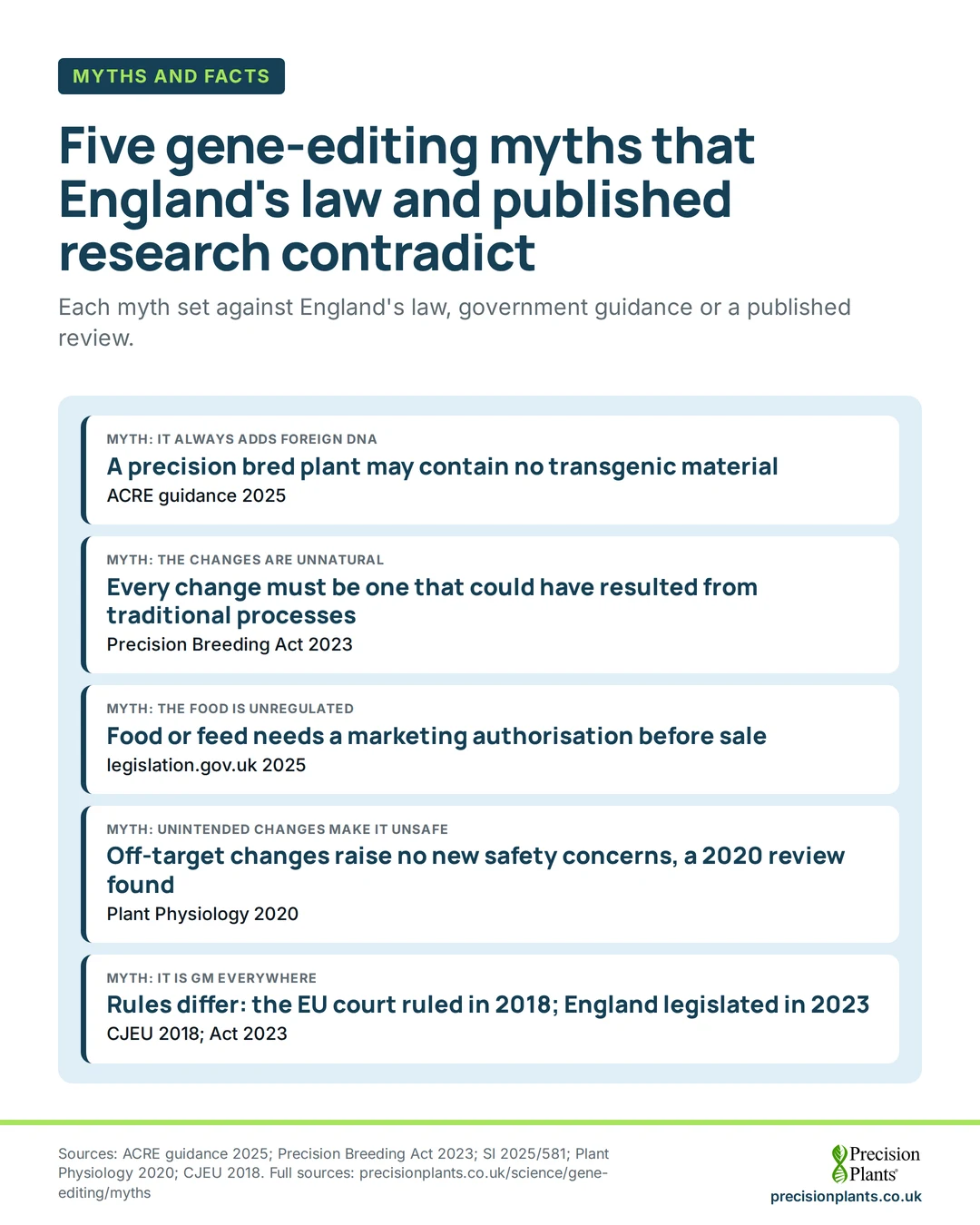
Infographic: Precision Plants. Sources: Advisory Committee on Releases to the Environment, GOV.UK (2025); legislation.gov.uk (2023); legislation.gov.uk (2025); Plant Physiology (2020); Court of Justice of the European Union (2018)
Myth: gene editing always adds foreign DNA
A plant is not precision bred in England if it contains transgenic material [1]. Before release it must be analysed to confirm that no transgenes remain [2]. Many edits simply let the cell rejoin a break in its own DNA [1].
Myth: the changes are unlike anything in nature
In law, a plant is precision bred only if every change made with modern biotechnology is stable and could have resulted from traditional processes, with or without selection techniques [3]. Government guidance notes that single-letter edits make the same type of change that occurs naturally, and that breeders already select for [1].
Myth: gene-edited food is unregulated in England
No person may place food or feed from a precision bred organism on the market in England without a food and feed marketing authorisation [4]. The Food Standards Agency assesses each application first [5].
Myth: unintended changes make it unsafe
A 2020 review found that off-target changes in edited crops raise no new safety concerns compared with other breeding practices [6]. It described genome editing as a targeted and more exact form of mutation breeding [6].
Myth: it is treated as GM everywhere
Rules differ. In 2018 the Court of Justice of the European Union ruled that organisms obtained by mutagenesis are GMOs under EU law [7]. England passed its own law in 2023 that sets precision bred organisms apart from genetically modified ones [3].
Frequently asked questions
Is gene editing the same as genetic modification?
Not in law in England. A precision bred plant can only contain changes that could have arisen through traditional breeding, and no transgenic material.
Can gene editing create any trait?
Not under England's precision breeding rules, which cover only changes that could have come from traditional processes.
Is gene-edited food labelled?
England's rules require a marketing authorisation before sale. Check the Food Standards Agency for current labelling guidance.
Which gene-editing methods are there?
Five are widely described. Zinc finger nucleases, TALENs and CRISPR/Cas9 cut both DNA strands at a chosen site, while base editing and prime editing change the sequence without a double-strand break.
References
- Advisory Committee on Releases to the Environment, GOV.UK (2025). ACRE guidance on producing precision bred plants
- Department for Environment, Food and Rural Affairs, GOV.UK (2026). Releasing precision bred plants into the environment
- legislation.gov.uk (2023). Genetic Technology (Precision Breeding) Act 2023, section 1
- legislation.gov.uk (2025). The Genetic Technology (Precision Breeding) Regulations 2025, Part 7
- Food Standards Agency, GOV.UK (2025). FAQ for precision breeding application guidance
- Plant Physiology (2020). Plant genome editing and the relevance of off-target changes (Graham and others)
- Court of Justice of the European Union (2018). Organisms obtained by mutagenesis are GMOs and are, in principle, subject to the obligations laid down by the GMO Directive (Case C-528/16)
Last reviewed 2026-09-26. Edited by Mark Turner.