Guide RNA
Published · Updated
A few dozen letters of RNA decide where a CRISPR enzyme acts. Choosing those letters well is much of the craft of gene editing.
What is a guide RNA?
A guide RNA is a short RNA molecule that carries a sequence matching the chosen DNA target. It binds a CRISPR enzyme such as Cas9 and steers it to that site, so changing the guide reprogrammes where the enzyme acts.
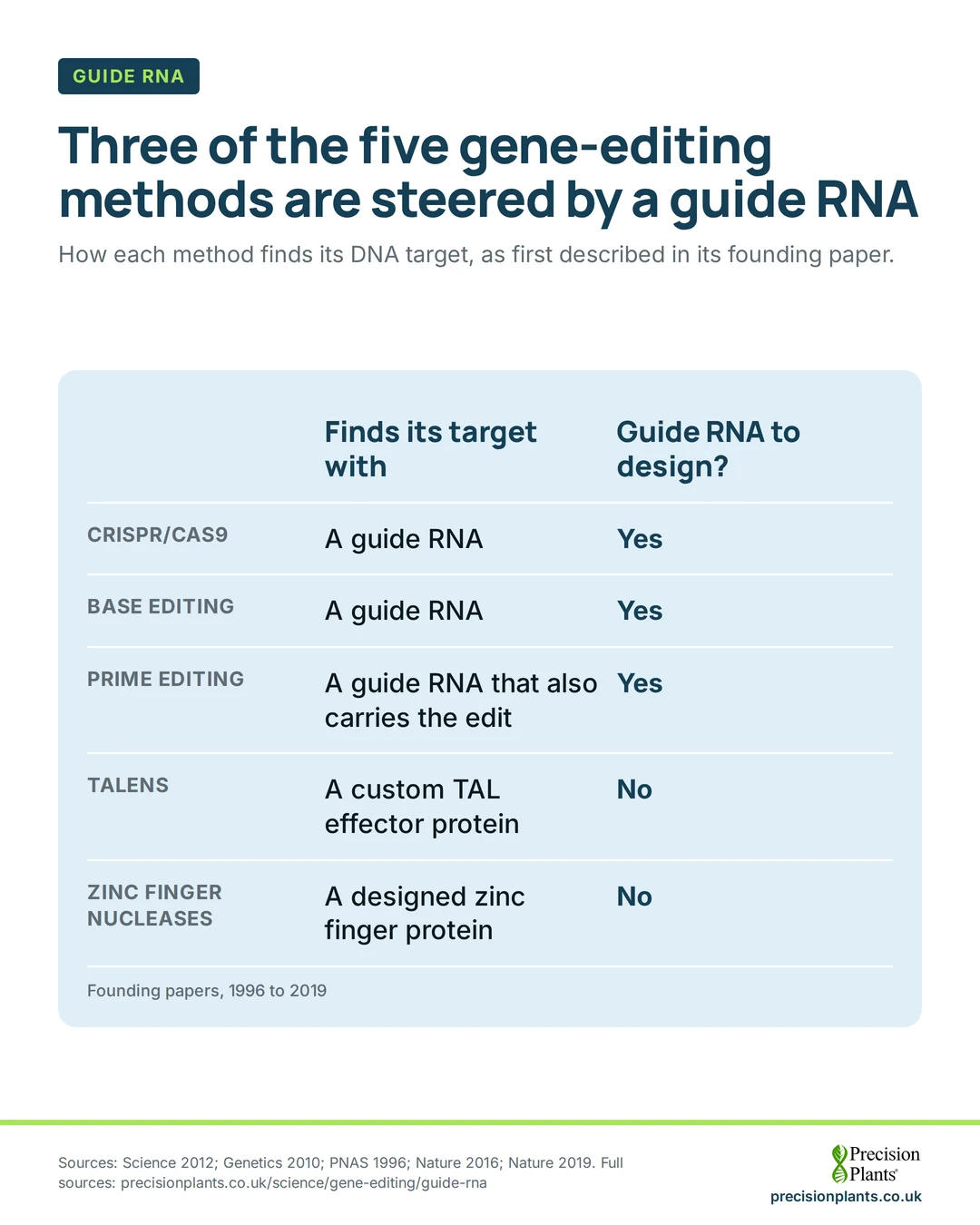
Infographic: Precision Plants. Sources: Science (2012); Genetics, via PubMed (2010); Proceedings of the National Academy of Sciences (1996); Nature (2016); Nature (2019)
What it does
In bacteria, Cas9 is guided by two RNAs working together. Researchers showed in 2012 that the two can be joined into a single guide RNA that programmes Cas9 to cut a chosen DNA target [1]. The enzyme also needs a short signal next to the target in the DNA, called a PAM [1].
Because the target is set by the RNA sequence rather than by the protein, pointing the enzyme at a new site is a matter of writing a new guide [7].
Why design matters
Guides that look equally suitable on paper can behave very differently. Their activity at the intended site and their activity elsewhere in the genome both vary widely from one guide to the next [7]. A study of thousands of guides produced rules for predicting both, which design software now draws on [7].
- The enzyme tolerates some mismatches between guide and DNA, depending on how many there are, where they fall and how they are spread [6].
- Lowering the amount of enzyme and guide can reduce changes at unintended sites [6].
- In plants, careful choice of the target sequence remains the most important way to reduce off-target cutting [9].
Which methods use a guide RNA
Three of the five methods covered here are steered by a guide RNA. CRISPR/Cas9 uses one to find the site it cuts [1]. Base editing pairs a modified Cas9 with a guide RNA to change a single letter without cutting both strands [4]. Prime editing uses an extended guide, the prime editing guide RNA, which both finds the target and carries the new sequence [5].
TALENs and zinc finger nucleases work differently. Both find their target with custom-built proteins that read the DNA directly, so there is no guide RNA to design [2][3]. In England, guidance for plant breeders groups the nuclease tools together as ways to create DNA strand breaks at specific locations [8].
| Method | How it finds its target | What it does to the DNA | First described |
|---|---|---|---|
| CRISPR/Cas9 | A guide RNA pairs with the target sequence [1] | Cuts both DNA strands at the chosen site [1] | 2012 [1] |
| TALENs | A custom TAL effector protein that binds the target sequence [2] | A FokI cutting domain breaks both strands at the site [2] | 2010 [2] |
| Zinc finger nucleases | Zinc finger proteins built to match the target [3] | A FokI cutting domain cuts near the site [3] | 1996 [3] |
| Base editing | A guide RNA, as with CRISPR [4] | Converts one DNA base into another without cutting both strands [4] | 2016 [4] |
| Prime editing | A prime editing guide RNA that also carries the edit [5] | Writes a short new sequence into the site without cutting both strands [5] | 2019 [5] |
Frequently asked questions
What is the difference between a guide RNA and an sgRNA?
An sgRNA, or single guide RNA, is the engineered form in which the two RNAs that guide Cas9 in bacteria are joined into one molecule. In everyday use the terms are often interchangeable.
Can a guide RNA cut DNA on its own?
No. The RNA does not cut DNA itself. In CRISPR/Cas9 and base editing it finds the site and the enzyme makes the change; in prime editing the extended guide also carries the template for the new sequence, which the enzyme copies in.
Does every gene-editing method need a guide RNA?
No. CRISPR/Cas9, base editing and prime editing use one. TALENs and zinc finger nucleases find their target with engineered proteins instead.
References
- Science (2012). A programmable dual-RNA-guided DNA endonuclease in adaptive bacterial immunity (Jinek and others)
- Genetics, via PubMed (2010). Targeting DNA double-strand breaks with TAL effector nucleases (Christian and others)
- Proceedings of the National Academy of Sciences (1996). Hybrid restriction enzymes: zinc finger fusions to Fok I cleavage domain (Kim, Cha and Chandrasegaran)
- Nature (2016). Programmable editing of a target base in genomic DNA without double-stranded DNA cleavage (Komor and others)
- Nature (2019). Search-and-replace genome editing without double-strand breaks or donor DNA (Anzalone and others)
- Nature Biotechnology (2013). DNA targeting specificity of RNA-guided Cas9 nucleases (Hsu and others)
- Nature Biotechnology (2016). sgRNA design for high activity and few off-target effects (Doench and others, title shortened)
- Advisory Committee on Releases to the Environment, GOV.UK (2025). ACRE guidance on producing precision bred plants
- Plant Cell Reports (2019). CRISPR/Cas precision and off-targeting in plants (Hahn and Nekrasov, title shortened)
Last reviewed 2026-09-26. Edited by Mark Turner.