Cas9 and Cas12a compared
Published
The CRISPR family has more than one cutting enzyme. Two are widely described in the literature, and their differences decide which DNA sites each can reach.
What is the difference between Cas9 and Cas12a?
Both are RNA-guided CRISPR enzymes that cut both DNA strands. Cas12a, also called Cpf1, recognises a T-rich signal next to its target, uses a single short RNA and leaves a staggered cut, whereas Cas9 needs a different signal and a longer guide.
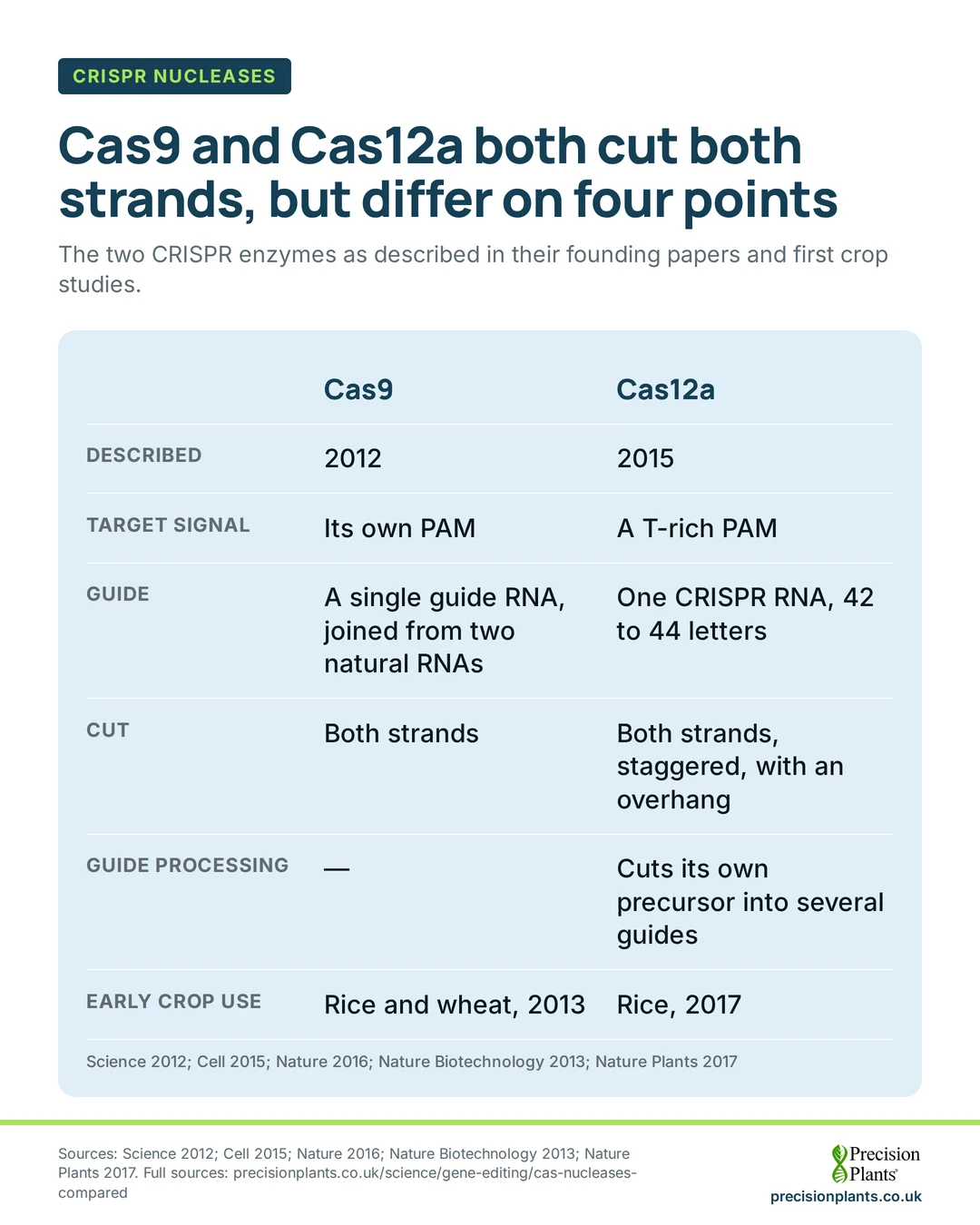
Infographic: Precision Plants. Sources: Science (2012); Cell (2015); Nature (2016); Nature Biotechnology (2013); Nature Plants (2017)
Cas9
Cas9 was shown in 2012 to be programmable with a single guide RNA to cut a chosen DNA target [1]. It needs a short signal next to the target, called a PAM, and each of its two cutting domains cuts one strand [1].
Cas12a
Cas12a was described in 2015 as a distinct single RNA-guided enzyme [6]. It recognises a T-rich PAM, needs no second RNA, and works with a single CRISPR RNA only 42 to 44 letters long [6]. It cuts both strands at staggered points, leaving a short overhang rather than blunt ends [6][7].
Cas12a can also process its own precursor RNA into mature guides [7]. That means several guides can be made from one transcript.
Side by side
The published descriptions of the two enzymes differ on four points [1][6][7].
- Target signal: Cas9 and Cas12a read different PAMs, so each reaches sites the other cannot [1][6].
- Guide: Cas9 uses a single guide RNA made by joining two natural RNAs; Cas12a uses one short CRISPR RNA [1][6].
- Cut: Cas12a leaves a staggered cut with an overhang [6][7].
- Guide processing: Cas12a can cut its own precursor RNA into several guides [7].
Use in plants
Both enzymes have published records in crops. Custom guide RNAs directed Cas9 to make targeted changes in rice and common wheat in 2013 [8]. In 2017, one form of Cas12a produced changes in both copies of the target at nearly 100% efficiency at four sites in first-generation transgenic rice plants [9]. In the same study, Cas12a forms were repurposed to switch down a gene in Arabidopsis rather than cut it [9].
Where they sit among the five methods
Cas9 and Cas12a are both CRISPR nucleases. The other methods covered here work differently: TALENs and zinc finger nucleases find their target with custom proteins rather than an RNA guide, while base editing and prime editing change the sequence without cutting both strands [2][3][4][5].
| Method | How it finds its target | What it does to the DNA | First described |
|---|---|---|---|
| CRISPR/Cas9 | A guide RNA pairs with the target sequence [1] | Cuts both DNA strands at the chosen site [1] | 2012 [1] |
| TALENs | A custom TAL effector protein that binds the target sequence [2] | A FokI cutting domain breaks both strands at the site [2] | 2010 [2] |
| Zinc finger nucleases | Zinc finger proteins built to match the target [3] | A FokI cutting domain cuts near the site [3] | 1996 [3] |
| Base editing | A guide RNA, as with CRISPR [4] | Converts one DNA base into another without cutting both strands [4] | 2016 [4] |
| Prime editing | A prime editing guide RNA that also carries the edit [5] | Writes a short new sequence into the site without cutting both strands [5] | 2019 [5] |
Frequently asked questions
Is Cpf1 the same as Cas12a?
Yes. Cpf1 was the name used when the enzyme was described in 2015; it is now more widely known as Cas12a.
Is Cas12a more precise than Cas9?
The papers cited here describe how the two recognise and cut DNA, not a head-to-head ranking. Precision depends on the enzyme, the guide and the target chosen.
Why would a researcher choose one over the other?
One consideration is reach. Each enzyme needs its own signal next to the target, so the sequence around a gene affects which one can be pointed at it.
References
- Science (2012). A programmable dual-RNA-guided DNA endonuclease in adaptive bacterial immunity (Jinek and others)
- Genetics, via PubMed (2010). Targeting DNA double-strand breaks with TAL effector nucleases (Christian and others)
- Proceedings of the National Academy of Sciences (1996). Hybrid restriction enzymes: zinc finger fusions to Fok I cleavage domain (Kim, Cha and Chandrasegaran)
- Nature (2016). Programmable editing of a target base in genomic DNA without double-stranded DNA cleavage (Komor and others)
- Nature (2019). Search-and-replace genome editing without double-strand breaks or donor DNA (Anzalone and others)
- Cell (2015). Cpf1 is a single RNA-guided endonuclease of a class 2 CRISPR-Cas system (Zetsche and others)
- Nature (2016). The CRISPR-associated DNA-cleaving enzyme Cpf1 also processes precursor CRISPR RNA (Fonfara and others)
- Nature Biotechnology (2013). Targeted genome modification of crop plants using a CRISPR-Cas system (Shan and others)
- Nature Plants (2017). A CRISPR-Cpf1 system for efficient genome editing and transcriptional repression in plants (Tang and others)
Last reviewed 2026-09-26. Edited by Mark Turner.